“With Midjourney, I feel like I’ve got 300 illustrators working for me, and within 10 seconds each illustrator comes back to me with stuff that’s unexpected and that I never would have come up with myself.” This is how Tino Schaedler, production designer and art director whose work spans feature films, music videos, and commercials, described his first experience with generative AI tools in an interview with Filmmaker Magazine in 2023. The statement is striking not because it celebrates a new technology, but because of what it reveals about a specific phase of the creative process: the moment, before any camera is turned on and before any location is scouted, when a visual world needs to be found.
This moment, the pre-production phase, where a sonic or narrative idea must be translated into a shared visual language, is where this article begins. Because what Schaedler is describing is not simply a faster way to make images. It is a fundamental redesign of one of the most delicate and expensive stages of visual communication design: the construction of the moodboard.
Pre-production has always been the most expensive and most uncertain part of any visual campaign. Traditionally, it unfolds over weeks: reference images collected from films, photography books, fashion editorials and archive material, assembled into physical or digital moodboards, presented, debated, revised. The process is slow not because the people involved are slow, but because translating a feeling into a shared visual language is genuinely difficult. Words like “melancholic but not dark” or “futuristic but analog” mean different things to different people. A moodboard tries to resolve that ambiguity by showing rather than describing, but building one that is precise enough to actually guide a shoot requires significant time, taste, and resources.
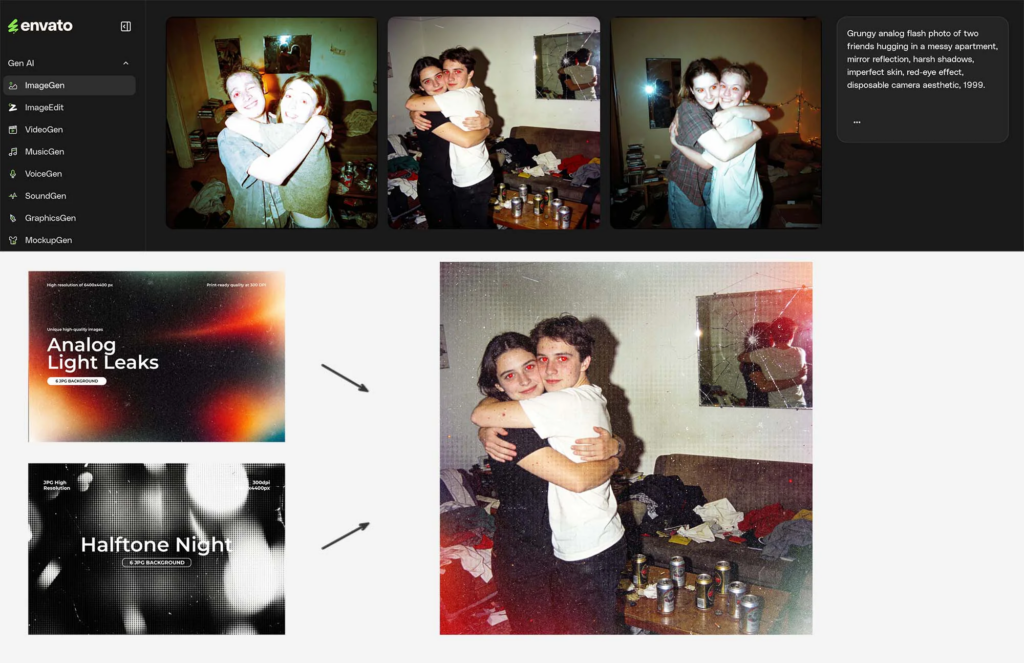
Generative AI tools like Midjourney, Adobe Firefly, Stable Diffusion, DALL-E have inserted themselves into this process in a way that is neither a revolution nor a mere upgrade. They are something more specific: a new kind of thinking tool. A creative director can now generate fifty visual variations of an idea in an afternoon, test different aesthetic directions in parallel, and arrive at a shoot with a level of visual specificity that previously required either a very large budget or a very long timeline. The moodboard is no longer assembled from existing images — it is generated from a described intention.
This shifts something fundamental in the design process. When a moodboard is built from found images, a still from a Tarkovsky film, a photograph by Nan Goldin, a frame from a 1970s Italian western, it carries with it all the cultural and historical weight of those references. The designer is curating a conversation between existing visual worlds. When a moodboard is generated, the designer is instead describing a world that does not yet exist and watching it appear. The references are still there, embedded in the model’s training data, but they are dissolved and recombined rather than cited.