Each session ran with somewhere between 5 and 10 people – not a large group, which matters for how much weight to put on what follows. Out of that group, I got 4 responses to the feedback survey. That’s a small sample, and I’m treating the results accordingly, with a healthy grain of salt. But small or not, it’s the first real signal I’ve had on how the course landed, and after two sessions of getting nothing back at all by email, even a handful of honest answers felt like a meaningful upgrade.
The Numbers
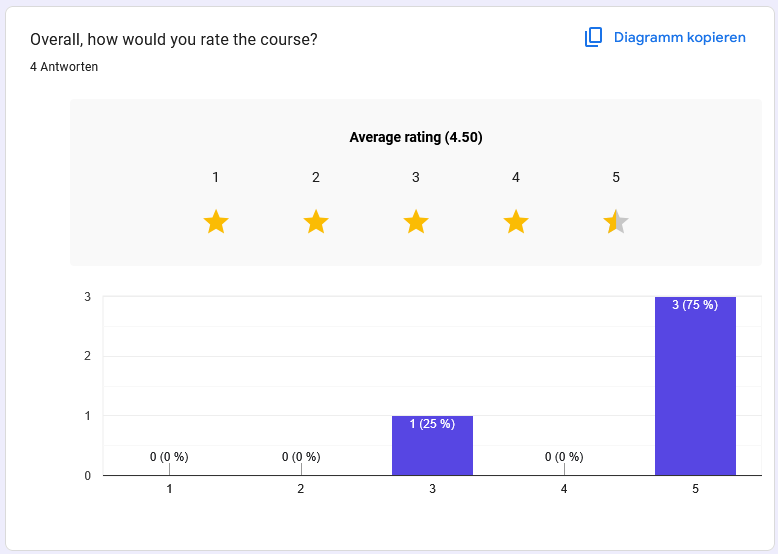
The average rating came out to 4.5 out of 5 – three people rated it 5 stars, one rated it 3. That one 3-star rating is worth sitting with rather than averaging away; without more written context from that specific respondent, I can’t say exactly what fell short for them, and that’s a small blind spot in a four-person sample that a larger survey would have filled in.
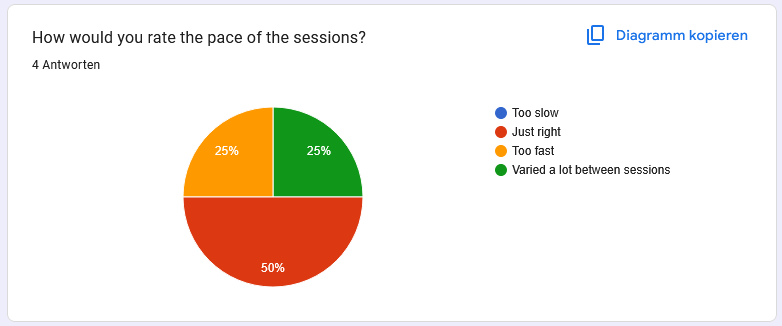
On pace, two people said it was “just right,” one said “too fast,” and nobody flagged it as too slow or inconsistent, which suggests the difficulty curve across the three sessions was reasonably well judged. That “too fast” answer lines up with something I noticed myself in session two, when the fish-in-a-bottle task pulled in more techniques than any single exercise really should – so that data point tracks with my own read of the sessions rather than coming as a surprise.
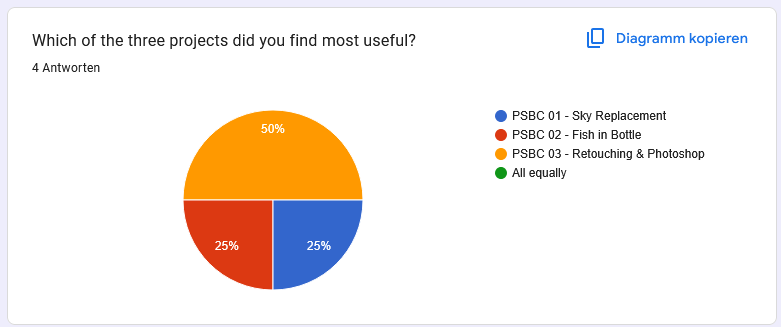
Asked which of the three projects they found most useful, the split leaned toward the final session: one vote each for the first and second sessions, and two votes for the third. Nobody selected “all equally,” which I read as a good sign – it means the sessions were distinct enough from each other that people had a real preference rather than defaulting to a neutral answer. The lean toward session three also makes sense given it was the most varied session, covering both retouching and mockup work rather than a single combined exercise.
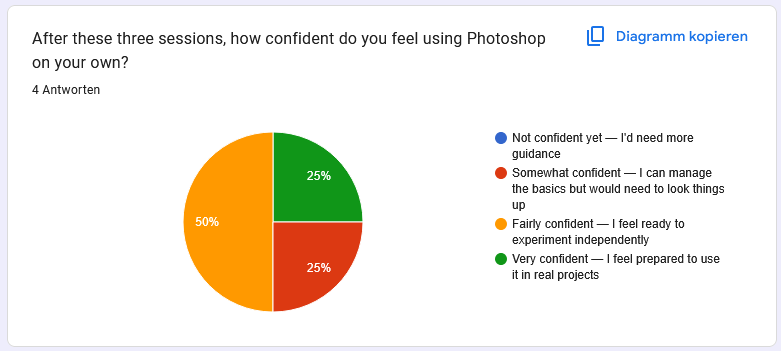
On confidence using Photoshop independently after the course, the results were more spread out: nobody said they felt “not confident yet,” one person landed on “somewhat confident,” two on “fairly confident,” and one on “very confident.” Given this was three two-hour sessions and not a semester-long course, having the majority land in the upper half of that scale feels like a reasonable outcome, and having nobody land at the bottom of the scale suggests the pacing didn’t leave anyone behind entirely – which was one of my bigger worries going in.
What People Wanted Changed
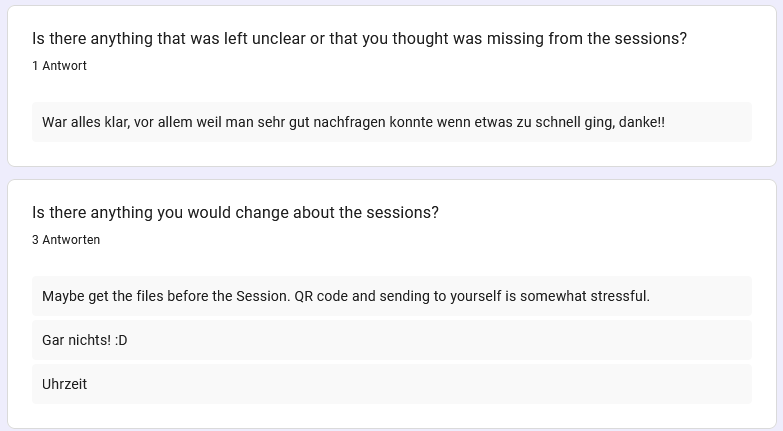
The open feedback was short but useful. One response asked for the files ahead of the session, noting that scanning a QR code and emailing yourself the material mid-session felt unnecessarily stressful – which lines up almost exactly with the file-transfer frustration I ran into myself from the presenting side, so it’s reassuring in a way to see the same friction point show up independently from the student side. Two people wrote some version of “nothing” – happy with the format as is, which I take as a decent sign the overall structure doesn’t need a rework, just refinement. One simply flagged the time slot itself as the thing they’d change, which is useful to know but not something I can fully control given it’s tied to the FH’s own scheduling rather than anything I decide.
The Real Takeaways
Numbers aside, two practical lessons stood out from running the course. The first is that file transfer needs to be smoother – the FH SharePoint QR code system worked maybe one out of every three times, and having that fail live in front of a room is not a great use of anyone’s patience. Between that and the student feedback asking for files ahead of time, the fix is fairly obvious: send the material out in advance rather than relying on an in-room QR scan that may or may not cooperate that day.
The second lesson was less about Photoshop and more about equipment: always carry a backup adapter. The final session nearly didn’t happen because my adapter stopped working for the beamer with no warning, and the only reason the session went ahead on time was that a friend happened to have one I could borrow. That’s not a mistake I plan on repeating – a spare adapter is going in my bag permanently from now on.
Taken as a whole – the ratings, the specific feedback, and the operational hiccups – I’d call the course a genuine success, with clear, specific things to improve before running it again. Nothing in the feedback pointed to a structural problem with the course itself; the issues were all around the edges – logistics, timing, hardware – rather than the actual teaching or the content. That combination is exactly what you want from a first attempt: proof the format works, plus a concrete list of what to fix next time, rather than having to question the fundamentals of the approach itself.
