#slowness #slowliving #slowinteraction #digitalcalm #calmtechnology #navigation #urbanexperience
In previous posts, I explored how maps and cities dictate our pace: navigation apps optimize for the fastest route [1], while streets are often designed for flow rather than for lingering. This time, I want to look at a space structured the other way around – a building that cannot be “optimized.”
On September 25, I attended the opening of Red Flags – the central exhibition of the steirischer herbst ’26 festival—at Griesplatz 34 in Graz [2]. The festival occupies a 17th-century building that previously housed a traditional schnitzel restaurant. The opening began at 5:00 PM on the street with a dance performance by Xenia Kogilaki titled Slamming Unplugged (2024), followed by music and drinks.
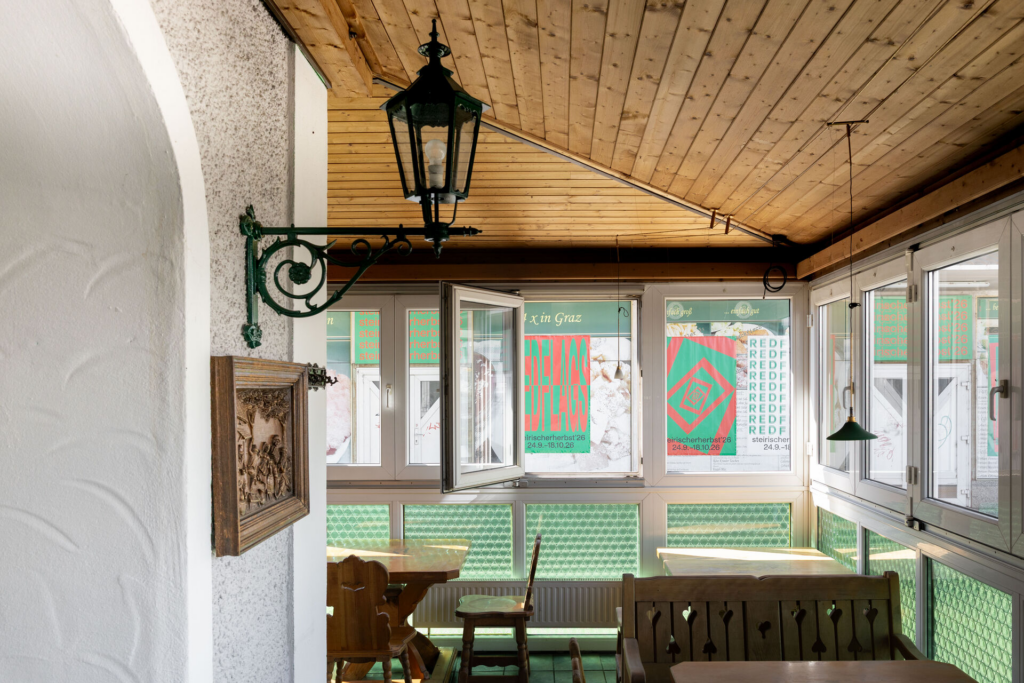
🚪 The Threshold Before the Journey
Even before you enter the building, an outdoor performance holds you in place. You stop, you look, you arrive. In navigational terms, this is a threshold: a conscious pause between “getting there” and “being here.” Most mapping apps end the journey with the phrase “You have arrived” – and nothing more.
🗺️ A building with no “fastest route”
Curators describe the space of the former tavern as a labyrinth of fragmented stories, cause each room tells its own tale, inhabited by detectives, “tradwives,” cult members, cam girls, and vampires. There is no shortest path through it. You navigate by means of doors, sounds, objects, and other people – not instructions.
Kevin Lynch wrote that a city’s “legibility” aids navigation, yet excessive legibility can reduce a city to a mere transit environment (see post 8/10). Here, low legibility is the design itself: the exhibition compels you to slow down because it refuses to be a corridor.
🏡 The room that slowed me down the most
The work that held my attention the longest was Nikolai Karabinovych’s Prohujalo sa južnim vetrom (2026): a detective agency, sealed off and abandoned mid-investigation, with walls and desks covered in evidence [3]. (A detailed description follows below.)
The detective moves through the space in a way that is the opposite of turn-by-turn navigation. He is not given a route; instead, he gathers clues and constructs his own picture of what transpired. This is precisely what navigation studies term a “cognitive map”: turn-by-turn GPS supports a form of passive navigation that does not help build such a map.
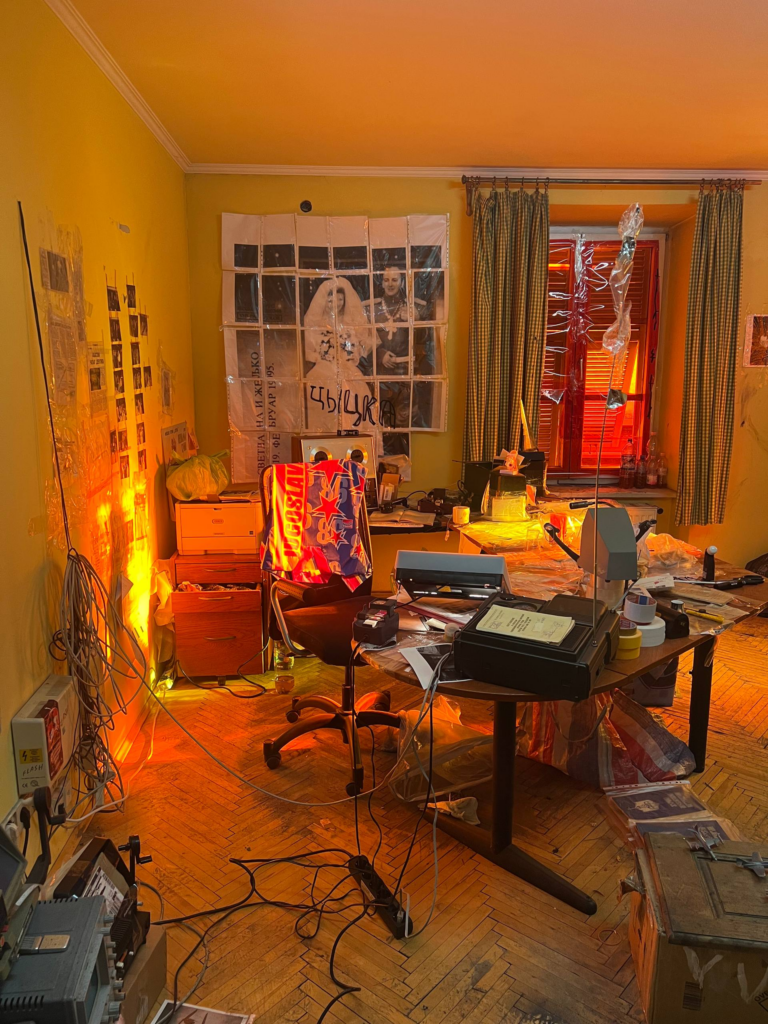
🔍 A Detective Agency Where the Investigation Came to a Halt
The viewer enters a detective agency that was sealed off and abandoned right in the middle of an investigation. What happened to the protagonist – the agency’s owner – remains a mystery. Walls and desks are covered with evidence, though not of an ordinary crime. These are dusty artifacts from the fringes of former empires – testimony to crimes people would prefer to forget. Through them, the artist reveals the errors and failures of the so-called transition from socialism to capitalism. Among the evidence are signs of an impending catastrophe – one that, as the festival puts it, we should have noticed much sooner.
This format transforms the viewer’s role. Visitors do not merely look at objects; they step into the shoes of a detective, piecing together connections between items, faces, and dates. There is no prescribed route or ready-made answer – the full picture emerges only through slow, attentive observation.
🎼 Sound and Fanzine
A “torture room” is located in the corridor, where this music plays on a continuous loop. The sound renders the space physically palpable and unsettling; unlike a phone notification, it is impossible to simply tune it out. At the same time, visitors can pick up a free fanzine containing the detective’s case files. Thus, the investigation continues even after one leaves the room.
The Work within the Exhibition Context
The Red Flags exhibition is structured as a labyrinth of fragmented narratives: each room tells its own story, inhabited by contemporary archetypes and marginal figures – detectives, “tradwives,” cult members, cam girls, and vampires. The curators note that at a time when right-wing forces are aggressively claiming public space, the exhibition retreats into the private realm – demonstrating that there is no safe haven. Karabinovich’s Detective Agency is one such “private” room, into which the broader sweep of political history intrudes. Age restrictions apply to some of the exhibition’s rooms.
❓ Why this work is relevant to the theme of “slowness”
It is impossible to “rush through” the installation. Clues are scattered across walls and tables, the music prevents one from simply relaxing, and the meaning is not conveyed by a single explanatory plaque. It is a space that demands the same approach as slow navigation: noticing details, lingering, and constructing one’s own map from the traces found, rather than following a pre-set set of instructions.
Sources 🛈
[1] Rethinking GPS navigation: creating cognitive maps through auditory cues. Scientific Reports, 2021. Available at: https://pmc.ncbi.nlm.nih.gov/articles/PMC8032695
[2] Ausstellung, Griesplatz 34. steirischer herbst ’26. Available at: https://www.steirischerherbst.at/de/program/8162/ausstellung
[3] Nikolay Karabinovych, Prohujalo sa južnim vetrom (2026). steirischer herbst ’26. Available at: https://www.steirischerherbst.at/de/program/artists/9040/nikolay-karabinovych