Let’s Start Over and Reflect

Before beginning this master’s program, my work already revolved around questions of storytelling and communication. Coming from a background in interior and exhibition design, I became interested in how people understand narratives through space, atmosphere, and visual cues rather than through long textual explanations. In my previous thesis, I explored how lighting can support storytelling and guide perception within an installation. The project focused on how visitors interpret meaning through sensory experience, even when verbal guidance is limited.

Alongside this academic interest, communication has also been a personal challenge in my everyday life. Living and studying in a country where my mother tongue is not spoken has created a constant negotiation between languages. I regularly move between Persian, English, and German depending on the situation and the people I interact with. Often I notice that certain thoughts are easier to express in one language than in another. At times I struggle to find the right words, even when the idea itself feels very clear in my mind. Because of this, communication has become something I am highly aware of in daily life. It is not simply a neutral tool but something that requires constant adjustment and creativity.

This experience has gradually led me to search for ways of expressing ideas that are less dependent on words. Over time I have experimented with different forms of expression that allow communication through other senses or forms of perception. One example is music. When I began learning the violin, part of the motivation came from a desire to express emotions that are difficult to articulate verbally. Music can communicate mood, tension, and rhythm without requiring a shared language.

Visual expression has played a similar role in my life. Drawing and painting have been lifelong challenges for me. I have repeatedly tried different mediums and techniques in order to find a visual language that feels natural. Although this process has often involved frustration, it has also kept my interest in visual communication alive. Photography became another way to observe and communicate moments visually. Through photography I became more attentive to gestures, light, and composition as ways of conveying meaning.

Even baking has played a role in this exploration of communication. Through my small project Dot Pastry I experimented with recipes, presentation, and packaging. While baking might appear unrelated to design research at first glance, it also involves communication through sensory experience. Taste, color, form, and presentation all contribute to how people interpret and experience something. In this sense, the process also became another way of thinking about how meaning can be conveyed without relying on written or spoken language.

In the first semester of this master’s program I explored storyboarding as a method of visual communication. The project focused on how a narrative can be conveyed within a group that shares a common language while using as few words as possible. The aim was to experiment with visual sequencing and the minimal use of text, relying instead on images, gestures, and context to communicate meaning. Through this process I became more interested in how people read visual sequences and how much information can be communicated through images alone.

Now, in the current semester, I feel the need to deepen my skills in illustration. While storyboarding allowed me to think about narrative structure and the sequence of events, illustration focuses more on the creation of individual images that carry meaning on their own. I am interested in experimenting with different illustrative approaches and visual styles to understand how ideas, emotions, or instructions might be communicated with little or no text.

At this stage the direction is still developing and not yet fully structured. For this reason this section reflects a process of thinking through possibilities and connecting past experiences with current interests. This process of reflection is also part of the research itself. By looking at the different ways I have tried to communicate over the years through language, music, drawing, photography, and even baking, I begin to recognize a common thread. It is an ongoing search for ways to express meaning when words alone are not enough.

ID1 – NIME Article

Authors: Hugh Aynsley, Pete Bennett, Dave Meckin, Sven Hollowell, and Thomas J. Mitchell

For this NIME research task, I chose a paper that sits exactly at the intersection of my Master’s research and the future of interaction design. While many NIME papers focus on sensors or sound synthesis, this 2025 study explores the psychology of the design process when using Generative AI.

The authors conducted workshops to see how Text-to-Image (TTI) tools like Midjourney change how we brainstorm. Instead of the traditional “slow” process of sketching by hand, designers used AI to “materialize” their thoughts instantly.

Visualizing the Abstract: Turning vague feelings (like “granular” or “metallic” sounds) into concrete visual shapes.

The Power of the Pivot: Using AI “hallucinations” or mistakes as a spark for a new, unplanned design direction.

High-Speed Variation: Generating dozens of different “vibes” for a controller in seconds to see what sticks.

Style Mapping: Forcing the AI to blend two unrelated worlds—like a “violin” and a “space station”—to find a new aesthetic.

Boundary Objects: Using the AI images as a bridge to help team members understand a complex concept without long explanations.

As someone who has spent the last semester investigating whether automation “steals the joy” of creativity, this paper gave me a new perspective. I’ve often seen AI as a “thief of the mistake,” but Aynsley et al. argue that the AI’s mistakes are actually its biggest strength in the ideation phase. It provides a “surprise” factor that a human designer might never think of on their own.

What I find missing in this research, however, is the tactile reality. It’s easy to generate a beautiful, “instant” image of a musical instrument, but the paper doesn’t address the massive gap between a 2D AI dream and a functional, ergonomic 3D interface. As interaction designers, we know that how something looks is only half the battle; how it feels in the hand is where the real design happens.

Overall, I think “Instant Design” is a powerful look at how our tools are evolving. It confirms my belief that the future isn’t about the machine replacing the artist, but about the designer becoming a “Curator of Possibilities.” We are still the pilots; the AI is just helping us navigate the “Fog” of the early design phase much faster.

References:
[1] H. Aynsley, P. Bennett, D. Meckin, S. Hollowell, and T. J. Mitchell, “’Instant Design’: Five Strategies for the use of Generative AI in NIME Ideation Workshops,” in Proc. Int. Conf. on New Interfaces for Musical Expression (NIME), 2025.

ID1 – NIME Article

The paper I chose to read on the NIME archive was:

Bubble Drum-agog-ing: Polyrhythm Games & Other Inter Activities by Jay Alan Jackson

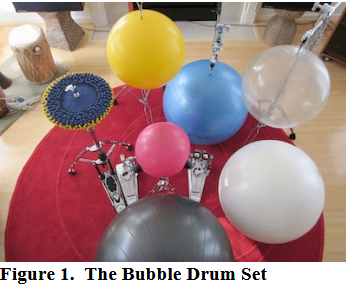
The reason I chose this paper is because it had something to do with games, which was my very open research topic so far. The whole thing is about using big exercise balls as drum kits.

As seen on the picture, this project wanted to re-imagine drum kits capable of input. Regular drums are loud and can damage hearing, but provide a steady exercise value. Rubber drum kits for practicing with input also exist in the form of Guitar Hero or Rock Band.

What the author wanted to achieve was to eliminate the feeling of no feedback and thus no feeling when it comes to hard rubber kits. The data is captured using an accelerometer, microphone and camera inputs, to make it possible to play rhythm games. There are microphones placed closely to the bubble drum and they use Drumagog to replace the drum samples, while replicating the original performance responsively and accurately.

The paper also mentions that both aural and visual feedback are provided, but this is within the games themselves. The game that was developed by the author was a simple flash game “Polynome”. The objective and challenge is for the player to perform polyrhythmic patterns to existing songs, using the drums as controllers. The drum samples are using different elements depending on the song, in order to create unique remixes of rhythm and sound.

Figure 2: Polynome Screenshot

What’s interesting to me is the UI shown, the circles with the lines inside them are a reoccurring motif that is, I assume, meant to be the main indicator of what to do within this game. I’m not very well versed with music theory, but I am well versed with rhythm games, so I would have to wonder what these symbols mean and how this game actually makes things clear to the player. Unfortunately, these aspects aren’t described or analysed in this paper.

Overall, I find the idea fun because I like rhythm games and unique interaction methods acting as controllers. However, I find the paper to be a bit shallow and lacking more technical information. I can’t fully imagine the interaction, how the game would work, or how this entire thing would provide a “rigorous workout” (as stated many times in the text).

  • [1] J. A. Jackson, “Bubble Drum-agog-ing: Polyrhythm Games & Other Inter Activities,” in Proc. 12th Int. Conf. on New Interfaces for Musical Expression (NIME), Ann Arbor, MI, USA, May 22, 2012, exhibit.