In my last blog post I was already thinking about a final product, but since then I came to realize that I might need to do some more research.
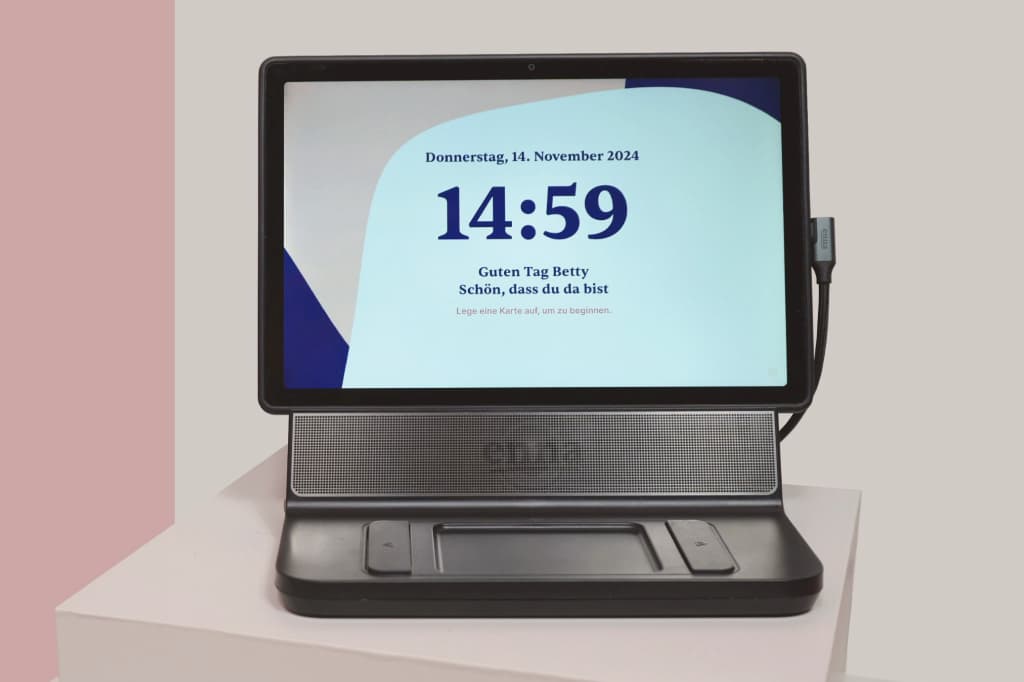
This week, I came across a tablet-based system called Enna Care, a product created in Germany that uses NFC cards as a “physical” way of interacting with digital content. Instead of navigating a touchscreen interface, users simply place a card on the device to trigger a specific action.
When I first looked at the system, it raised an interesting question: Should the challenges elderly people face with digital technology be solved entirely through digital solutions or should designers also consider combining digital and analog interaction?
From the research I reviewed, it became clear that many seniors experience difficulties when using touchscreen interfaces. Age-related changes in motor and cognitive abilities, such as reduced dexterity, attention and memory, can make digital interaction more challenging. [1]
This is where tangible user interfaces become particularly interesting. Instead of relying solely on abstract digital elements, they connect digital functions to physical objects that users can touch. Research shows that NFC-based systems seem to be well accepted by seniors and can encourage greater engagement with digital technology. Because the interaction is linked to familiar physical actions, users can rely on existing knowledge and experiences rather than learning entirely new interaction patterns. [2]
What I found particularly interesting about Enna Care is that it does not try to force users to adapt to technology. Instead, it adapts the technology to the users. By using NFC cards as physical objects that relate to digital functions, the system reduces complexity and makes interaction feel more familiar.
When designing for elderly people, the goal might not always be to simplify existing digital interfaces. In some cases, it may be more effective to rethink the interaction itself and build on users’ existing mental models. Maybe also a hybrid interface that combines analog and digital interaction could be a solution.
Sources
[1] G. A. Wildenbos, L. Peute, and M. Jaspers, “Aging barriers influencing mobile health usability for older adults: A literature based framework (MOLD-US),” International Journal of Medical Informatics, vol. 114, pp. 66–75, Jun. 2018, doi: https://doi.org/10.1016/j.ijmedinf.2018.03.012.
[2] E. de la Guía, M. D. Lozano, and V. M. R. Penichet, ‘Increasing engagement in elderly people through tangible and distributed user interfaces’, in Proceedings of the 8th International Conference on Pervasive Computing Technologies for Healthcare, Oldenburg, Germany, 2014, pp. 390–393.