Another talk I attended at the World Usability Congress was “The UX Horror Show: Let’s Talk About Dark Patterns” by Vicky Pirker. This talk connects directly to another talk (Addiction vs. Control: How (not) to build habit-forming products), since deceptive patterns are used to make products that are habit-forming. Moreover these patterns are used to manipulate and deceive users. What I found most interesting was that Digital Service Act already prohibits these tactics yet few businesses adhere to them.
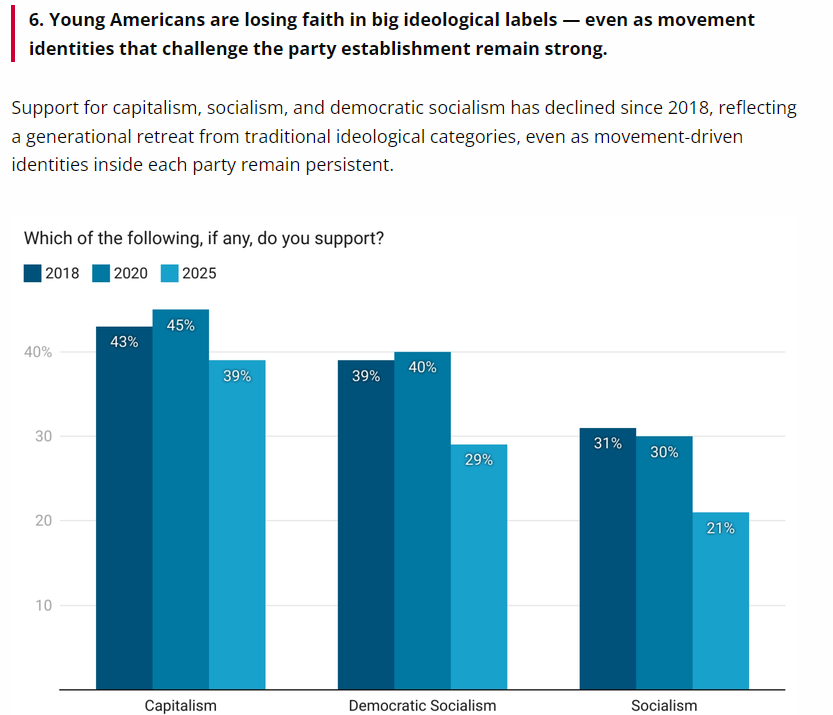
As Designers we understand how people think and therefore we have the power to either protect users or exploit them. I know that as Designers, we still depend on big corporations to make a living. And as both speakers mentioned we probably can’t change capitalism in an instant but we can make things better little by little through the design decisions we make. I would argue that many young people are also growing sceptical of businesses that are purely profit-driven and prefer companies that act more responsibly and socially. This is also reflected in the 51st edition of the Harvard Youth Poll, in which the share of young Americans who identify as capitalist fell by ten percent (from 29% in 2020 to 19% in 2025).
3 Guidelines for Designers (Article 25(3) Digital Service Act)
The speaker mentioned some easy guidelines to adhere for Designers:
- Don’t give prominence to one option: This is most commonly used in cookie banners, where businesses often highlight the option that benefits themselves than the users.
- Don’t repeatedly ask the user to reconsider: Also called Nagging, which is used by businesses to upsell certain subscription plans or products. (e.g. choosing the Basic plan and then getting “Are you sure? You’ll miss these Pro features.”)
- Don’t make it harder to cancel than to sign up: Many businesses use this model called Roach Motel to keep users from unsubscribing from their service. (e.g. unsubscribing from a newsletter)
DATA Framework by Vicky Pirker
How can Designers make the right decisions? The speaker created a framework called DATA, which offers some pointers for making digital products less manipulative and exploitative.
- D (Dignity): Users should be respected and not shamed into making decisions.
- For example, pop-ups that try to upsell users at checkout, such as “Are you sure you want to continue with Basic? Get 5% off if you upgrade now.”
- A (Autonomy): User should be able to choose freely.
- One well-known example is the cookie banner, where the “Accept all” button is highlighted while the other options are barely visible. Thus, users often click whatever stands out, even if it isn’t in their best interest.
- T (Transparency): User should always know what is going on.
- One example is unsubscribing, which is often extremely complicated. Instead of simply confirming that everything has been turned off and the user is unsubscribed, many businesses add extra steps.
- A (Authenticity): Pressure placed on users should be real not fabricated.
- A common example might be fake urgency on hotel booking platforms, such as “20 people are looking at this hotel right now” or “only 3 rooms left.” A more honest version would be “3 rooms left on our platform,” which makes clear that the hotel itself possibly has more availability.
Related Links
- https://iop.harvard.edu/youth-poll/51st-edition-fall-2025
- https://gesetz-digitale-dienste.de/dsa/artikel-25/
- https://deceptive.design/hall-of-shame/ ← one of my new favourite websites