Introduction
How can home automation help make the invisible life processes of plants perceptible? Over the last few decades, both scientific research and artistic practices have shown a growing interest in plant life and in the hidden processes that regulate growth, health, and interaction with the environment.
Some of the most emblematic experiments combining technology, plants, and perception can be found in the field of music and sound. These works explore how biological signals from plants can be translated into audible forms, allowing humans to sense processes that are normally invisible.
Plants and music experiments
One of the most well-known examples is the musical project by Mort Garson. In 1976, he released the album Mother Earth’s Plantasia, a collection of electronic compositions created entirely with synthesizers. Each track was associated with a specific houseplant and was intended to accompany and support plant growth. [2] Although the album was not initially very successful, since it was not released for the commercial music market, it has gradually gained recognition among a niche audience as an early work of electronic music. [3]

Album cover of Mother Earth’s Plantasia. from: https://mortgarson.bandcamp.com/album/mother-earths-plantasia
In other experiments, plants have been used as actual musical instruments, or as sources of data that are transformed into music.
Composer Mamoru Fujieda, for example, worked with a bioelectric interface developed by botanist Yuji Dogane. This system, known as the Plantron, uses electrodes attached to plant leaves to measure changes in their electrical activity. These signals are then translated by a computer into MIDI data and converted into musical patterns using digital software.
Furthermore, Mileece, an English sound artist and environmental designer, gives a voice to plants by creating installations and performances based on generative music [4]. Her installation Soniferous Eden (2010) reflects her intention to create a bridge of communication between humans and plants, and even between plants themselves. In this work, plants become sensitive to one another and respond when humans touch the leaves of a neighboring plant.
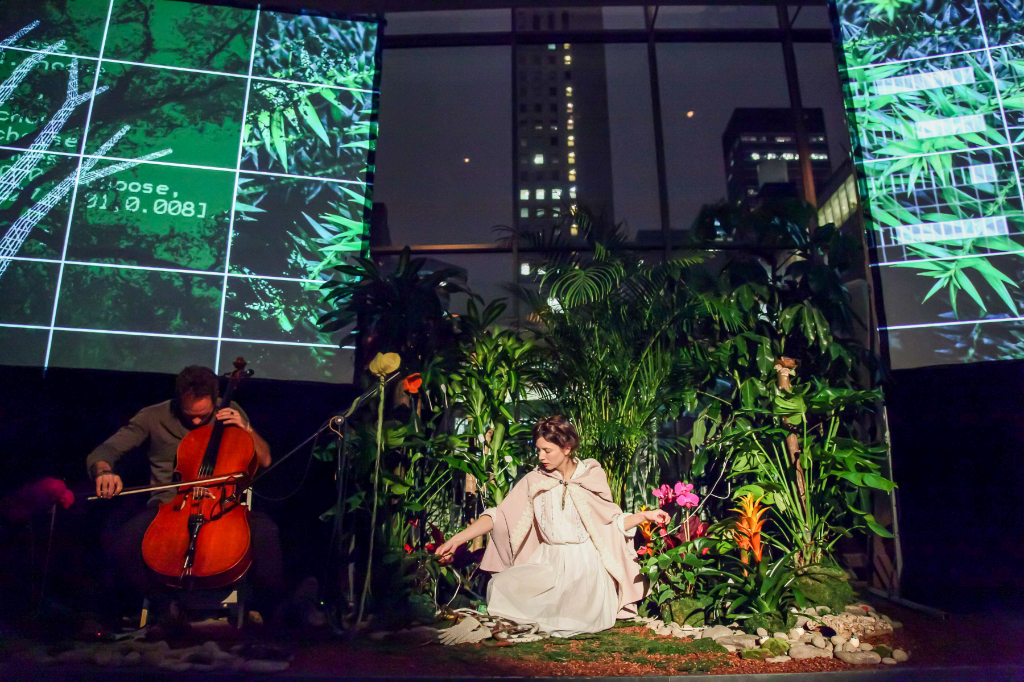
MILEECE, how to translate plant signals into immersive soundscapes- from: https://clotmag.com/interviews/mileece-translating-plant-signals-into-immersive-soundscapes
Another notable example is Data Garden, a collective inspired in part by Mileece’s work. Their installation Data Garden: Quartet consists of four plants connected to galvanometers through electrodes attached to their leaves. The electrical signals collected from each plant are translated into MIDI notes, with each plant controlling a different musical instrument. [6]
From Artistic Experiments to Interaction Design
These experiments invite us to reflect on the possibility of linking sound to dynamic interfaces. Sound, in particular, is a powerful tool for turning biological data into a sensory and perceptible experience. In the field of interaction design, for example, biometric data collected from plants can become parameters that influence technological objects or interfaces.
Within a domestic environment, it would be interesting to integrate a musical or sonic layer into plant care. Following Garson’s early intuition, sound could be used to support plant growth and overall well-being, since research has shown that certain audible frequencies and musical patterns can support physiological processes in plants, such as nutrient absorption, photosynthesis, and protein synthesis [5].
Alternatively, a generative soundscape could be linked to the real-time condition of plants: a stressed plant could produce more tense or dissonant sounds or environmental balance could be expressed through harmonic and stable melody tones.
In this way, home automation systems could help make the perception of plants and their well-being more active and dynamic.
Reference
[1] HGB Leipzig, “Plantasia,” HGB Leipzig, n.d. [Online]. Available: https://www.hgb-leipzig.de/plantasia/planta_english.html. [Accessed: n.d.].
[2] R. F. M. Lêdo, Music with Plants: Cultivating Bonds Between Grade-Schoolers and Nature Through Sound Design, Master’s thesis, University of Porto, Porto, Portugal, 2019. [Online]. Available: https://repositorio-aberto.up.pt/bitstream/10216/121890/2/346398.pdf. [Accessed: n.d.].
[3] “Mother Earth’s Plantasia,” Wikipedia, n.d. [Online]. Available: https://en.wikipedia.org/wiki/Mother_Earth%27s_Plantasia. [Accessed: n.d.]. Wikipedia
[4] CLOT Mag, “Interview with Mileece: Translating Plant Signals Into Immersive Soundscapes,” n.d. [Online]. Available: https://clotmag.com/interviews/mileece-translating-plant-signals-into-immersive-soundscapes. [Accessed: n.d.]. clotmag.com
[5] S. Raga and others, “Effect of Music on Plants — An Overview,” n.d. [Online]. Available: https://www.researchgate.net/publication/291086163_Effect_of_Music_on_Plants_-_An_Overview. [Accessed: n.d.].
[6] Data Garden, “Home,” Data Garden, n.d. [Online]. Available: https://www.datagarden.org/. [Accessed: n.d.]. Wikipedia