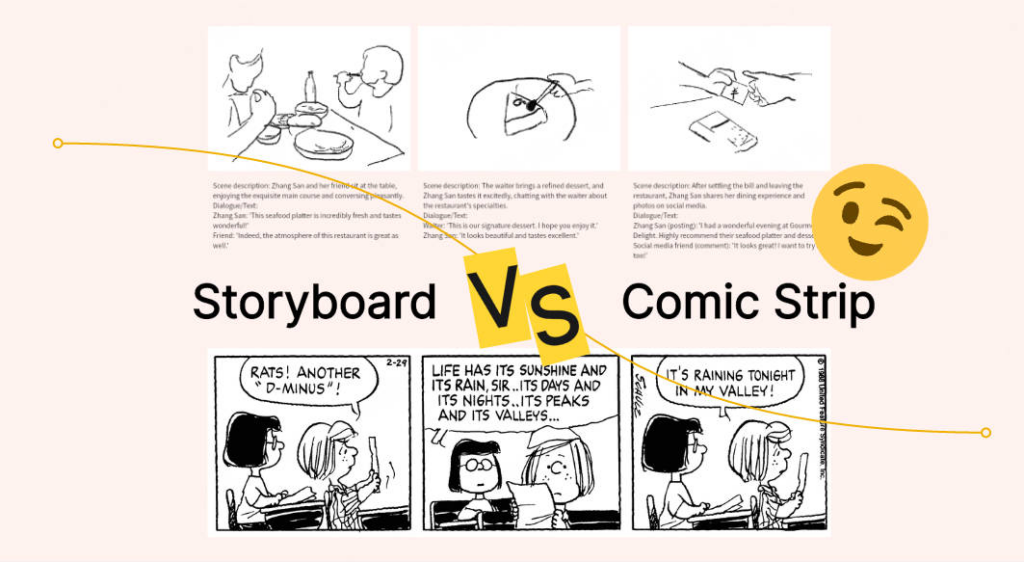
At first glance, the answer feels obvious. Comic strips and storyboards look almost identical. Both rely on panels. Both arrange images in sequence. Both suggest time, movement, causality. Both ask the reader to connect what happens between frames. Because of this visual overlap, many people intuitively assume that storyboards are simply a rough or unfinished version of comic strips.
But this assumption, while understandable, hides a more important distinction. Comic strips and storyboards may share a visual language, yet they exist for very different reasons.
The confusion begins with form. Panels, framing, pacing, and transitions are highly visible elements. When we see them repeated across media, we assume the purpose must be similar. However, in design, form alone rarely tells the full story. Function matters more.
Comic strips are finished artifacts. They are designed to be read. Their sequence is intentional and fixed. The reader is the final destination of the work. A comic strip can afford ambiguity, stylistic excess, visual metaphor, and personal voice. In fact, these qualities are often its strength. The meaning of a comic strip does not need to be resolved into a single interpretation. It can linger. It can invite multiple readings. It can slow down or speed up time purely for emotional effect.
Storyboards, by contrast, are not meant to be read as an end in themselves. They are working tools. They exist inside a process. Their audience is not the public, but collaborators. Designers, directors, curators, engineers, clients. A storyboard does not aim to express a personal voice. It aims to test whether something will work.
This difference changes everything.
A comic strip asks: what is the story?
A storyboard asks: will this story function in the real world?
Because of this, clarity matters more than expression. Ambiguity becomes a problem rather than a feature. Every frame needs to communicate intention. What happens first. What follows. Where attention goes. What the user, visitor, or viewer is expected to do next. If a frame is misunderstood, the storyboard has failed its task.
Another crucial distinction lies in permanence. A comic strip is stable. Once published, it does not change. A storyboard is provisional. It invites revision. It is drawn to be criticized, altered, reordered, or discarded. Its value lies precisely in the fact that it is not precious. It is allowed to be wrong early, so the final outcome can be right.
There is also a difference in authorship. Comic strips often carry a strong authorial presence. Even collaborative strips still speak with a recognizable voice. Storyboards, especially in design contexts, tend to dissolve authorship. They belong to the project, not to the person who drew them. Their success is measured by how well others can use them, not by how expressive they are.
Understanding this distinction is important because it frees storyboarding from the narrow association with entertainment and fiction. Once we stop thinking of storyboards as comic-like drawings, we begin to notice them everywhere. In airline safety cards. In IKEA manuals. In emergency evacuation diagrams. In exhibition walkthroughs. In participatory art instructions. In internal communication documents that were never meant to be beautiful, only effective.
So are comic strips storyboards?
Visually, they can look similar. Structurally, they share a grammar. Historically, they influence each other. But functionally, they are doing different work.
A comic strip is the story.
A storyboard is a tool for asking whether the story, the instruction, or the experience will actually hold together once it leaves the page.
Seen this way, comic strips are not the origin of storyboards, but one visible reference point among many. Storyboarding is less about drawing narratives and more about testing futures.
Refrences
Carter, Mackenzie. “Storyboard vs Comic Strip: Is a Storyboard Similar to a Comic Strip?” Boardmix, April 1, 2025, updated April 11, 2025. https://boardmix.com/articles/storyboard-vs-comcs-strip/.
