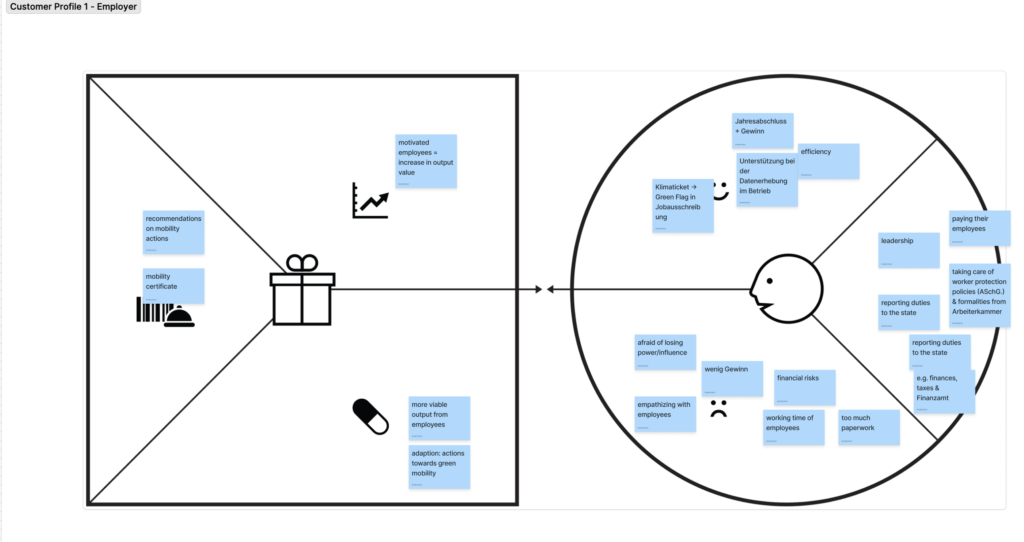
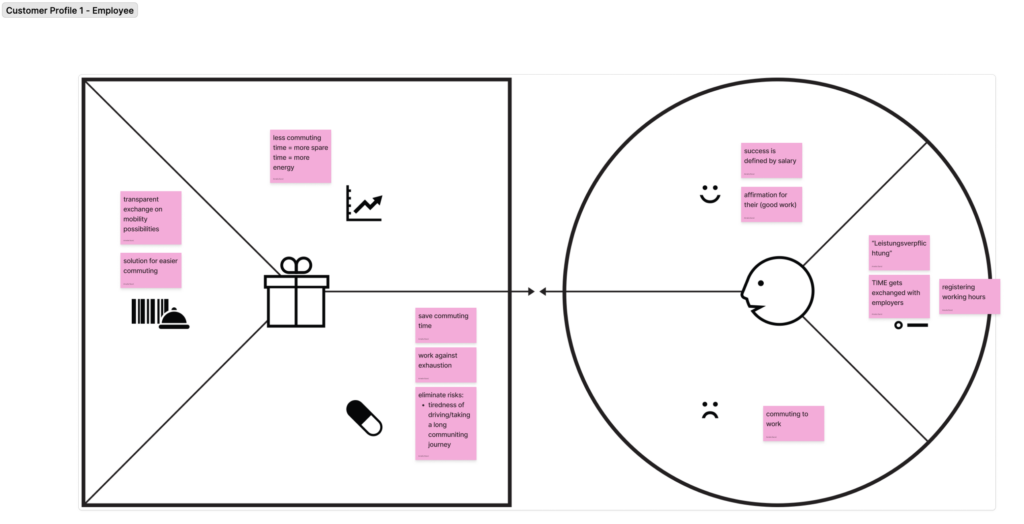
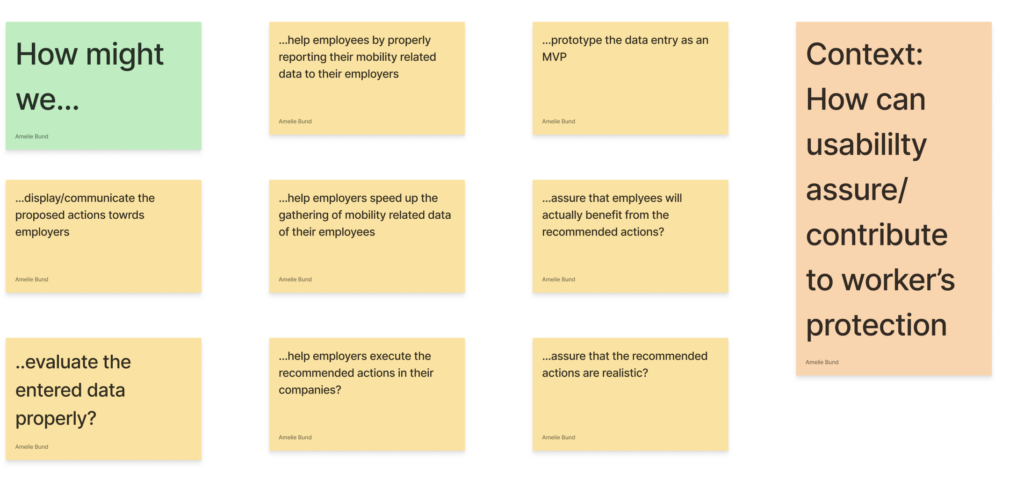
Blogpost Number 1 (Katerina): Value Proposition Canvas and Business Idea

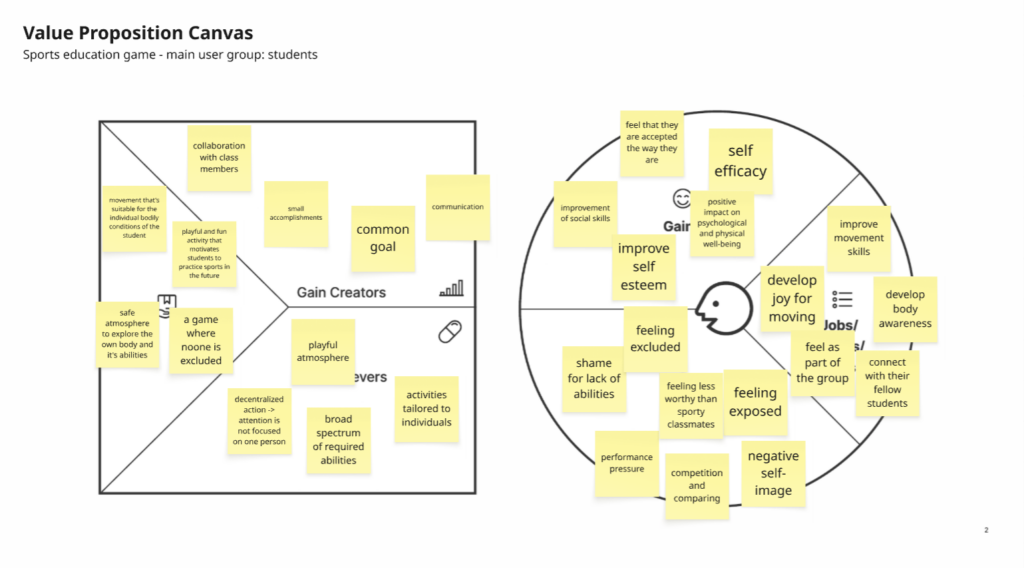
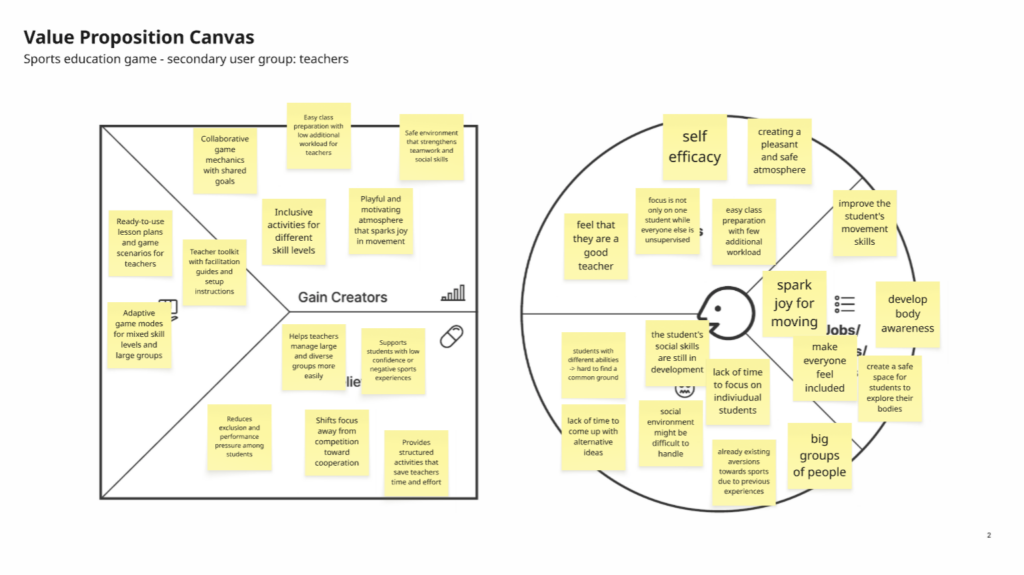
I started with the value proposition canvas for the main user group (the students). Most of it was easy to fill out because I had already done research on it previously. I identified teachers a secondary user group. While filling it out, I noticed that some of the aspects, especially the jobs to be done, were very closely related.

Based on those canvases I formulated the following business idea:

Physical education classes are meant to encourage movement, teamwork, and confidence, yet for many students they are associated with pressure, exclusion, and comparison. A German study from 2022 found that 39% of students do not enjoy PE classes, which can contribute to a long-term aversion toward sports and physical activity. This is especially concerning because sports and movement are closely linked to psychological well-being, self-esteem, and social development.

The idea behind this project is to rethink how movement is experienced in schools by creating a collaborative game concept specifically designed for PE classes. Instead of focusing on competition and individual athletic performance, the game encourages students to work together toward a shared goal. The activities rely on decentralized action and a broad range of abilities, meaning that participation does not depend only on traditional sports skills such as throwing, catching, or speed.

The concept is designed for school environments with diverse groups of students and aims to create situations in which everyone can contribute in different ways. By shifting the focus from performance to collaboration, the game can help reduce feelings of exclusion while making movement more enjoyable and accessible. Teachers also benefit from a structure that is easy to prepare, adaptable to large groups, and flexible enough for different ages and ability levels.

The long-term goal is to create more positive experiences with movement during school years and help students build confidence, social skills, and a healthier relationship with sports. Beyond the classroom, the project could contribute to a more inclusive understanding of physical education where participation and teamwork become more important than competition alone.

As a product, the concept could be offered to schools and educational institutions through physical or digital game kits, ready-to-use lesson plans, and a platform with adaptable activities for PE teachers. Additional revenue streams could include teacher workshops, subscriptions for new game content, or partnerships with schools and educational organizations.

Pitch

Here you can watch my elevator pitch for my app for reporting light pollution, with a transcript below.

Have you ever been on holiday and there is a beautiful landscape, but it is polluted by a lot of garbage lying around and you feel really sad and powerless because there is nothing you can do about it? Well, that is how I feel about the night sky when I look at it and it is all orange.

This happens due to light pollution. Many people do not know that light pollution is harmful to the ecosystem, to a lot of animals and to our health. They also do not know what to do about it.

I believe that the first step is reporting it. I plan to design an app where this can be done in an easy way, so that researchers and authorities can access data.

I plan to make it fun by combining education and some fun facts with challenges to encourage its usage.

I feel like I need to do something about light pollution because it makes me angry and I think that through interaction design I can engage more people and raise more awareness.

6# Transcript of the Elevator pitch – Design & Research II (Katerina)


[DesRes 2 @KaterinaSedlackova] Pitch Transcript – DesRes 2

Two thirds of Austrian employees commute to work by car.

To guarantee a sustainable future this must change.

  • It is difficult to leg to of habits. How do we convince car drivers to consider alternatives?
  • one could argue that there’s plenty of possible alternatives – but are these said alternatives always tangible?
  • Once you live and work in a city you might have a simple one: Just use public transport! But not everyone has a bus stop right in front of their door-step. Therefore, we must also think about the obstacles are people on the countryside are facing.
  • And last but not least, one important question remains:  How much responsibility should be carried upon employers?

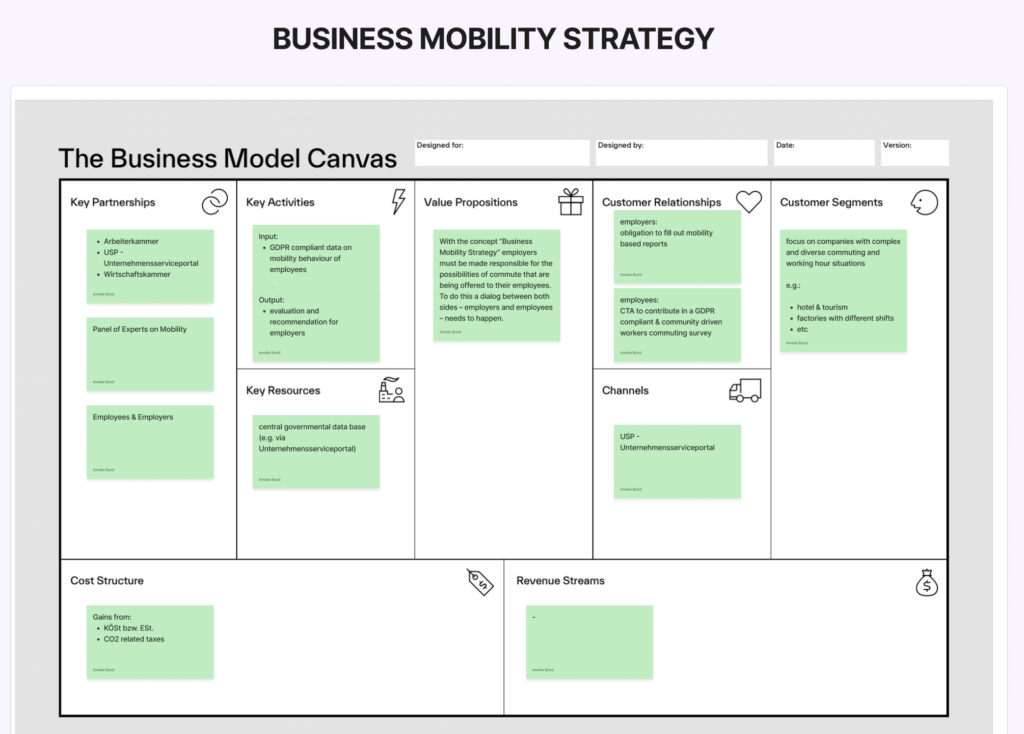
Together with legal experts I have develop a concept surrounding the topic of “Business Mobility Strategy” which seeks to make employers responsible for the possibilities of commute that are being offered to their employees. To do this a dialog between both sides – employers and employees – needs to happen.

A service will be implemented in the “USP – Unternehmensserviceportal” where employers must enter data such as the distance to the nearest bus station or the amount of parking space available for employees. Business owners are constantly exposed to endless and redundant paperwork. Efficient UX practices will assure a seamless and viable end-to-end experience.

Elevator Pitch; Playgrounds

Here is my pitch for design and research class;

Have you ever imagined of a playground where children can explore imagine and learn through play ? Traditional playgrounds are often designed by adults and not by children. I am interested in play based interaction- driven methods that allows children to participate as co-designers.

Play is essential for children’s development like social skills, cognitive abilities and physical health. Interaction design can help include children in the design process of playgrounds. I believe children should have more saying in a place where it is only for them and not for adults.

Design & Research II – Elevate Pitch

Design & Research 2 | For: Katerina Sedlackova

In our last class of Design and Research II with Katerina Sedlackova, we practiced crafting elevator pitches using a structured framework. Here is the pitch I developed for my concept:

We’re living in an era where everyone is a ‘photographer,’ but nobody actually knows how to use a camera. We’ve traded the craft of photography for a ‘smart’ button that does all the thinking for us.

The problem is that cameras are now so good, they’ve made the person behind the lens irrelevant. The AI chooses the light, the blur, and the mood. It’s a great image, but it isn’t your craft — it’s just a software output.

I’m building Photography Co-Pilot. It’s an AI that stops taking the photo for you and starts teaching you how to do it yourself. It explains the manual settings in plain English, in real-time, so you can take back creative control.

While everyone else uses AI to replace the artist, I’m using it to empower the artist. I’m giving the craft back to the person behind the lens.

I’m a designer and photographer. I believe technology should help us learn a skill, not replace the need for one.

13*BRANDING POLITICS: Analogue authenticity and why handmade print feels political

There is something strangely emotional about badly aligned ink.

A slightly crooked screen print, uneven letterpress pressure or rough photocopy texture often feels more politically sincere than an expensive, perfectly polished campaign advertisement. Even when communicating identical messages, analogue print aesthetics carry entirely different emotional weight.

And that difference says a lot about how we understand authenticity in contemporary political culture.

Over the past decades, political communication has become increasingly professionalised. Campaigns are data-driven, strategically branded and visually optimised across platforms. Political actors operate similarly to corporations, carefully managing tone of voice, visual identity and public image. As political branding became more polished, audiences simultaneously became more sceptical.

Authenticity emerged as a response to this distrust.

In contemporary political branding, this dynamic is also visible in campaigns – such as Zohran Mamdani – where visual identity often leans into a deliberately analogue-inspired, community-made aesthetic. Rather than presenting overly polished corporate-style branding, these materials frequently emphasise warmth, locality and a handmade visual language that feels closer to neighbourhood organising than institutional campaigning. This analogue touch contributes to a perception of being more personal, more grounded, and therefore more trustworthy, as if the communication is emerging from lived community experience rather than distant political machinery.

Sociologist Alison Hearn argues that contemporary culture increasingly values performances of authenticity as a reaction against excessive commodification and strategic self-branding (Hearn, 2008). In political communication, this means that “imperfect” aesthetics often appear more trustworthy precisely because they seem less manufactured.

Analogue print aesthetics benefit heavily from this perception.

Unlike digital design, analogue printing processes leave visible traces of labour. Screen printing produces texture variations. Letterpress creates physical pressure marks. Risograph printing often misaligns colours slightly. Photocopies degrade image quality through repetition. These imperfections reveal process.

And process feels human.

Historically, analogue print has also been deeply connected to political resistance. Protest posters, underground newspapers, activist zines and labour pamphlets relied on accessible print methods long before digital media existed. Political movements used whatever reproduction technologies were available – often cheaply, quickly and collectively.

This historical relationship matters because aesthetics carry memory.

Contemporary analogue-inspired political design unconsciously references these earlier traditions. A rough screen print visually echoes anti-war posters, punk zines, feminist publishing and grassroots organising. Even when reproduced digitally, analogue aesthetics signal resistance culture.

Design historian Steven Heller notes that alternative print cultures historically prioritised urgency and accessibility over technical perfection (Heller, 2003). The goal was communication, mobilisation and visibility – not polished branding consistency. Ironically, these “imperfect” aesthetics later became highly recognisable visual identities in themselves.

Today, many contemporary political movements intentionally recreate analogue aesthetics, even within digital environments.

Instagram graphics imitate photocopies. Protest campaigns use hand-drawn typography. Digital posters simulate screen-print textures. This aestheticisation of analogue media reflects a broader desire for authenticity within increasingly corporate communication systems.

But authenticity itself is complicated.

Just because something looks handmade does not necessarily make it politically radical or sincere. Analogue aesthetics can be strategically manufactured like any other branding technique. Large corporations frequently adopt “DIY” visual language to appear approachable, ethical or community-oriented. Handmade aesthetics have become marketable.

This creates an interesting contradiction.

The visual signs of authenticity are now fully integrated into contemporary branding culture. What once signalled anti-establishment politics can now be reproduced intentionally by institutions themselves.

And yet, audiences still respond emotionally to material imperfection.

Part of this response may relate to physicality. Digital communication often feels temporary and endlessly replaceable. Analogue print, by contrast, exists materially. Ink occupies space. Paper deteriorates. Posters wrinkle, fade and tear over time. Political messages become objects rather than purely images.

Media theorist Walter Benjamin famously argued that mechanical reproduction transforms how audiences experience authenticity and presence within visual culture (Benjamin, 1935). In many ways, analogue political print reintroduces a sense of aura into contemporary communication. Its imperfections make each object feel slightly singular.

This singularity becomes politically meaningful.

Analogue aesthetics suggest effort. Time. Human involvement. Collective production.

Whether these assumptions are always accurate is almost secondary.

What matters is perception.

In a political environment dominated by hyper-polished digital branding, analogue print aesthetics create emotional distance from institutional communication. They feel slower. More personal. More grounded in physical reality.

Not because they are inherently more honest.

But because they still look like someone made them.

This perception becomes especially relevant in contemporary protest culture, where movements constantly negotiate visibility, credibility and emotional resonance. Handmade aesthetics visually communicate effort and participation. They imply that politics is not only produced by institutions, but also by ordinary people physically engaging with public space.

And perhaps this is why analogue print continues to survive despite the efficiency of digital communication.

Analogue political media is slower. More expensive. Less scalable. Often messier.

But it also feels tangible in ways digital media rarely can.

You can hold it.

You can damage it.

You can walk past it every day on the same street corner until the message embeds itself into memory.

In that sense, analogue political print does more than communicate ideology.

It materialises it.

And maybe, in a political landscape increasingly shaped by polished branding and disappearing content, material presence itself has become a form of resistance.

Sources:

  • Benjamin, W. (1935). The Work of Art in the Age of Mechanical Reproduction.
  • Hearn, A. (2008). “Meat, Mask, Burden”: Probing the Contours of the Branded Self. Journal of Consumer Culture.
  • Heller, S. (2003). Merz to Emigre and Beyond: Avant-Garde Magazine Design of the Twentieth Century. Phaidon.
  • McQuiston, L. (1993). Graphic Agitation: Social and Political Graphics Since the Sixties. Phaidon.

12*BRANDING POLITICS: The basic politics of design – colour, typography and ideology

At first glance, design choices often appear aesthetic rather than political.

A blue poster is just blue. A serif font is simply elegant. Bold typography is supposedly just “good graphic design.” But political communication has never been neutral, and neither are the visual systems it relies on. Colours, typography, composition and visual style function as ideological shorthand long before audiences consciously process a message.

Politics, in many ways, is learned visually. Which we established quite well (at least in my very extremely humble opinion) last semester.

The association between colour and political identity is perhaps the clearest example of this process. Across much of Europe and North America, red has historically become linked to socialism, labour movements and revolutionary politics, while blue frequently signals conservatism, nationalism or institutional stability. Green has become inseparable from environmental politics. Black often appears in anarchist or anti-authoritarian contexts.

These associations are not biologically fixed. They are culturally constructed through repetition.

Political theorist Murray Edelman argued that political symbols gain power through emotional conditioning rather than rational understanding (Edelman, 1964). In other words, colours become political because societies repeatedly attach ideological meaning to them over time. Eventually, recognition becomes automatic.

This visual conditioning explains why certain political campaigns feel immediately legible even before any text is read. Audiences subconsciously decode ideological cues through aesthetics. A minimalist sans-serif campaign using soft gradients and inclusive photography communicates something very different from a poster built around aggressive typography, national symbols and rigid composition.

Typography functions similarly.

Fonts carry cultural histories. Serif typefaces are often associated with authority, tradition and institutional legitimacy due to their long relationship with newspapers, academia and governmental communication. Sans-serif typography, particularly geometric modernist fonts, frequently communicates progressiveness, accessibility and contemporary thinking.

These associations become politically significant because typography shapes emotional interpretation. Design theorist Ellen Lupton describes typography as a “visual form of language” that structures tone before content is consciously understood (Lupton, 2010). A slogan written in a clean modern grotesk feels fundamentally different from the exact same slogan written in a decorative script font.

This becomes especially visible in political propaganda.

Authoritarian political communication historically relies heavily on bold, condensed typography, strong geometric composition and limited colour palettes. Soviet constructivist posters, fascist propaganda and nationalist campaign materials all utilised highly controlled visual systems designed to communicate strength, urgency and collective identity.

Contemporary political branding continues these traditions, although often in more subtle ways.

Progressive political movements frequently rely on softer aesthetics, participatory visuals and inclusive colour systems intended to signal openness and diversity. Conservative campaigns often prioritise visual stability, tradition and national symbolism. These design strategies are not accidental – they are carefully constructed emotional frameworks.

Importantly, audiences do not need formal design education to interpret these signals.

Visual literacy develops culturally. Through repeated exposure, people learn how political ideologies “look.” This process operates almost automatically. You may not consciously analyse typography when looking at a campaign poster, but you still respond emotionally to its visual tone.

And this emotional response matters politically.

Communication scholar George Lakoff argues that political persuasion relies heavily on framing rather than factual argument alone (Lakoff, 2004). Visual design contributes directly to this framing process. Design shapes whether political communication feels trustworthy, threatening, rebellious or institutional before any policy position is evaluated.

This becomes particularly important in digital political culture, where audiences consume information rapidly and often superficially. Visual impressions are formed within seconds. Political branding therefore relies heavily on recognisability and immediate emotional clarity.

But these systems are never universal.

Colour associations differ internationally. In the United States, red is associated with conservative politics, whereas across much of Europe it remains linked to socialism and labour movements. Typography trends also shift culturally and historically. What feels progressive in one context may feel corporate or outdated in another.

Political design is therefore not fixed ideology translated visually.

It is negotiated perception.

And perhaps this is what makes political branding so powerful.

It rarely convinces through argument alone.

Sometimes, it simply teaches audiences what a political idea is supposed to look like.

And the more consistently these aesthetics are repeated, the more natural they begin to feel.

This is precisely why branding in politics becomes so effective. Visual language creates familiarity long before ideological understanding develops. A person may not fully understand a movement’s policies, but they can still recognise whether it appears modern, radical, patriotic, rebellious or trustworthy through design alone.

The danger, however, is that visual coherence can easily be mistaken for political coherence. A professionally branded campaign may appear organised and convincing even when its ideological foundations are weak or contradictory. Likewise, movements with less polished communication may struggle to gain legitimacy despite strong political substance.

Design therefore does not simply support political communication.

It shapes political perception itself.

And in a media environment increasingly built around rapid visual consumption, this influence becomes difficult to separate from politics entirely.

Before audiences evaluate arguments, they evaluate aesthetics.

Before they process policy, they process feeling.

And feeling, more often than not, begins with design.

Sources:

  • Edelman, M. (1964). The Symbolic Uses of Politics. University of Illinois Press.
  • Lakoff, G. (2004). Don’t Think of an Elephant! Chelsea Green Publishing.
  • Lupton, E. (2010). Thinking with Type. Princeton Architectural Press.
  • Crowley, D. (2013). Graphic Design and Protest. Design Issues, 29(3).