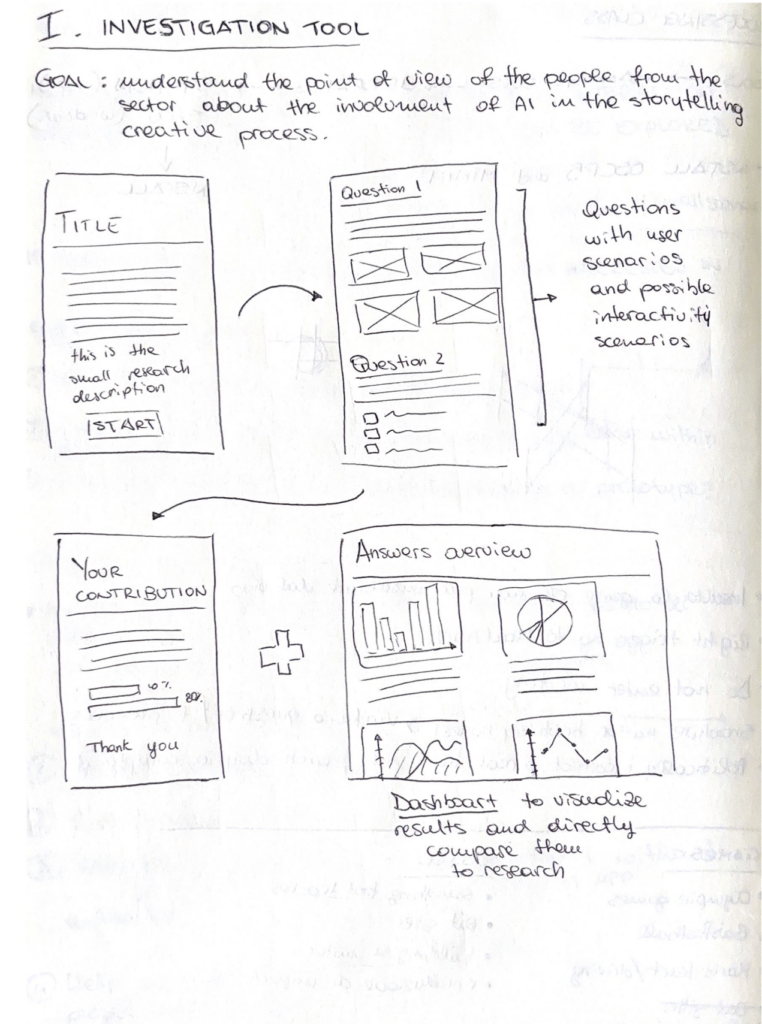
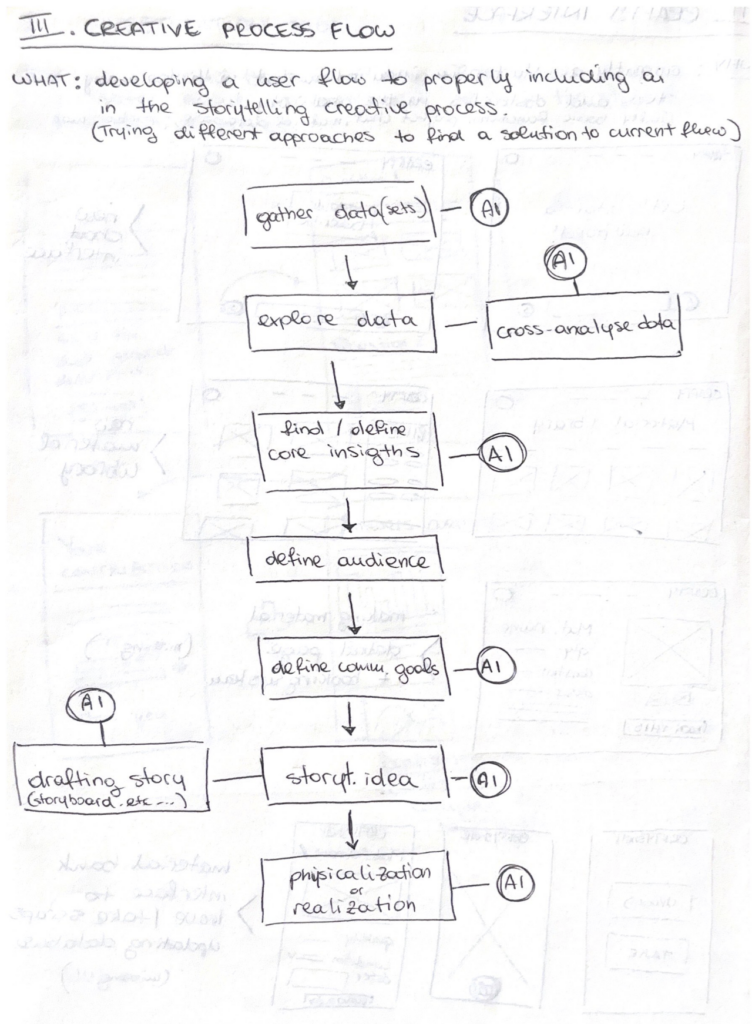
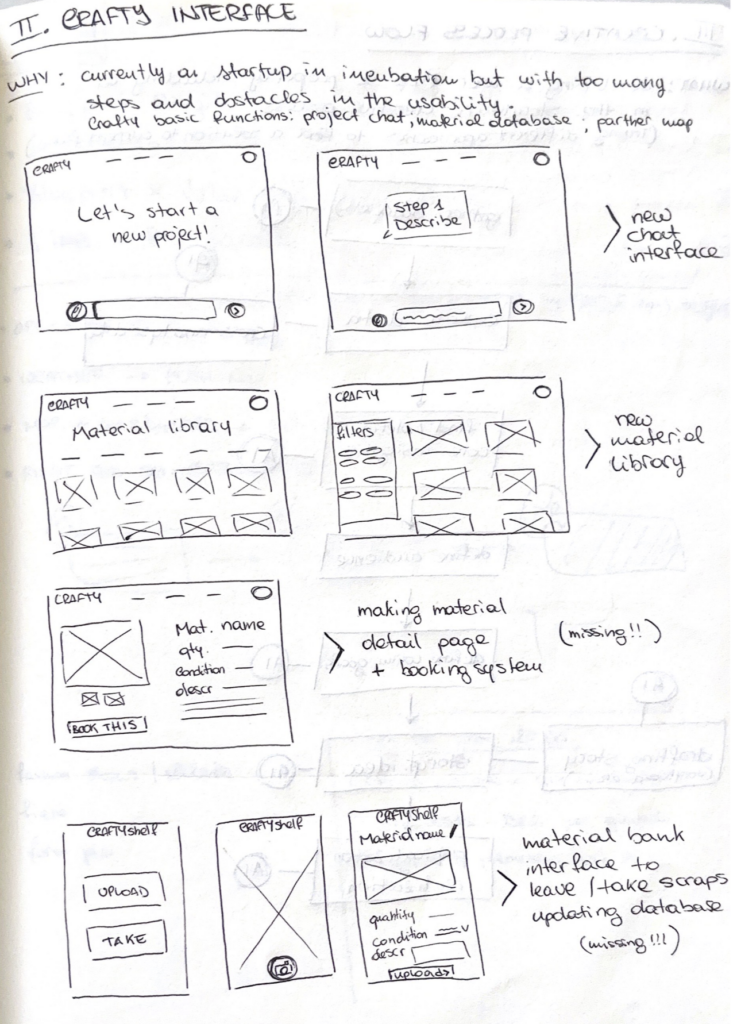
Imagining what could be prototyped for such highly conceptual and unexplored subject was initially challenging, as it required translating something abstract into tangible. Nevertheless, I was able to find two possible directions for further developments of the research, each exploring a different aspect of the topic. As a precautionary measure to ensure a deliverable outcome, I then also considered a separate (maybe more practical) direction as a reliable backup plan and idea 3. Here follows a description of each idea in detail.
1. Building a tool to conduct research on userbehaviour and AI usage
The concept sketched above stems from the need of conducting a survey for the thesis research, which should investigate the behaviour and habits in AI usage in the creative process of people in the field. Instead of relying on common survey tools, the idea here is to build/prototype a tool based on my needs, which could then show in a dashboard the data collected in the survey part. Why a dashboard? Because I would like the results to be always available and accessible to other researchers and designers, even without completing the assessment). This to ensure more open data in real time, that can illustrate our current usage trend ans possibly the environmental impact based on the numbers.
2. Developing a new framework/workflow for the involvement of AI in the data-driven storytelling creative process
This second, more ambitious, idea is to study and develop myself a new (or just different) workflow framework for the community into data-driven storytelling. This would work as a step by step guide to follow for a conscious employment of AI in the creative process, highlighting the steps in which it can actually be helpful and how to properly write our prompts to have answers and outcomes that respect our needs in less requests. The scheme right now shows how our currently AI usage, yet the goal is to offer clearer steps with less involvement of generative models to ensure more human-centered design.
3. Implementing the interface of the website CRAFTY (the plan B)
This concept focuses on a project developed with other students one year ago and currently undergoing a startup competition at Politecnico di Milano. Its name is CRAFTY and it is an AI enhanced website dedicated to creatives, which should help with project development relying on (and suggesting) recycled resources and waste materials collected in storage spaces in universities and Fablabs. The idea drafted in this sketch aim to rethink the whole interface and interaction for the website, to make the usage smoother and more intuitive. In addition, it was considered to develop the missing interfaces for an autonomous warehouse management.
Here you can watch the pitch for the final idea of the project!
Audio transcription:
I have a question for you, be honest. How many times you felt lost in your creative process and wished to had a proper framework to help you?
Okay, so we can agree that we surely have issues with that and that we are missing a huge step and also a guide in our daily workflow.
I have another question for you. How many of you struggle because of AI not doing what you are actually asking for?
Well, what started as a research is now an accessible framework you can follow step-by-step every time you feel lost in your creative process, or just when you feel (ready) to try something new.
But why does this matter? Because it started from the actual needs of someone who is involved in this field and is also actually experiencing the same frustrations as you, as you.
Because we don’t need to make our work more stressful in parts that could actually be lighter and faster.
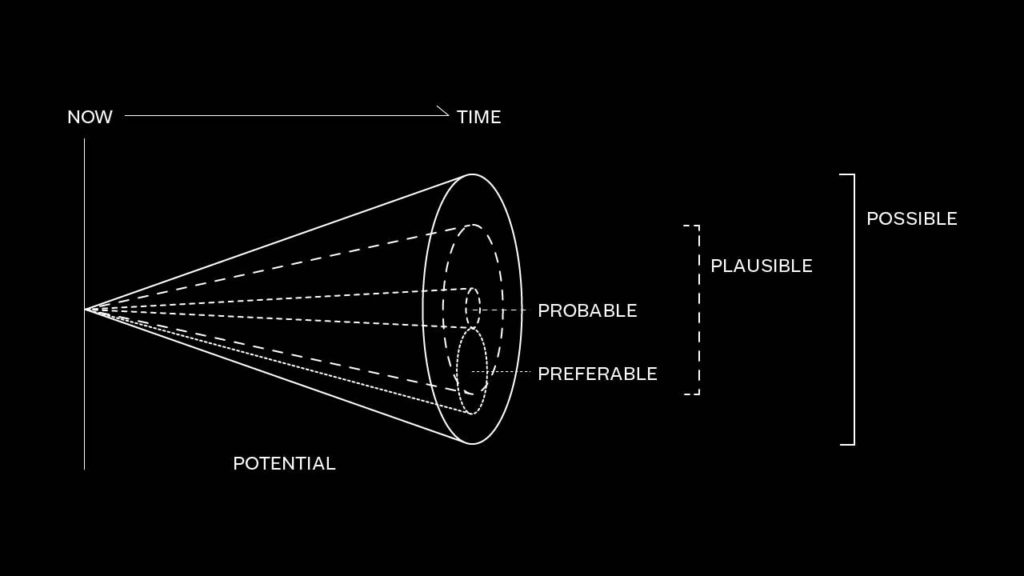
One of the most effective tools for visualizing different ways the future can unfold is the Futures Cone, also known as the 3P Model. It was developed by Anthony Dunne and Fiona Raby (2013), building on earlier work by Stuart Candy (2009) and introduced within the Design Interactions program at the Royal College of Art in London. The model is structured as a series of cones that branch out from a shared starting point, the present, each representing a different category of future. The probable refers to what is most likely to happen, and it is the space where most designers typically operate. The plausible moves beyond simple prediction, exploring scenarios that are believable, even if not certain, an approach often used by companies preparing for unexpected developments. Then there is the possible, which includes everything that may seem unattainable today due to technological, cultural, or social limits, but could become achievable in the future, as suggested by Michio Kaku in Physics of the Impossible (2008). Alongside these, we can also consider the preferable future, located at the intersection between the probable and the plausible. While it inevitably reflects subjective values, it also aligns with broader societal and market needs.
Figure 1. The Futures Cone (Candy, 2009).
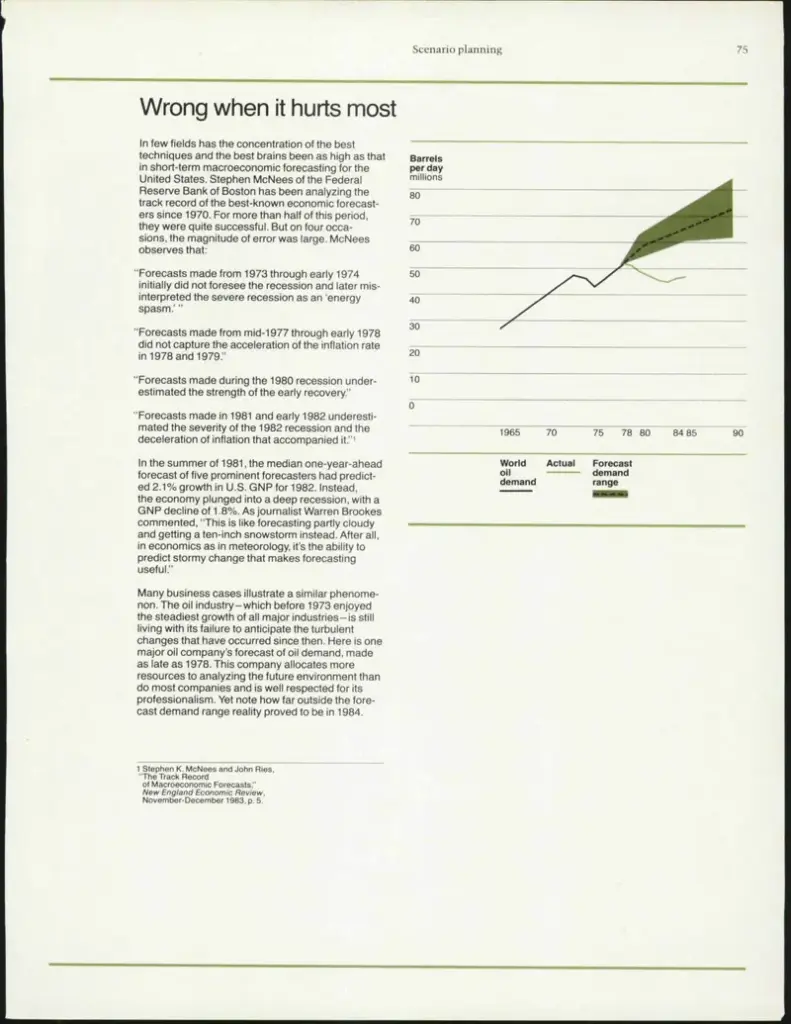
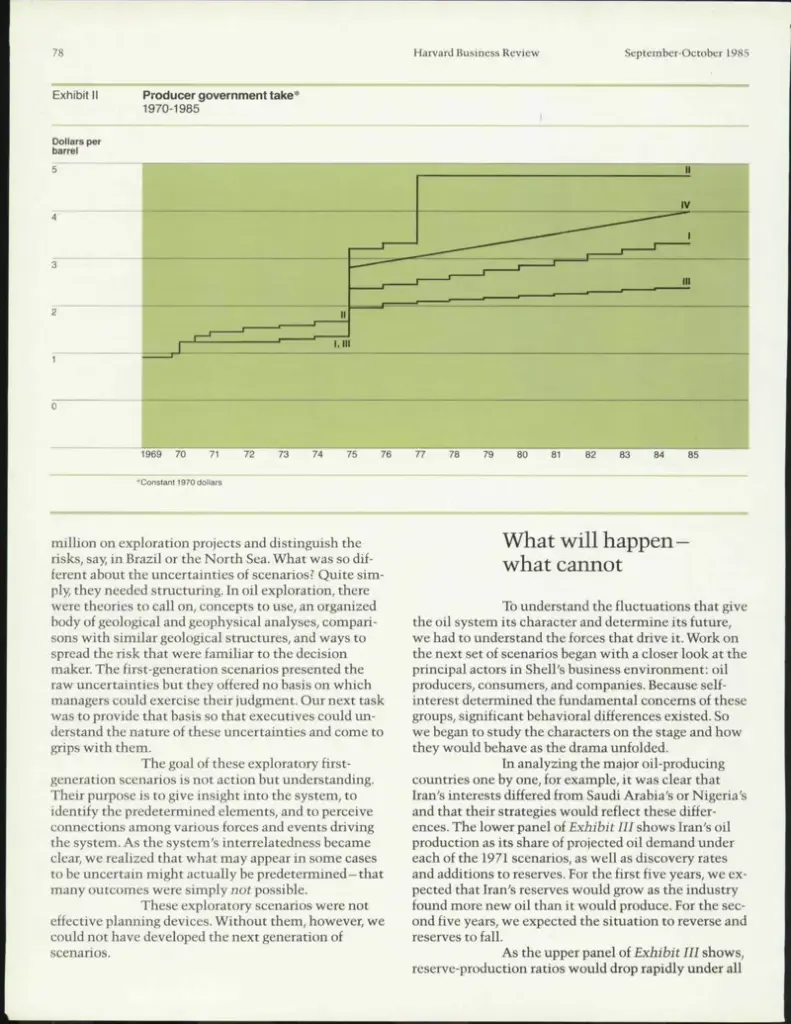
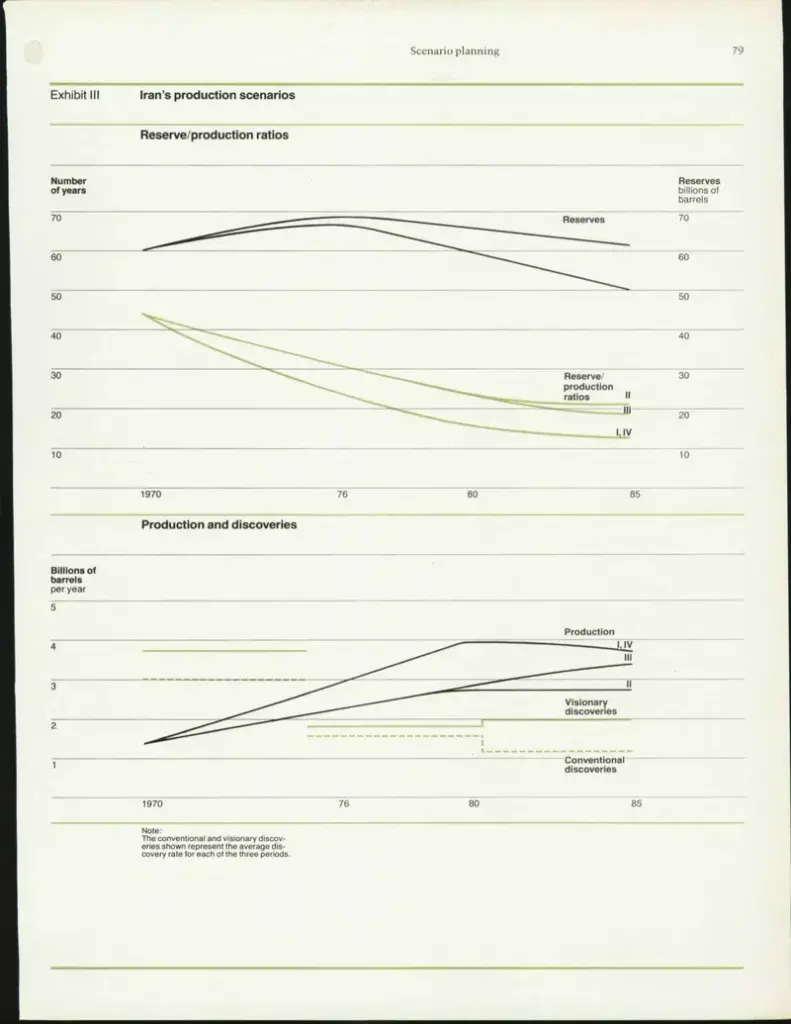
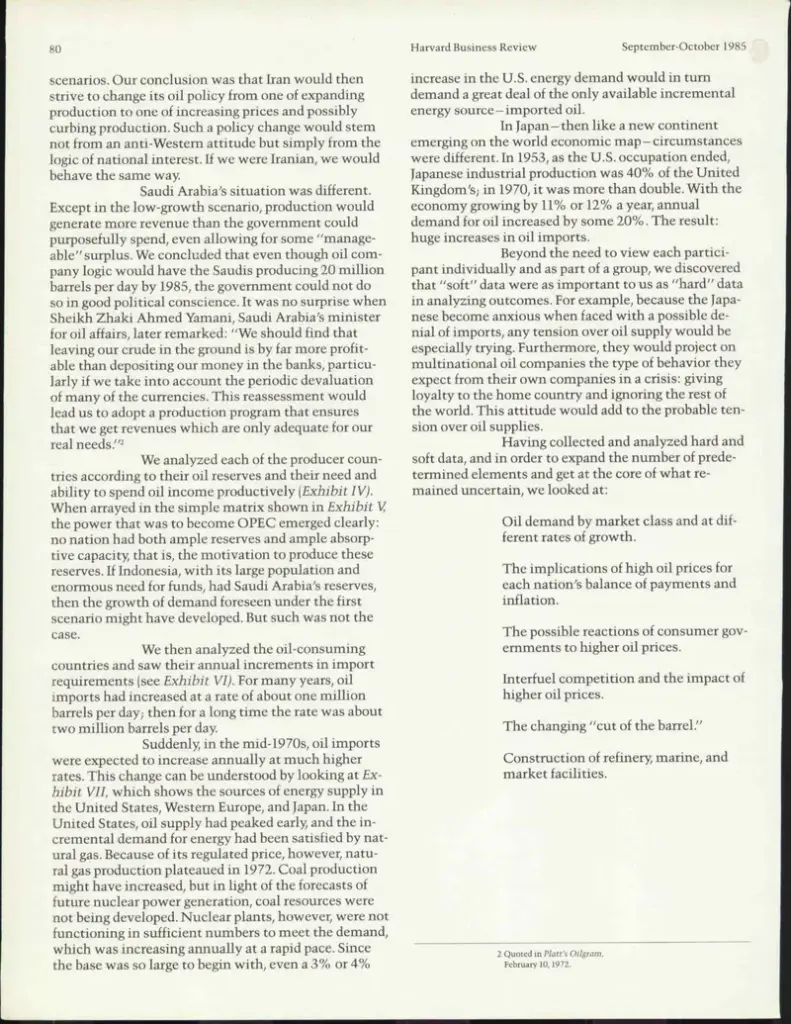
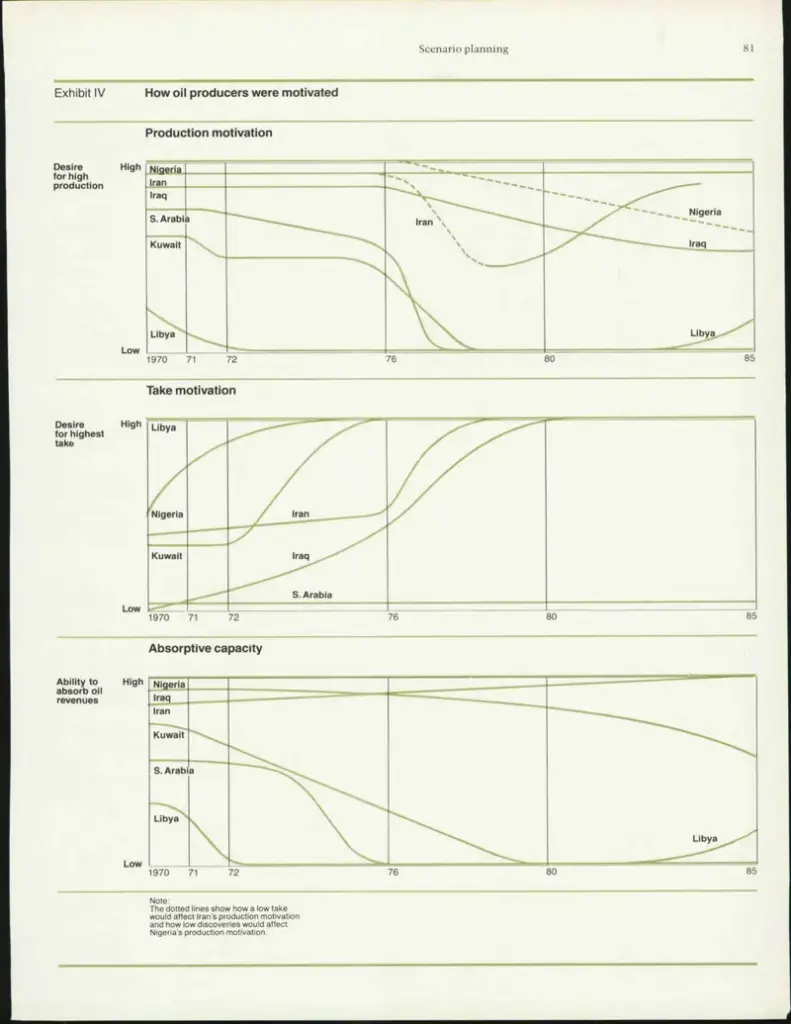
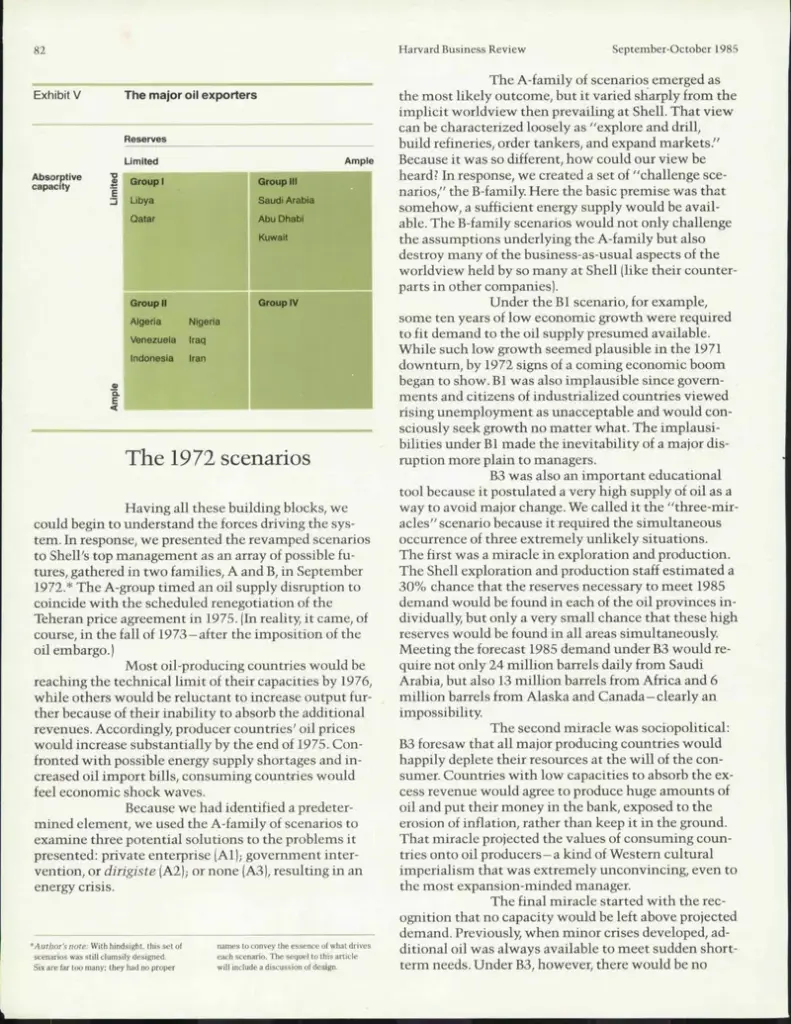
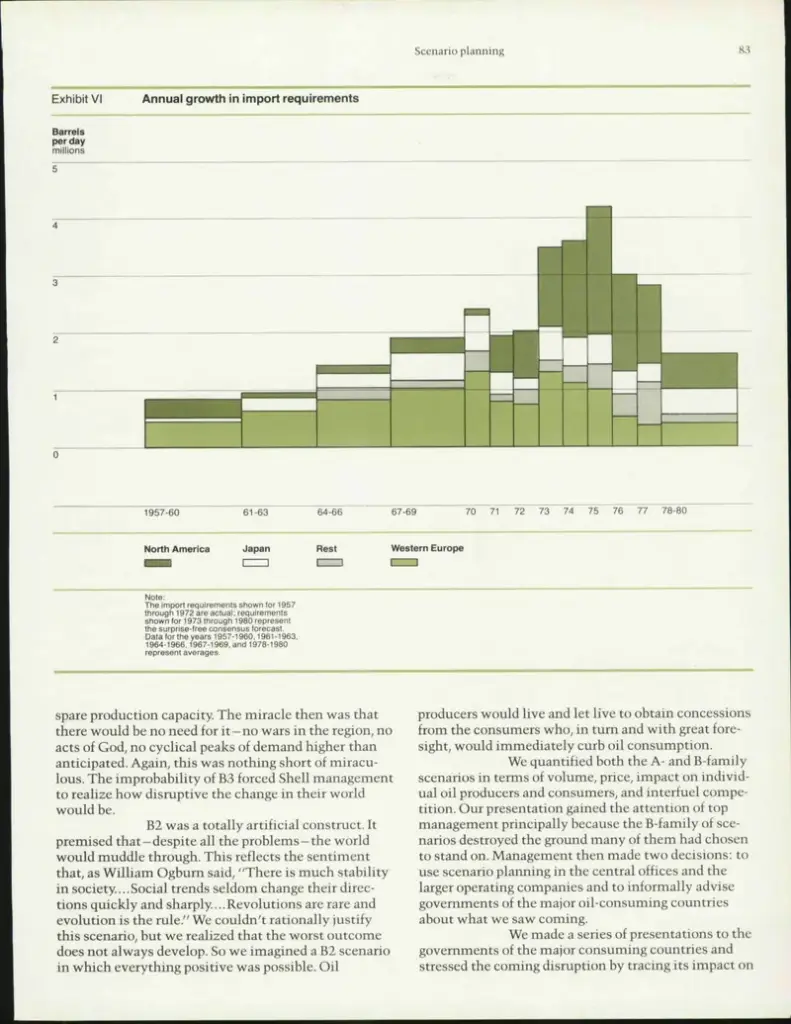
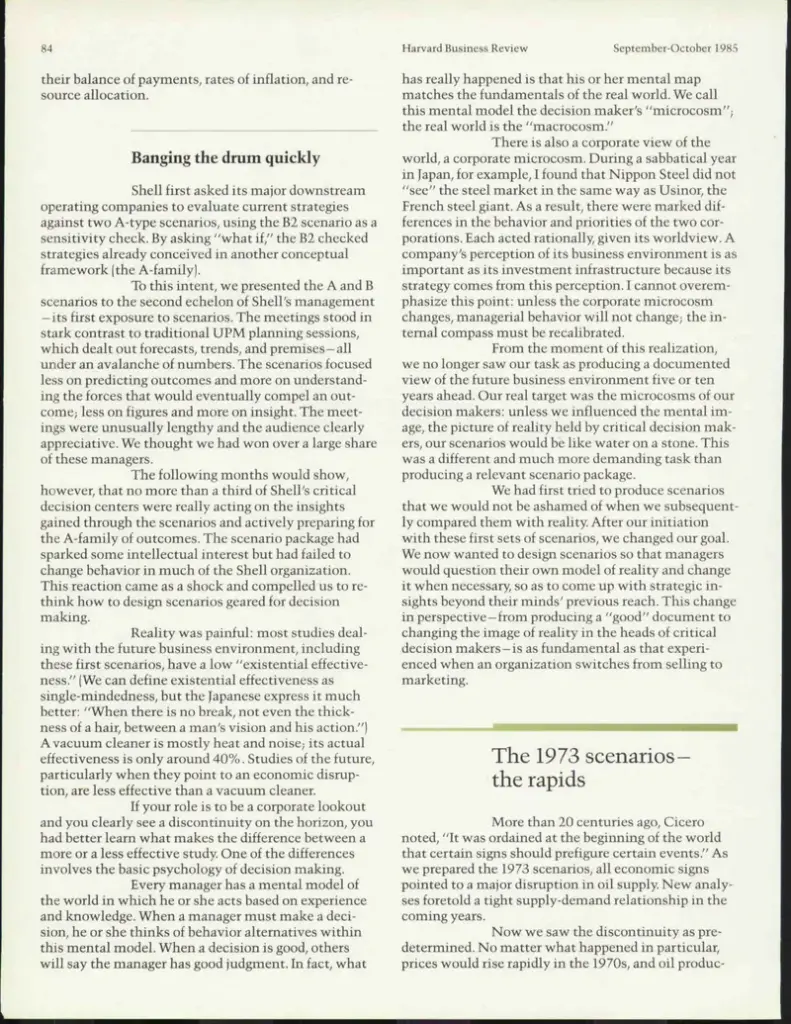
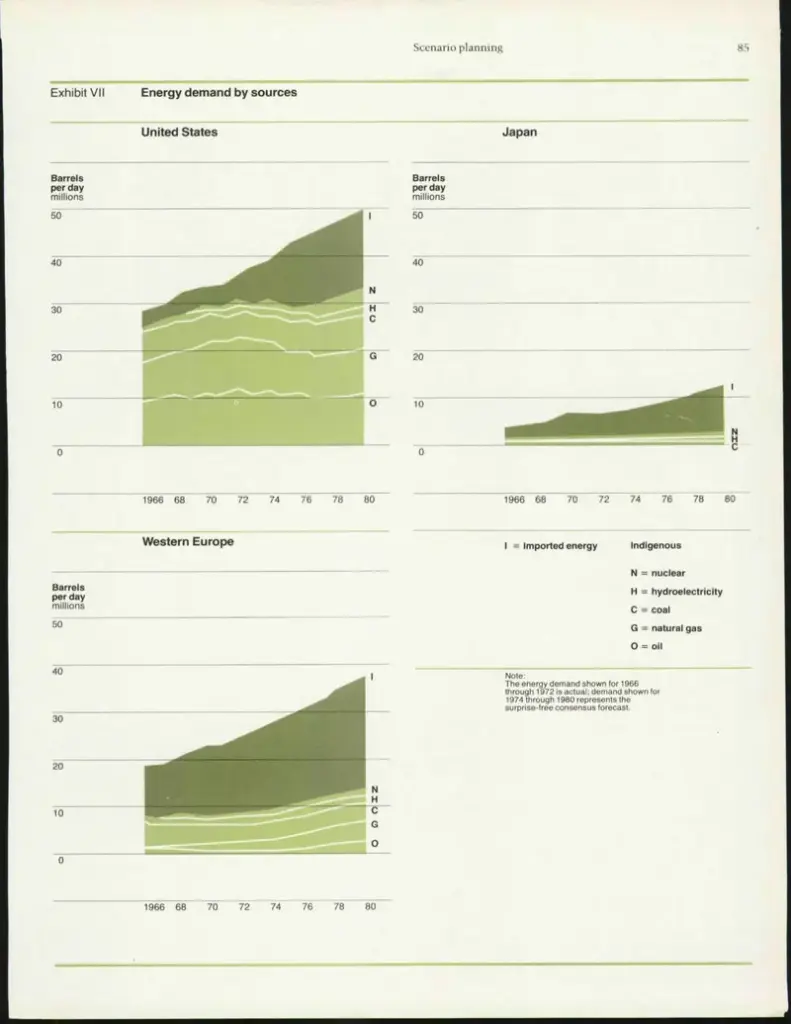
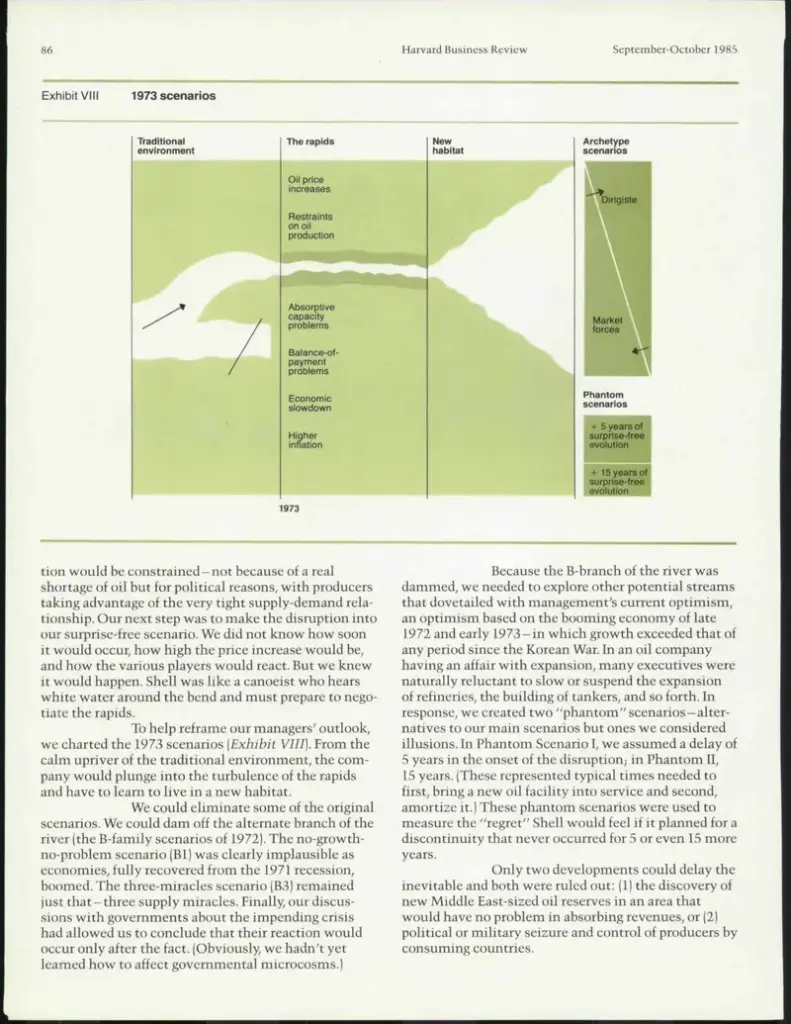
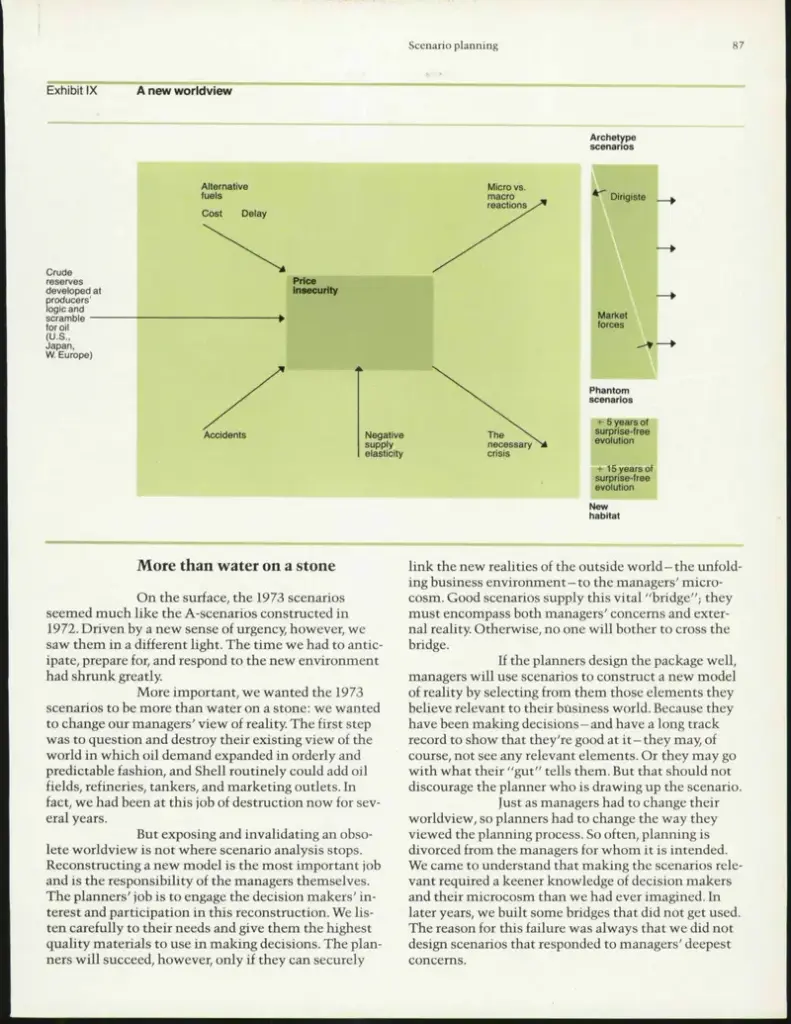
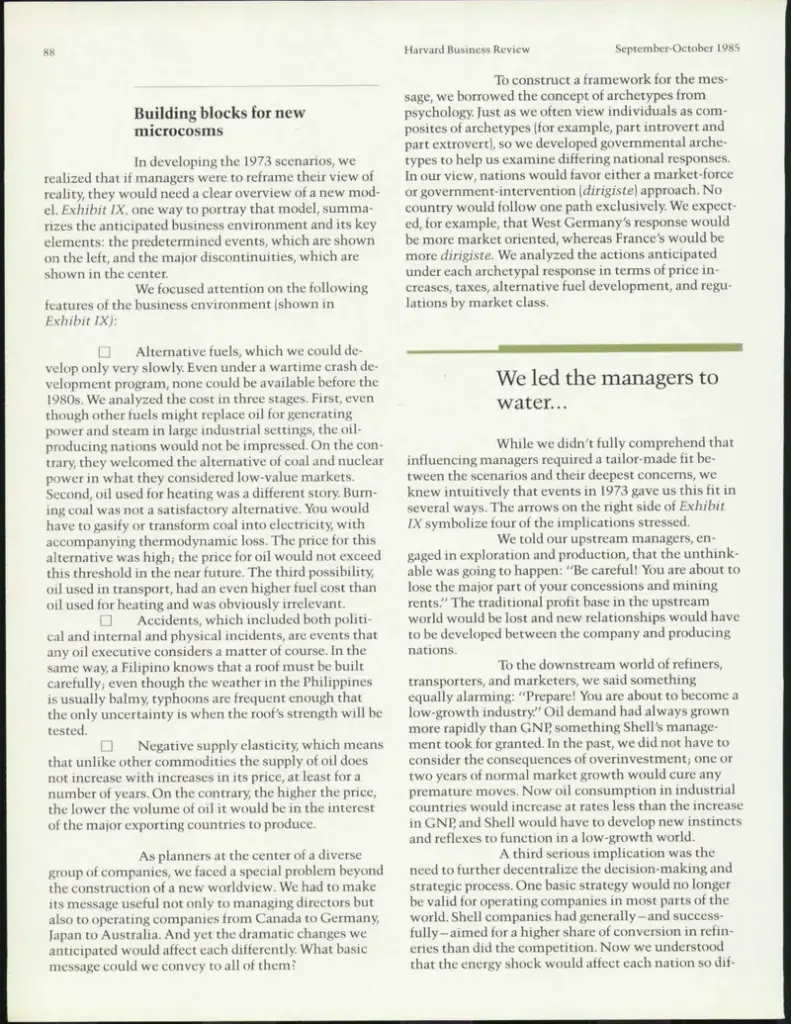
For this reason, it becomes a key area for Speculative Design, which aims to guide change by proposing alternative, inclusive, and sustainable scenarios. To better understand how these scenarios are actually constructed, it is useful to look more closely at what is known as Scenario Building, or Scenario Planning. Scenario Planning originated in the pioneering work of Pierre Wack, a French strategist at Royal Dutch Shell, one of the world’s leading oil companies. His task was to monitor global events that might influence oil prices. Until the Second World War, prices had remained relatively stable and affordable, but from the 1970s onward the situation began to shift dramatically: U.S. oil reserves were declining, global demand was rising, and exporting countries, particularly Arab nations, were gaining increasing negotiating power. This combination of factors posed a serious risk to the company’s economic stability. In response, Wack and his team developed a new planning approach that moved beyond linear forecasting. Rather than searching for a single “correct” prediction, they constructed multiple possible scenarios, each based on different political, economic and social variables. Two main scenarios stood out: a more optimistic one, in which oil prices would remain low and stable, and a more challenging but realistic one, which anticipated a sharp increase in costs. The effectiveness of this approach became clear during the 1973–1974 oil crisis. Shell was the only major company that found itself prepared, as its leadership had already adjusted their strategies according to the most plausible scenario identified by Wack. This foresight allowed the company to navigate the crisis from a position of strength, further consolidating its role in the global market. Building on this legacy, Peter Schwartz, who later succeeded Wack at Shell, defines a scenario in his book The Art of the Long View (1991) as «a tool for ordering one’s perceptions about alternative future environments in which one’s decisions might play out». He goes on to explain that «Scenario Planning is about making choices today with an understanding of how they might turn out». In this sense, Scenario Planning is fundamentally about making informed decisions in the present, with an awareness of their potential future consequences. Within this framework, the role of the designer becomes central. It is no longer just about introducing new products to the market, but about contributing to the creation of more just and sustainable futures. Design can therefore take two different directions: a traditional approach, focused on problem solving, responding to concrete needs through efficiency, aesthetics, and ergonomics and a more critical and speculative one, focused on problem finding, which brings questions to the surface and opens up space for reflection on ethical, environmental and social issues.
Figure 2. Early Royal Dutch Shell scenario planning reports.
In the collective imagination, design is almost always seen as a problem-solving process. Even in its most artistic and expressive forms, it ultimately remains tied to the idea of fixing something, of providing an answer, whether aesthetic or functional. But what if design could instead become a tool for questioning the present, or even for imagining the kinds of futures we would actually want to live in? This question lies at the core of Speculative Design, an approach that began to take shape in the early 2000s as a way of exploring alternative future scenarios, rather than simply addressing problems through rational or functional solutions. In other words, Speculative Design presents itself as a practice that does not seek definitive answers, but new questions. It is a form of design that opens up scenarios, sparks dialogue, encourages exchange, invites critique, and fuels the imagination. What truly matters here, however, is not so much predicting the future as using the idea of possible futures as a lens through which to better understand the present. These alternative futures, as mentioned earlier, do not provide solutions, they raise questions. One above all: “What if…?” It is precisely within this suspended space that the possibility emerges to think the unthinkable, to explore alternatives that would otherwise remain invisible or unexpressed.
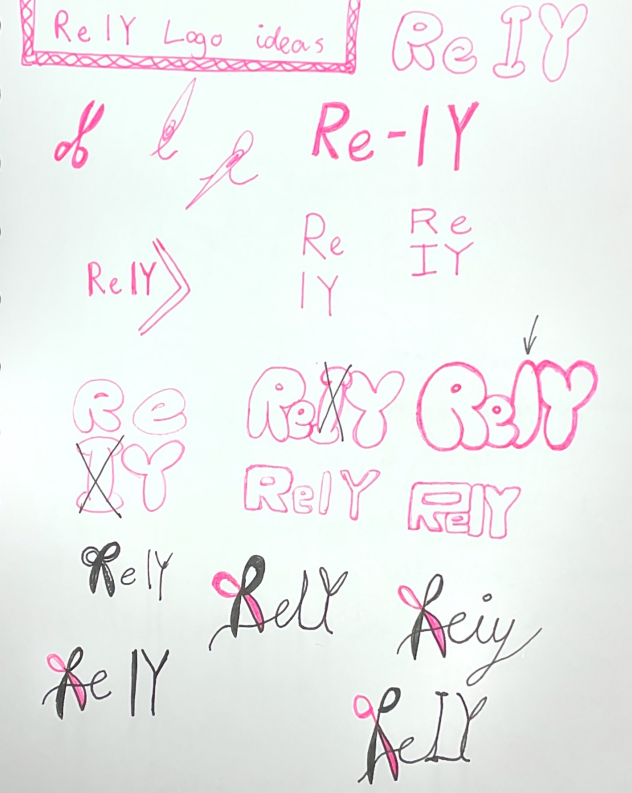
Since the last blog post, I have been working on the branding of my concept. I came up with a name for my website: ReIY. My focus has been on redesigning, reusing, and recycling materials, kind of “re-loving” your old clothes, so I wanted to include “Re” as part of the name.
The point of the website is also that you can use it as a tool to help yourself fix your problem, doing it yourself. Therefore, I thought about using the common phrase DIY (Do It Yourself). That’s how I came up with ReIY: redesign, reuse, and recycle it yourself.
I have been trying to develope the concept for ReIY and figure out what features would actually make sense for the website. And I also had the one-to-one feedback session with Birgit, which helped me think about the project from some new perspectives.
AI or not?
One of the biggest things we talked about was AI. Earlier in the project, I was thinking a lot about having AI as the main feature. being used for things like generateing custom sewing patterns based on measurements etc. While I still think that could be interesting, I started questioning whether AI really needs to be such a big part of the website.
My project is mainly about helping people redesign, reuse, and repair things they already own, and promotes sustainability. It is also about encouraging people to spend less time passively consuming content online and instead spend more time creating things themselves. Because of that, I don’t want AI to become the focus of the platform.
At the same time, AI is something people expect from digital products today, and without it I feel like the website can quickly be outcompeted by other websites. My current idea is therefore to make it an optional feature rather than the main attraction. Instead of generating lots of new content, AI could help users find relevant tutorials, patterns, and projects based on their skill level, available tools, materials, and what they are trying to make or repair.
Sources
Another thing I have been thinking about is where the content on the website should come from. At first, I imagined creating most of the tutorials myself, but after the feedback session I started exploring the idea of making the platform more community-driven.
One comparison that came up was Stack Exchange, where people can ask questions and share knowledge. I like the idea of users being able to post their own solutions, tutorials, and project results. If this were implemented, there would probably need to be some kind of review system to make sure the information is useful and trustworthy.
I have also been trying to narrow down what kinds of problems the website should help people solve. Right now, I am leaning towards focusing on common situations, such as repairing ripped pants, fixing holes in socks, altering clothes, or finding creative ways to reuse old textiles. These are things many people encounter, but often don’t know how to fix themselves.
At the moment, some features I am considering include:
Search filters for skill level, available tools, materials, and time needed
Sewing tutorials and repair guides
Community posts and project sharing
Reviews and ratings of tutorials
Tips and tricks for making clothes last longer
An optional AI assistant that helps users find relevant content
One thing I am still trying to figure out is how to make the website engaging without turning it into another platform that keeps people endlessly scrolling. Since my previous project focused on doomscrolling, I want ReIY to encourage people to get inspired and then actually leave the screen to start making something. Finding that balance is something I want to keep exploring as I continue developing the concept.
Overall, I feel like the project is becoming more focused. Instead of being a website about AI and sewing, it is starting to feel more like a platform that helps people care for their clothes, learn practical skills, and build a stronger connection to the things they own.
At the beginning of this research phase, a low-fidelity prototype was developed to evaluate whether users could understand the project’s context and purpose based on a very simple visual representation. Initial testing showed promising results, as all participants correctly identified the scenario as a train station environment. Based on these findings, I decided to continue working with the existing low-fidelity prototype while conducting further research and user testing.
Goal and approach
The primary objective of this study was to identify what additional information, guidance, and support users consider helpful when traveling by train and navigating railway platforms in Germany. The prototype was intentionally kept at an early stage of development to encourage creativity and open-ended feedback from participants. Rather than directing users toward predefined solutions, I aimed to provide a flexible testing environment that would allow for unexpected ideas and alternative approaches to emerge. Since the final form of the intended product had not yet been defined, maintaining openness to new insights and potential changes in direction was considered essential. The overall goal of the testing process was to gain a deeper understanding of user needs and to explore how these needs could be addressed through an effective design solution.
Prototype
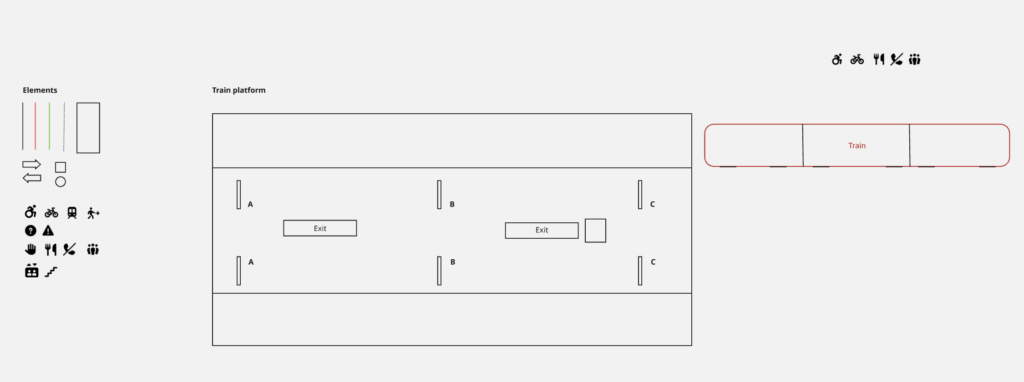
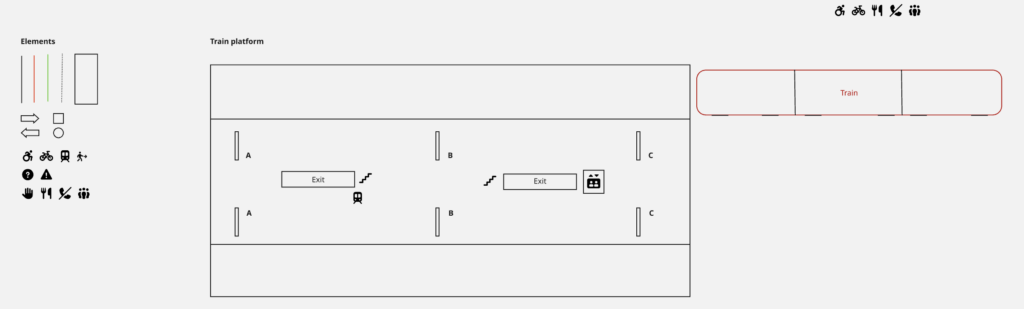
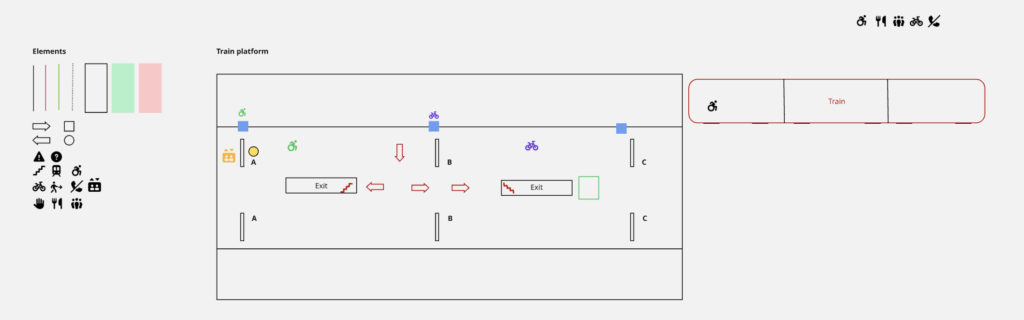
As this represented both the first prototype and the first round of user testing, the prototype remained in a low-fidelity state. The prototype was created and tested using Miro. The interface consisted of simple lines and geometric shapes forming the outline of a train platform with two tracks. A simplified train shape was positioned on the right side of the platform to represent an approaching train. To increase realism and improve orientation, platform sections labeled A, B, and C were included, reflecting common signage found on German railway platforms. Additional rectangles and squares were used to indicate stairways and elevators. Furthermore, a set of design elements was provided for participants to use during the testing session. These elements included icons, shapes, and lines that could be freely placed, modified, or expanded upon.
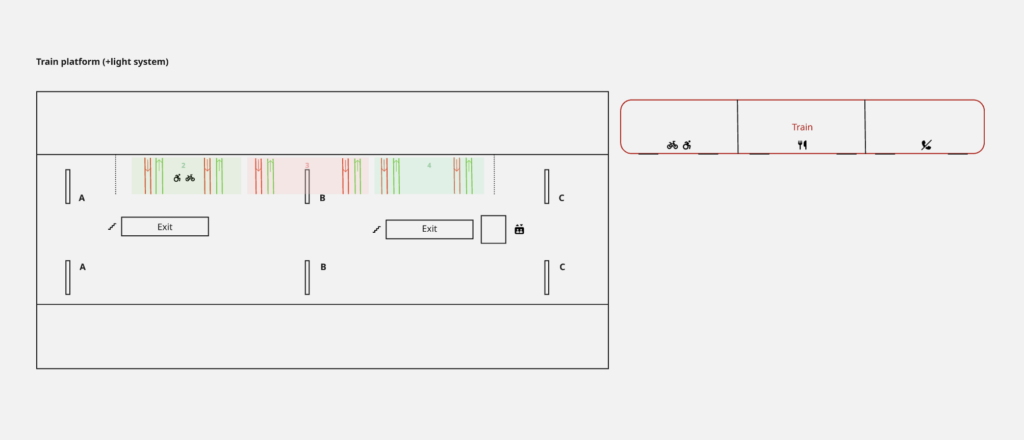
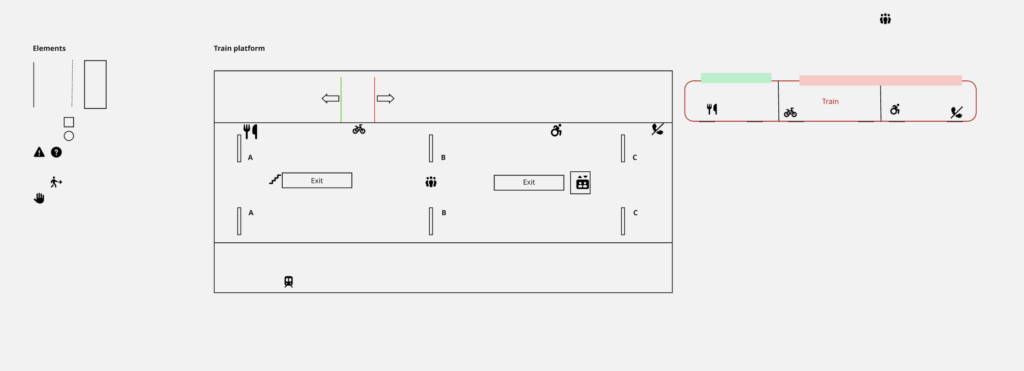
Prior to the testing sessions, I also created an example interface based on my own assumptions regarding what information might be useful for travelers. This served as a visual record of my initial design ideas and later enabled a comparison between my assumptions and the solutions proposed by participants.
Testing
To gather insights and evaluate initial design assumptions, the prototype was tested with five participants from my personal network. All participants were experienced train travelers in Germany. The testing sessions were conducted individually on a laptop, and each participant received the same initial prototype setup.
The first task required participants to position themselves on the platform by placing their cursor at the location where they would wait if they intended to board the arriving train. Most participants selected a position near the center of the platform. When asked about their reasoning, they explained that without knowing the exact stopping position of the train, standing in the middle would allow them to move efficiently toward either end of the platform if necessary.
The second task asked participants to use the provided elements to add information, guidance, or explanatory features to the train platform environment. Participants were informed that they could freely modify existing elements, create new ones, and place information either on the platform or on the approaching train itself. While participants could ask for clarification regarding the task, no further restrictions or guidance were provided. The resulting designs differed considerably in terms of creativity, visual language, use of elements, time invested, and overall outcomes.
Participant 1
The first participant adopted a highly minimalist approach. Their primary focus was on platform exits and onward connections. Icons were added to indicate stairs, elevators, and transfer options such as subway and tram connections. No colors, shapes, or additional lines were used.
Participant 2
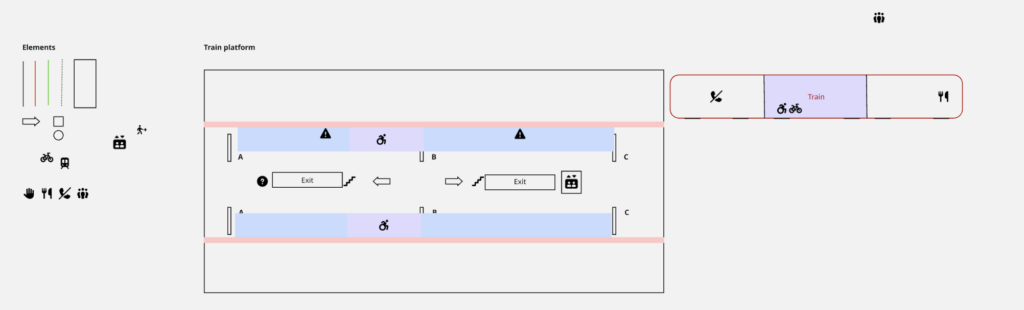
The second participant focused initially on differentiating train sections and communicating this information on both the train and the platform. Colored areas and icons were used for this purpose. Additional platform information, including stairs, elevators, walking directions, and information points, was also incorporated. Finally, safety markings were added along the platform edge to increase awareness of approaching trains. This participant made use of all provided design elements.
Participant 3
The third participant began by enriching the platform with informational icons. Particular attention was given to identifying different train entrances. Matching icons were then placed on both the train and the platform to establish a clear relationship between the two. This participant exclusively relied on icons and did not use colors or additional shapes.
Participant 4
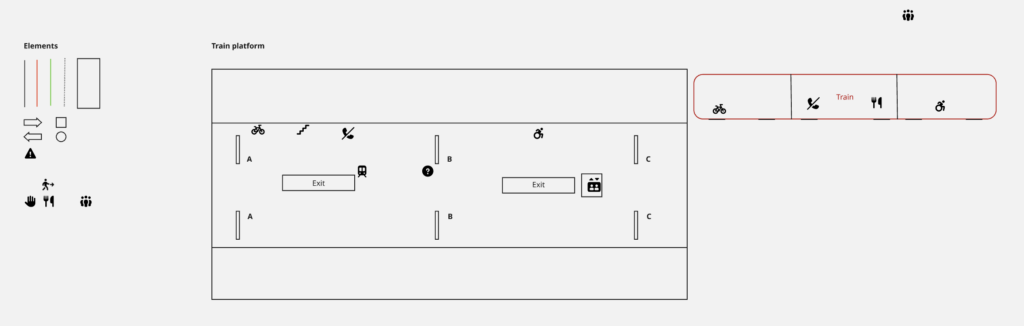
The fourth participant also started by adding icons to communicate information about sections, exits, and designated areas. To improve differentiation between information categories, colors were introduced. One icon was added to the train, although not all platform icons were mirrored on the train itself. This participant made use of all available element types.
Participant 5
The final participant added icons to indicate exits, meeting points, and train sections. Corresponding icons were then placed on the train. Additionally, this participant considered the distinction between first-class and second-class compartments and represented these areas through color coding, arrows, and platform markings. Similar to Participants 2 and 4, all available design elements were utilized.
Results and consideration
A comparison of the resulting interfaces reveals significant differences in design approaches. In particular, the use of colors and shapes varied substantially among participants, ranging from no use at all to extensive integration throughout the interface. Despite these differences, one design element remained remarkably consistent: the use of icons. All participants relied on icons to communicate important information and to establish connections between platform locations and train sections. Comparing the participant-generated designs with the initial concept created prior to testing also provided valuable insights. Interestingly, none of the participants considered indicating the train’s exact stopping position or its start and end locations on the platform. Similarly, no participant suggested dedicated boarding and alighting guidance systems. Some similarities emerged regarding the use of colored areas to distinguish train sections. Furthermore, the use of corresponding icons on both the platform and the train appeared consistently across several solutions.
These findings provide valuable indications of user priorities, reveal which design ideas appear intuitive to users, and identify areas where further validation is required.
Information Gathered
Overall, this testing phase contributed significantly to my understanding of how experienced train travelers perceive navigation and information systems within railway environments. The study demonstrated that users approach the same problem in diverse ways and often propose solutions that differ considerably from the designer’s initial assumptions. At the same time, recurring patterns emerged, particularly regarding the importance of clear visual information and the use of icons as navigational aids. These insights provide a strong foundation for future design decisions and further development of the concept.
Next Steps
Based on the findings of this study, the next phase will focus on refining the product vision and defining the intended solution more precisely. Additional research into the technical feasibility of the identified concepts will be conducted, followed by the development of a higher-fidelity prototype that incorporates the most promising findings from this testing phase.
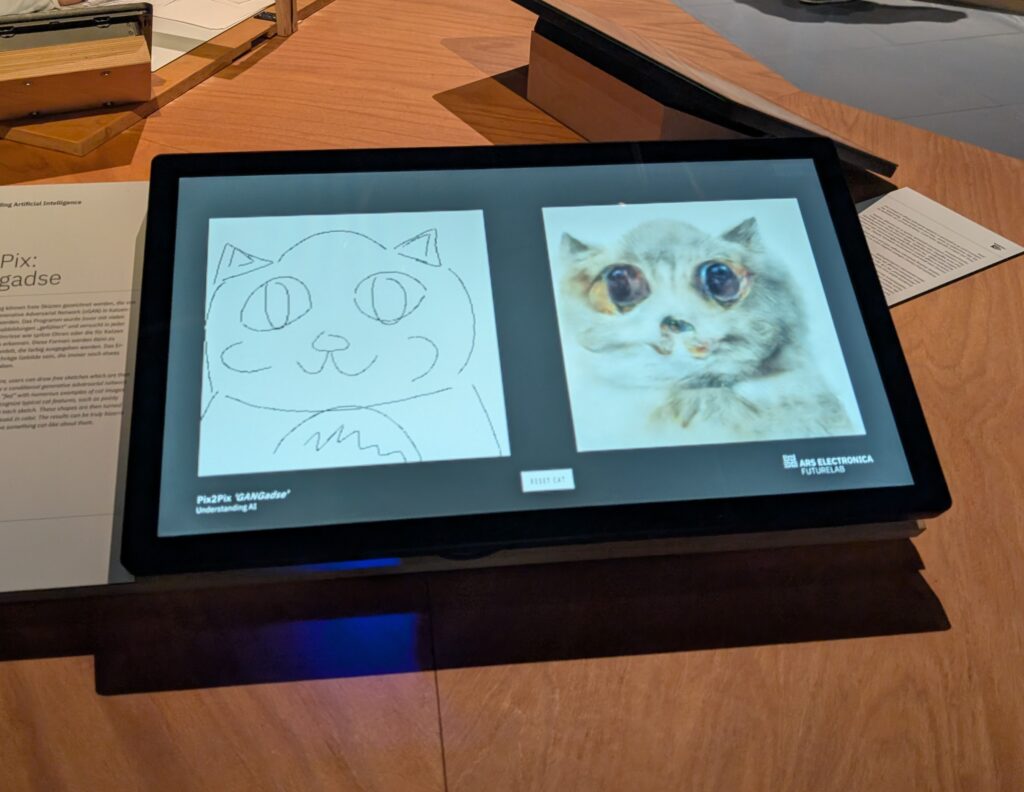
When I stood in front of the interactive screen at the Ars Electronica Center, there was one thing that sparked my interest immediately. The installation invites you to do something incredibly simple: pick up a digital pen, sketch a few lines, and watch a machine learning system immediately try to transform your doodles into a fully rendered, colorful cat. The piece plays on a popular piece of German internet slang for a cat, setting a lighthearted tone for what is actually an existential encounter with artificial intelligence. I drew a few shaky, anatomically questionable lines, and almost instantly, a furry, slightly cursed digital creature arose on the screen.
Beneath the humor of creating these accidental monsters lies a fascinating look into how modern generative AI interprets human input. The engine driving this transformation is an advanced neural network known as a Conditional Generative Adversarial Network. To understand how it brought my terrible drawings to life, I found it helpful to picture a high-stakes creative competition happening inside the computer. The system splits into two competing algorithms: a Generator and a Discriminator. The Generator acts like an art forger, starting with no knowledge of what a cat looks like and trying to create one from scratch. The Discriminator acts as a detective, comparing the forger’s creations against thousands of real cat photos it memorized during training. They push each other until the fake images become astonishingly detailed.
What makes this specific setup so fascinating to interact with is the conditional part of the tech, which is designed for image-to-image translation. In a standard setup, you press a button, and the AI spits out a random, perfect image. Here, the system is given a strict blueprint: a simple sketch. The Generator is forced to translate my exact lines, curves, and mistakes into the final image. It looks at the brushstrokes and figures out how to cram the textures of fur, whiskers, and shadows into the bizarre boundaries provided.
This translation process relies on the network’s ability to recognize spatial patterns. For my first attempt, captured in the image above, I tried to play along and drew a relatively standard, cartoonish cat face with big round eyes and pointed ears. Because the drawing roughly aligned with what the AI expected, it tried its best to map realistic textures over those specific regions. However, you can see how it over-interpreted the massive eyes I drew, filling them with an unsettlingly realistic, glossy depth that makes the final output look incredibly intense, yet undeniably feline.
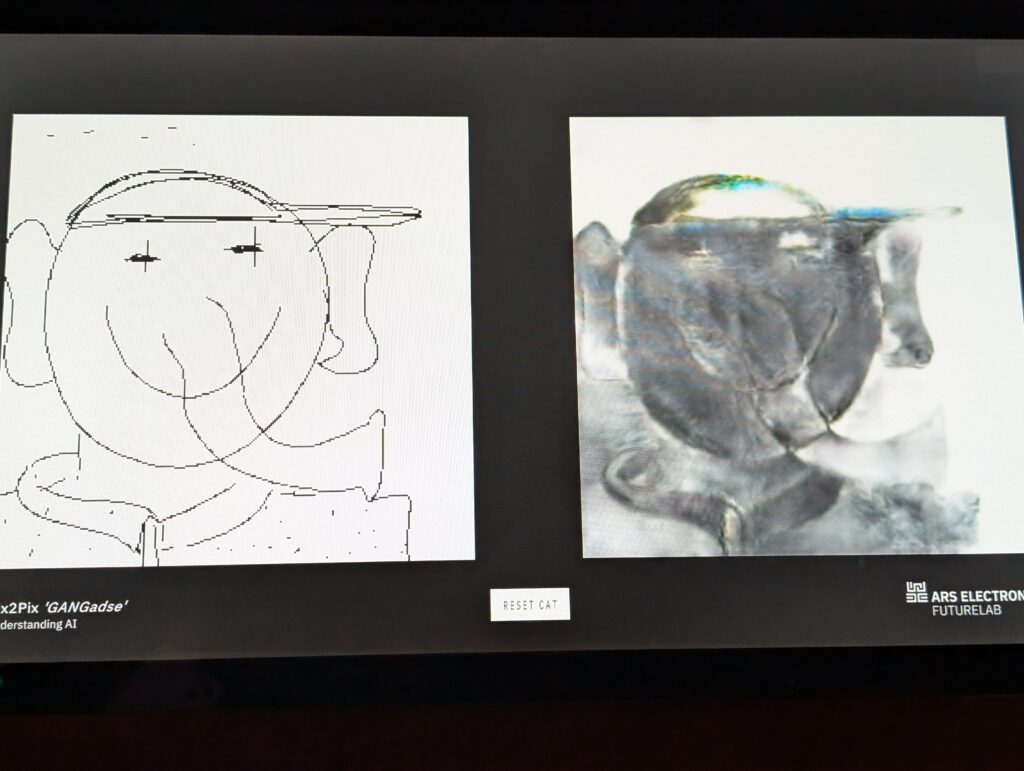
Because this network was trained exclusively on felines, it possesses a hilarious, stubborn blindness. It is completely incapable of seeing anything else. If you try to draw a house, a car, or something else entirely, the system will still desperately search your lines for pointy ears or whiskers, forcing cat attributes onto absolutely everything. I decided to test the absolute limits of this bias with my next drawing, which you can see in the image below. Instead of a cat, I drew a stylized character wearing a backwards cap, sporting giant elephant-like ears, and a long trunk-like shape on its face. The AI was completely unfazed by my lack of cooperation. It looked at the round head and the brim of the hat and somehow translated those shapes into a furry, shadowy texture, attempting to force the contours of an animal coat onto human streetwear.
This rigid worldview is exactly why the final drawings turn out so beautifully bizarre. The machine has no conceptual understanding of biology, anatomy, clothing, or what a living creature actually is; it only understands pixel statistics. When I drew an impossible, abstract shape, the network faithfully attempted to render photorealistic fur, depth, and organic lighting over my nonsensical geometry. The result was a surreal hybrid—a digital creature that looked like a cubist painting brought to life with organic textures.
Walking away from the screen, I realized the installation is a brilliant educational tool wrapped in a playful artistic experience. It peels back the layers of the mysterious AI black box and lets you see firsthand how these algorithms interpret, distort, and reconstruct our world. It left me thinking about a future where human-machine collaboration looks exactly like this: we provide the messy, creative spark through a simple sketch, and the machine handles the complex, data-driven task of rendering it into reality.
Nach der Produktion meines Werkstücks – einer etwa zweiminütigen Sportdokumentation – geht es nun in die Post-Production. Dafür müssen aber noch die häufigsten Merkmale von Sportdokumentationen herausgearbeitet werden, um diese auch mit in das Video einfließen lassen zu können.
Wie sich bereits in früheren Blogposts herauskristallisiert hat, sind Sportdokumentationen – egal, ob in voller Spielfilmlänge oder im Serienformat – in den vergangenen Jahren zu einem bedeutenden Bestandteil der medialen Sportberichterstattung geworden. Sie verbinden nicht nur dokumentarische Elemente mit dramaturgischen und vor allem auch emotionalen Stilmitteln, sondern stellen diese sportlichen Ereignisse zusammen mit den Athlet:innen, Teams und Entwicklungen einem breiten Publikum zur Verfügung. Dabei gibt es bestimmte Erkennungsmerkmale, die das Format „Sportdokumentation“ von fiktionalen Sportfilmen aber auch der klassischen Berichterstattung bzw. anderen Dokumentarfilmen unterscheidet. Charakteristisch sind insbesondere die Inszenierung von Spannung, eine starke emotionale Dramaturgie, die Personalisierung von Sportler:innen und die Verbindung von Informationen und Unterhaltung.
Inszenierung des Sports
Sportliche Ereignisse werden in Sportdokumentationen sowohl inszeniert und auch dramatisiert. Das ist eines der zentralen Merkmale dieses Formats. Die Sportart wird dabei nicht (nur) als Wettkampf dargestellt, sondern (auch) als eine Geschichte mit Höhe- und Tiefpunkten, Konflikten und Problemen und Wendungen. Oft orientiert sich die Dramaturgie in Sportdokumentationen auch an klassischen Erzählstrukturen mit einem Aufstieg, einer Krise und einem Triumph bzw. Erfolgserlebnis. Es gibt oft eine gezielte Kameraführung (variiert je nach Sportart), Musik und Schnitttechniken, die auch dazu dienen, die Emotionalität zu steigern und die Zuschauer:innen stärker und intensiver an die Ereignisse und die Sportart zu binden. Ein Beispiel dafür sind Zeitlupen, Nahaufnahmen oder dynamische Musik und Soundeffekte, die sportliche Leistungen, Erfolge oder Ereignisse heroischer bzw. in einem anderen Licht erscheinen lassen. Dadurch entsteht eine emotionale Dramatisierung, die über den Sport selbst hinausgeht.
Gleichzeitig haben Sportdokumentationen auch eine besondere visuelle Gestaltung. Ihre Bildsprache ist entscheidend für die Wirkung des gesamten Formats. Dazu gehören dynamische Kamerabewegungen, schnelle Schnitte oder spektakuläre Perspektiven. All das erzeugt beim Publikum ein Gefühl von Geschwindigkeit, Action und Intensität. Allein Sportübertragungen schaffen bereits eine eigene sogenannte „textuelle Realität“, die sich vom eigentlichen Sportereignis abhebt. Das wird bei Sportdokumentationen als eigenes Format noch zusätzlich verstärkt. Durch ihre Inszenierung wird der Sport gleichzeitig zu einem Unterhaltungsformat. Sportdokumentationen nutzen diese visuellen Mittel gezielt, um Spannung zu erzeugen und emotionale Ereignisse hervorzuheben und zu verstärken. Dabei werden häufig auch Interviews mit Originalaufnahmen und Archivmaterial kombiniert. So verschmelzen Authentizität und Inszenierung miteinander.
Diese Verschmelzung zwischen Inszenierung und Authentizität ist ein weiteres Merkmal von Sportdokumentationen. Das Format ist stark bearbeitet und absichtlich dramaturgisch gestaltet. Trotzdem vermitteln Sportdokumentationen einen Eindruck bzw. ein Gefühl von Realität, Unmittelbarkeit und Menschlichkeit. Dazu verhelfen vor allem exklusive Einblicke hinter die Kulissen, persönliche Interviews oder Originalkommentare aus Wettbewerben. Sportdokumentationen balancieren zwischen dieser dokumentarischen Authentizität und einer kommerziellen Unterhaltung, um reale Ereignisse mit emotionalen, dramaturgischen Erzählstrukturen zu verknüpfen. Allerdings besteht immer die Gefahr, dass gesellschaftliche oder politische Aspekte einer Sportart zugunsten dieser konsum- und unterhaltungsorientierten Perspektive vernachlässigt werden.
Personalisierung von Athlet:innen
Ein weiteres Erkennungsmerkmal von Sportdokumentationen ist die Personalisierung der Athlet:innen. Das Format konzentriert sich häufig auf eine bzw. mehrere Personen, die diesen Sport ausüben. Oft stehen auch ganze Mannschaften oder Teams im Rampenlicht. Sie alle haben eins gemeinsam: Sie erzählen ihre persönlichen Geschichten. Dadurch erscheint der Sport viel individualisierter, zugänglicher, nahbarer und emotionaler. Zuschauer:innen identifizieren sich mehr mit den Personen hinter dem Sport als nur mit den sportlichen Abläufen davon. Dadurch wird gleichzeitig auch mehr Aufmerksamkeit auf den Sport gelenkt und aber auch zunehmend Unterhaltungselemente integriert. Persönliche Geschichten, Einblicke und Hintergründe sowie emotionale Interviews verstärken die Nähe zwischen Publikum und Sportler:innen, die sonst so unnahbar wirken. Es macht sie menschlicher. Gleichzeitig werden die Athlet:innen zu medialen Figuren, fast schon Schauspieler:innen, deren persönliche Entwicklung genauso wichtig wird, wie deren sportliche Leistungen.
Infotainment
Ein weiteres Merkmal des Formats ist die Verbindung von Informationen und Unterhaltung – das sogenannte Infotainment. Sportdokumentationen sind eine Mischung aus Informationsvermittlung über den Sport und eine Form der Unterhaltung. Einerseits liefern sie Hintergründe, historische Entwicklungen oder erklären gesellschaftliche Zusammenhänge. Andererseits stehen vermehrt Unterhaltung, Emotionalisierung und Inszenierung im Vordergrund. Die Grenze zwischen journalistischen Dokumentationen und medialer Inszenierung verschwimmt zunehmend. Besonders populärere Sportdokumentationen konzentrieren sich verstärkt auf spektakuläre Geschichten und (emotionale) Konflikte als auf eine kritische, wissenschaftliche Analyse des Sports.
Sportdokumentationen nutzen diese Spannungen und Konflikte gezielt aus. Dabei kann es sich um verschiedenste Dinge handeln: Rivalitäten zwischen Sportler:innen oder Mannschaften, Niederlagen, Verletzungen oder persönliche Krisen. Diese werden oft ausführlicher dargestellt, so dass ein späteres Erfolgserlebnis umso mehr und stärker wirkt. Sportdokumentationen werden vermehrt zu einem Trend der Streamingkultur, in der solche emotionalen Geschichten oder persönliche Konflikte eine viel zentralere Rolle spielen. Ein gutes und oft angeführtes Beispiel in dieser Blogbeitragsserie, ist „Drive to Survive“.
Gleichzeitig bieten Sportdokumentationen auch einen Einblick in gesellschaftliche Werte und kulturelle Vorstellungen. Der Sport selbst dient oft als Symbol für Leistungsbereitschaft oder Disziplin. Außerdem wird er als nationale Identität dargestellt (siehe beispielsweise die Fußball-WM 2026). Das wird durch Inszenierungen oder das Infotainment noch zusätzlich verstärkt. Sportereignisse bilden oft eine Art Ritual für Menschen und ermöglichen gesellschaftliche Identifikationen. Besonders durch internationale Ereignisse wie die Olympischen Spiele oder Weltmeisterschaften (wieder: Fußball-WM 2026) wird die Nationalität und Kultur verstärkt dargestellt und inszeniert. Dadurch übernehmen Sportdokumentationen nicht nur eine unterhaltende Funktion, sondern haben auch einen prägenden Einfluss auf die Gesellschaft.
Fazit
Zusammenfassend lässt sich sagen, dass die Inszenierung, die Personalisierung und die Verbindung aus Information und Unterhaltung die zentralen Erkennungsmerkmale von Sportdokumentationen bilden. Auch die Dramatisierung und Emotionalisierung, sowohl das Bieten von gesellschaftlicher, kultureller oder nationaler Identifikation bilden dabei wichtige Punkte. Sportdokumentationen erschaffen eine andere mediale Realität, die Inszenierung eng mit Authentizität verbindet. Durch das Zunehmen von Streamingplattformen und der Serienkultur wird die Popularität des Formats wahrscheinlich weiterhin zunehmen. Gleichzeitig gewinnt es so neue Erzähl- und Darstellungsformen, die von der reinen Informationsverbreitung und Berichterstattung abweichen und sich zu einem eigenen Genre entwickelt.
In meinem Werkstück sollen einige dieser Merkmale – zusammen mit denen einer One-Shot-Production – verbunden werden und einfließen.
Dieser Text basiert auf Literaturvorschlägen von Perplexity pro und wurde von ChatGPT korrigiert. Alle Inhalte wurden von mir selbst auf Richtigkeit und Relevanz überprüft und der Text selbst wurde von mir erstellt. Das Literaturverzeichnis wurde von ChatGPT erstellt.
Activities must accommodate different physical abilities and fitness levels.
Multiple participation roles should exist beyond throwing, catching, or running.
Exercises should allow adjustable intensity and difficulty.
Social Accessibility
The game should minimize situations where students feel exposed or judged.
Collaborative mechanics should ensure every student can contribute meaningfully.
Group structures should avoid exclusion and fixed hierarchies.
Cognitive Accessibility
Rules and objectives should be easy to understand.
Instructions should be visual, verbal, and simple.
Activities should allow flexibility for different learning speeds.
Emotional Accessibility
The environment should reduce performance pressure and fear of failure.
Positive reinforcement and shared success should be emphasized.
Students should feel psychologically safe participating.
Teacher Accessibility
The system should be adaptable to different school contexts and resources. Preparation time should remain low. Materials should be intuitive and easy to implement in large groups.
Potential Barriers
Student-Related Barriers
Fear of embarrassment or failure
Existing negative experiences with sports
Social anxiety or low self-confidence
Physical disabilities or varying motor skill levels
Teacher-Related Barriers
Limited preparation time
Large class sizes
Lack of training in inclusive PE methods
Resistance to changing traditional PE structures
School-Related Barriers
Limited budget for materials or training
Fixed curricula and time constraints
Limited gym space or equipment availability
Social & Cultural Barriers
Strong focus on competition in sports culture
Stereotypes about athletic ability
Peer pressure and social comparison among students
Technical / Product Barriers
Overly complicated game rules
Lack of adaptability for different age groups
Insufficient guidance or onboarding for teachers
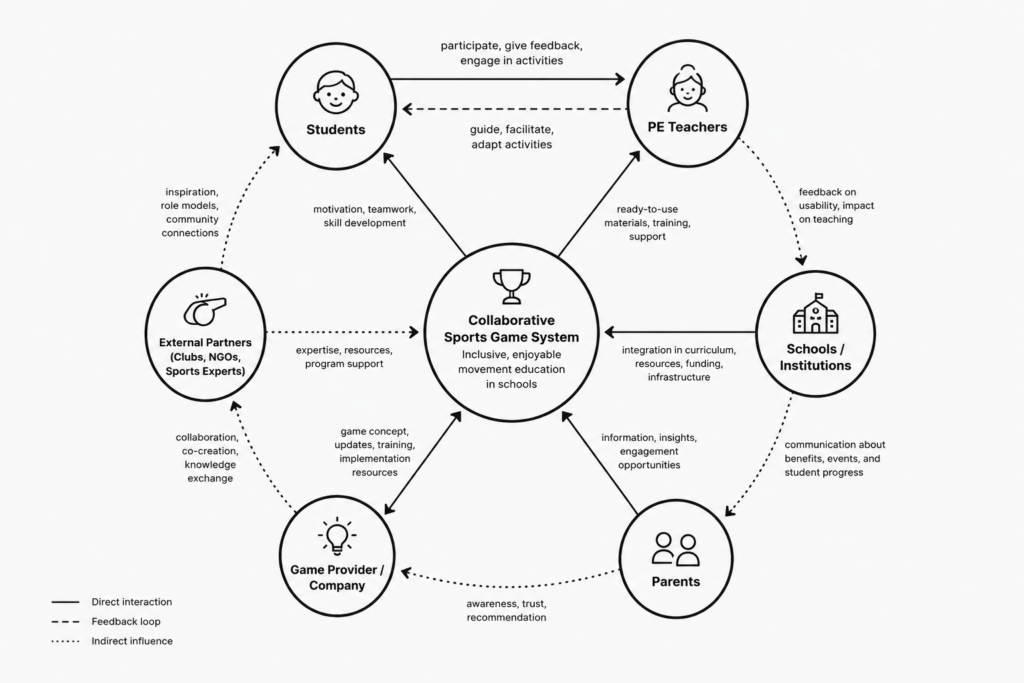
System Map
For the system map I identified the main stakeholders and their relationships. I then put my notes and findings into ChatGPT to create an image that shows how they are related in a graphic way.