Continuing my research on the topic of “Slowness”from last semester, I will be doing further work on this topic as part of the Design & Research II course with Birgit Bachler PhD.
For the final assignment, I will need to record a 2-minute video of the final prototype — in my case, I plan to use prototyping in Figma, which each of you will be able to test. The research will again focus more on contextual analysis, as well as user testing, bibliography, and heuristic evaluation.
Psychogeography and Dérive 🧠
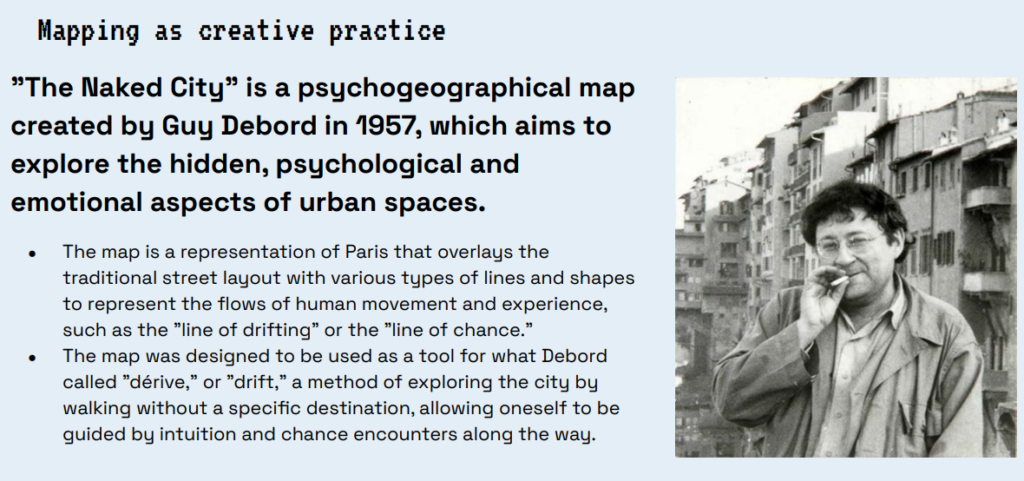
One of the ideas that fits my project particularly well is psychogeography. Simply put, psychogeography explores how a city influences our emotions, moods, and behavior. It’s not just about streets and buildings, but about how we experience space as we move through it. In the PDF [1], this topic is introduced through Guy Debord and his work “The Naked City“[2]. It is described as a psychogeographic map that reveals not a conventional map of Paris, but the hidden psychological and emotional connections between urban fragments.
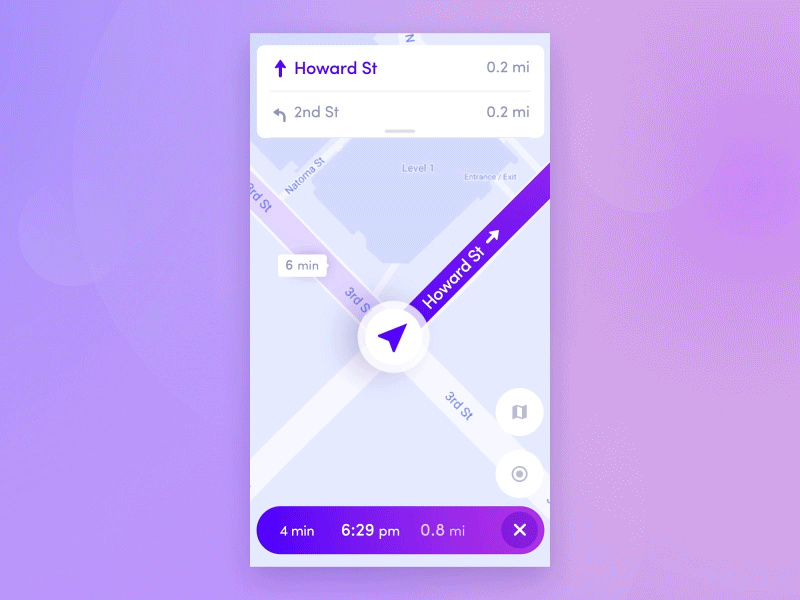
This is a very important shift for my project. Conventional navigation revolves around point A and point B. The user enters an address, the app calculates the route, and that’s it. But psychogeography offers a different way of looking at the city: not as a problem to be solved, but as an environment to be explored.
This is closer to my question: can navigation be not only efficient, but also more mindful, personal, and slow?
This is related to the concept of dérive, or drift [3]. In the presentation, dérive is explained as a method of exploring the city through unplanned, almost aimless wandering. A person does not follow a strictly predetermined route, but instead allows themselves to respond to the atmosphere of the place, random turns, their mood, and unexpected encounters. Debord described dérive as a practice distinct from an ordinary walk because it involves paying attention to the city’s psychogeographical effects and atmospheres.
I don’t want to literally turn the app into a chaotic, aimless wander. But I’m interested in adopting the very principle of dérive: a route can be not only functional but also open-ended. For example, the app could offer not just one “correct” path, but several options: a calm route, a curious route, a green route, or a social route. The user is still moving toward a destination, but the path becomes more flexible and dynamic.
It also helps me take a critical look at modern maps. Many apps try to eliminate uncertainty: turn right, walk 200 meters, and you’ll arrive in 6 minutes. On the one hand, this is convenient. On the other hand, people stop noticing the city around them. They look at the screen instead of their surroundings. In my project, I want to try to bring some of that attention back to the user.
For the prototype, this could take the form of a specific feature. For example, “Explore Mode” might occasionally suggest a slight detour from the route: walking through a park, taking a quieter street, choosing a route with interesting architecture, or making a short stop. It’s important that this isn’t forced, but feels like an invitation.
In this way, psychogeography and dérive help me formulate the foundation of the project: slow navigation isn’t just about “walking longer.” It’s a way to design a route so that a person not only reaches their destination, but also feels, notices, and remembers something along the way.
Sources 🛈
[1] Bachler, B. Intro to Information Design – Session 5: Commuting Cartographies. FH JOANNEUM, 2025.
After creating the three prototypes which I described in the last article, I reflected on which direction I wanted to go. The app about light pollution reporting is what interests me the most because I believe that it is the solution that could reach a broader audience out of the three.
My colleague Ahmed Turk and I started working on the light pollution reporting app for our App Design course. In the research phase, I realised that this app would fall under a niche. The risk that comes with it is low popularity and engagement. I decided to research gamification because I see it as a possible solution to this issue.
My research was based on three applications I have installed on my phone and that I used as a reference when designing: iNaturalist, Duolingo and Strava. iNaturalist is a citizen science application for reporting animal and plant species, while Duolingo is for language learning and Strava for fitness tracking. I decided to include the last two in my research because I believe that they have strong gamified features that I could use as an example.
In the following annotated bibliography you can see a summary and my review of the papers.
Howard, L., van Rees, C. B., Dahlquist, Z., Luikart, G., & Hand, B. K. (2022). A review of invasive species reporting apps for citizen science and opportunities for innovation. NeoBiota, 71, 165-188. https://neobiota.pensoft.net/article/79597/
The authors analysed the efficacy of existing apps to report invasive species.
These apps are based on citizen science, meaning that they rely on users to report data about the environment they are in. Although smartphones have largely enhanced the capability to monitor invasive species, existing apps do not make use of all known functionalities that could maximise their efficacy. User engagement is limited due to the lack of gamification and social media sharing options, which would encourage frequent and prolonged usage.
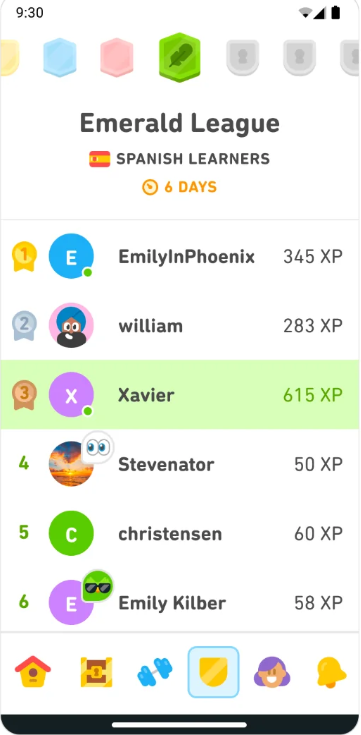
The introduction of a leaderboard would be a competitive element that encourages users to send data about a specific area that needs more coverage. Leaderboards, reward systems, Badges and ranks could motivate users to send reports regularly.
There are some other features that would improve engagement. Apps are not taking advantage of modern smartphone sensors such as thermometer, altimeter and barometer. Also, they are often not using machine learning and AI to verify or flag reports, which would save time and human resources. Moreover, in many cases offline saving of reports is not possible, making it hard for users to cover certain areas.
The reason why these features are not implemented is the lack of funding for design and development. The authors suggest the creation of open-source code or templates to spread quality and innovation and reduce costs.
This paper was crucial in understanding that citizen science apps struggle to keep their users motivated and engaged in the long-term. It made me realise that my project should feature a gamified design and social media sharing options to improve engagement. The exact gamified features are yet to be explored.
This paper explores the impact of Duolingo’s gamified design on user engagement and motivation, focusing on emotional responses.
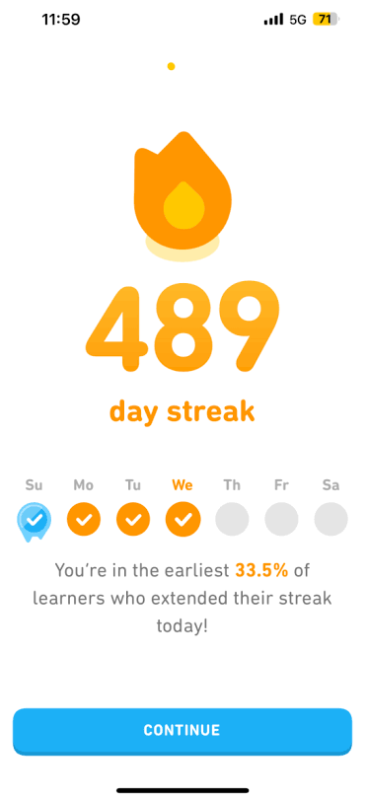
The encouragement mechanisms analysed were the streak, the leaderboard, the achievement system, the friend system, treasure boxes, daily tasks and double XP. While streaks are an effective method to keep users on the app daily, they can cause psychological stress. The “streak freeze” can relieve these feelings. The leaderboard causes mixed feelings: on one side, the competition motivates people to learn more and increase their points, on the other side a drop in rankings can cause loss of motivation and even an interruption in the daily usage of the app. The achievement system fails in its intention to motivate users because it is not seen or understood by most of them. The friend system succeeds in motivating users, creating a feeling of social responsibility. The treasure boxes also have a good impact because they spark curiosity. Daily tasks give users the positive feeling of making progress, but they can turn into stress factors when the tasks are not completed. Double XP (experience points) also generates mixed feelings: users can make progress more quickly, but the time limit causes stress.
The penalty mechanisms analysed were the life point limitation and the forced repetition. While the heart system made users more focused and careful, it also caused anxiety and finally frustration when it came to gaining hearts back by watching ads. While repetition helps with memory retention, the fact that it is forced feels like a punishment, therefore users should have the freedom to avoid it.
In conclusion, while Duolingo’s encouragement mechanisms successfully motivate users to learn regularly, they can cause feelings of stress and anxiety. Especially penalty mechanisms can reduce motivation.
The paper is outdated, in fact some issues such as the hearts have already been fixed. As a user of the app, I can confirm that the encouragement mechanisms cause me stress and even lead me to avoid opening the app. This happens especially when I receive notifications with a negative tone after skipping a day.
While Duolingo focuses on learning and often uses pushy and passive aggressive tones, I can still draw inspiration from its gamified design to keep the users of my application engaged. The paper could serve me as a guide to create more user-centered learning mechanisms that take emotions into account.
This paper analyses how gamification elements on the fitness app Strava influence runners’ behaviour, focusing on motivation, perceived social pressure, engagement, continued use and the activation of premium features.
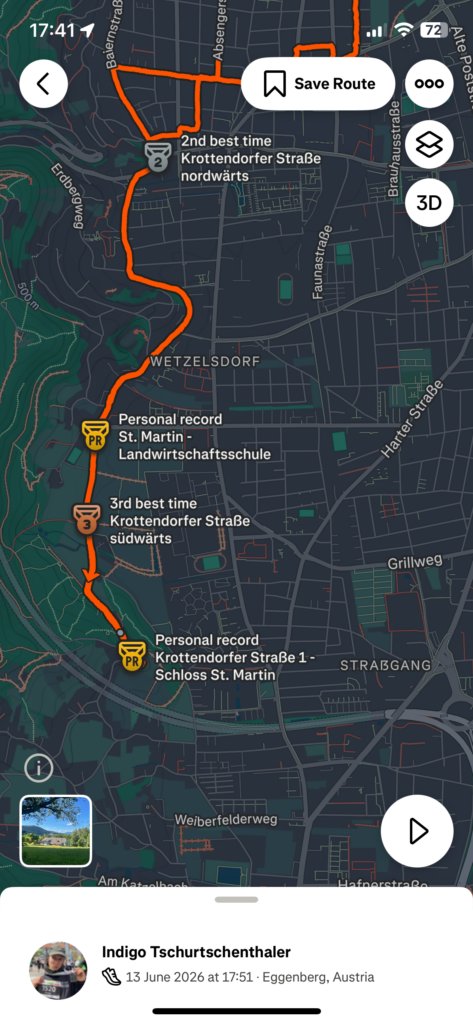
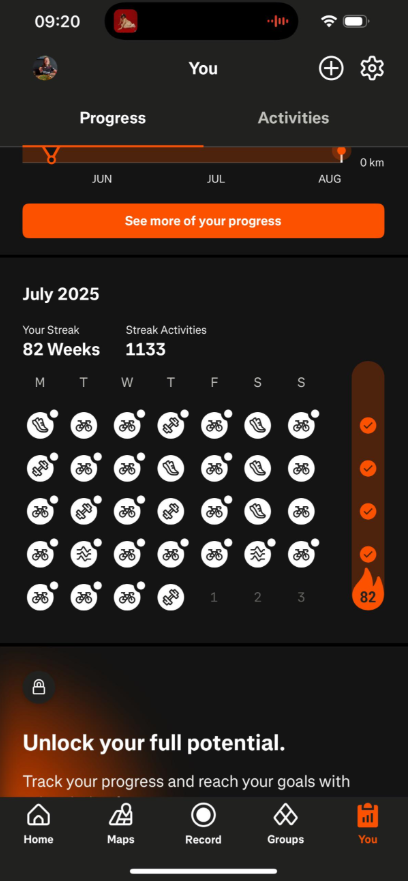
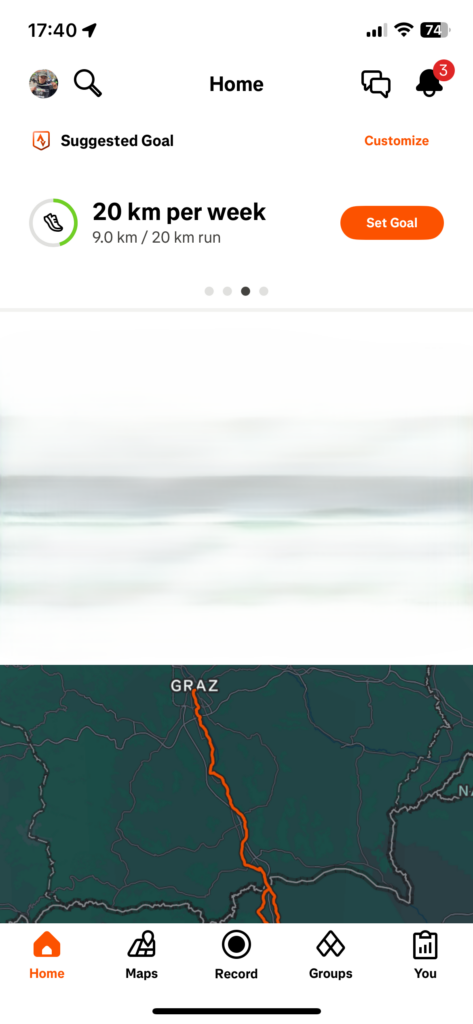
The gamification elements Strava uses are challenges, leaderboards, segment rankings and progress visualisations. It was found that gamification elements increase user motivation, leading to higher engagement on the platform. Features like optional challenges and individual goal setting are customisable, do not force participation and therefore promote autonomy. Visible progress indicators, performance feedback and personal achievements create a positive feeling of competence, while social interactions like kudos or comments are associated with higher perceived social connectedness. It can be said that the app supportings intrinsic motivational processes rather than relying on external pressure.
Higher engagements translate to an increased willingness to use premium features. The reason for this is that users perceive physical activity as self-determined and meaningful. Therefore, gamification is not directly linked to the adoption of premium features, but by encouraging users to regularly log their activity on Strava, the app becomes a part of one’s training routine.
Competitive elements and social comparison features did not have a negative impact on users and did not affect their engagement through perceived social pressure. This happens because social pressure is a highly individual experience. Feelings associated with comparison are usually temporary and are not sufficient to reduce engagement over time.
MedalsStreaksWeekly goals
In conclusion, Strava operates primarily through motivational mechanisms rather than social pressure and comparison.
In my opinion, Strava represents a healthier way to integrate gamification and increase engagement, because it relies on personal motivation rather than external pressure. I believe that pressure-free motivation and customisable goals are positive examples of gamification that I could include in my app.
Kuure, O., Kähkönen, K., & Hekkala, R. (2026). The Impact of Social Features and Application Design on User Behavior and Long-Term Engagement of Strava Users. Proceedings of the 59th Hawaii International Conference on System Sciences, Article 453, 1-10. https://scholarspace.manoa.hawaii.edu/items/c9eea53a-eddb-4a62-9429-16c8b005c1ac
This paper explores how Strava users interact with its social features and how its design and functionalities affect user engagement.
It was found that sharing activities with peers motivates users to exercise and engage more with the application. At the same time, some users feel insecure and curate their feed by selecting which activities to display, in order to maintain a positive social image.
Strava users downloaded the app or switched to it from other platforms because they value the sense of community it gives them. Group features are highly appreciated. Yet, a big network results in a cluttered feed. This makes some users feel stressed out, reducing their motivation to post activities.
Everyone stays on Strava because they appreciate a different feature. A large amount of features may cater to everyone’s needs, but some users feel overwhelmed by them and prefer quality over quantity.
All in all, users look forward to logging activities because they feel motivated when their peers interact with their logs. All this engagement creates a sense of loyalty that makes it so that the app becomes a part of the users’ fitness routine.
It was mentioned in this paper that the surveyed population may not represent the total of Strava users and I agree with it. The interviewed persons already use Strava various times a week. I think the results would be different if people new to fitness had participated. In my opinion this difference is relevant when studying how to cater to a new target group. Nevertheless, the paper helped me understand the role social media features can have in apps and I think my project should include this functionality.
After finding these papers, we did another research activity with Dr. Ursula Lagger. The session with her helped me to improve my research strategy and I was able to find more interesting papers.
I first described my topic to Gemini and asked it for keywords for my research. It recommended these:
Citizen Science Data Quality: To study how apps like iNaturalist structure data so scientists can trust and verify it.
Gamification for Behavior Change: To find frameworks for keeping users engaged in environmental apps over time.
Mobile AR Science Education: To research how to design effective augmented reality tools for teaching astronomy and light pollution.
Civic Tech & E-Participation: To understand how apps can successfully connect citizens to local government and petitions.
Artificial Light at Night (ALAN): The standard scientific term used in research papers for light pollution.
Kyba, C. C. M., Wagner, J. M., Kuechly, H. U., Cavazzani, S., Zamorano, J., Hänel, A., … & Hölker, F. (2013). Citizen science provides valuable data for monitoring global sky glow change. Scientific Reports, 3(1), 1835. https://doi.org/10.1038/srep01835
Kyba, C. C. M., & Hölker, F. (2013).Loss of the night: A citizen science project for monitoring skyglow. GFZ German Research Centre for Geosciences. https://doi.org/10.2312/GFZ.b103-13054
Bauer, B. (2020).Exploring the impact of artificial light at night (ALAN) through citizen science initiatives. University of Vienna.
B. Citizen Science Data Quality & Structure
Kosmala, M., Wiggins, A., Swanson, A., & Simmons, B. (2016). Assessing data quality in citizen science. Frontiers in Ecology and the Environment, 14(10), 551-560. https://doi.org/10.1002/fee.1436
Balázs, B., Mooney, P., & Novak, J. (2021). Data quality and validation protocols in crowdsourced environmental monitoring. In Citizen Science: Innovation in Open Science, Society and Policy (pp. 139-157). UCL Press. https://doi.org/10.1007/978-3-030-58278-4_8
C. Gamification & Civic Engagement
Thiel, S.-K. (2016). A review of introducing game elements to e-participation. Proceedings of the Innovation Systems Conference (AIT), 1-9.
Sailer, M., Hense, J. U., Mayr, S. K., & Mandl, H. (2017). How gamification motivates: An experimental study of the effects of specific game design elements on psychological need satisfaction. Computers in Human Behavior, 69, 371-380. https://doi.org/10.1016/j.chb.2016.12.033
Bowser, A., Hansen, D., & Preece, J. (2025). Gamifying citizen science: Long-term engagement and behavior change in biodiversity apps. Biological Conservation, 301, 111001. https://doi.org/10.1016/j.biocon.2025.111001
Sirakaya, M., & Alsancak Sirakaya, D. (2022). Augmented reality in science education: An analysis of design features and learning outcomes. Journal of Science Education and Technology, 31(1), 45-61.
My last blogpost was quite a while ago, after the one-on-one session. For the last few weeks, I have been postponing my user research task. It turns out that I’m more introvert than I thought I would be. My initial goal was to speak to people on the public transport and ask them if they would like to play a game with me. I already knew that I am normally not that comfortable talking to strangers, especially when I must make the first move, but it turns out that it’s very hard to convince myself to walk up to someone. Especially when I have no specific reason for it other than playing a game on a 10-minute tram ride (or even shorter, depending on when the person would have to get off). I started questioning why that was the case, because I think if I really wanted to, I could easily get myself to talk to people. I think what actually makes me curious is people and their stories, not playing games with them, even though I realize that this might be a good conversation starter.
I love sitting in public spaces like cafés or squares, or on the public transport and just observing people. It’s interesting to me how they walk, how they behave, how they dress and talk to other people, the conversations they have, the emotions on their faces and their thoughts. I love making up my own story about them in my head. This led me to start exploring the act of observation more deeply. What makes observation so fascinating? How does it affect you when you’re being observed? Is observation always purely neutral? Can observation be a form of interaction?
Observing as passive social interaction
Social interaction not always consists of only conversations. A big part of it is also what is not being said, the looks, body language, the vibes someone gives off. Sometimes nothing is being said at all, but you can still feel the atmosphere in a room. Observing also plays a role in this: feeling observed can change the vibe of a situation a lot. As soon as the person being observed realizes they are being watched, one of the following passive interactions takes place: either the person feels a sense of sympathy for their observer, makes brief eye contact and smiles, and after repeated eye contact, a conversation may even ensue, or the person feels uncomfortable being watched, which becomes apparent through their gaze or by looking away. Often, the person’s body language also changes, signalling a clear sense of discomfort. Ideally, this indirect communication leads to the observation being discontinued. If the signals are not correctly recognized or are ignored by the other person, the last resort is often to leave the situation. I occasionally observe such interactions and have noticed that they usually occur without any verbal exchange. Sometimes it feels okay to be observed, sometimes it can even feel good, but it can also make you feel uncomfortable.
The dynamic between the observer and the observed can create a power imbalance, since the observed person is initially at the mercy of the observer if they have no way to shield themselves from being watched. Women, in particular, can find themselves in dangerous or extremely uncomfortable situations as a result, some of which are not easy to escape. I’d like to write more about this dynamic in one of my upcoming blog posts.
Being observed vs. being unobserved
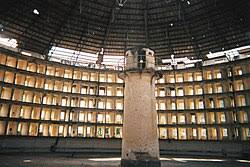
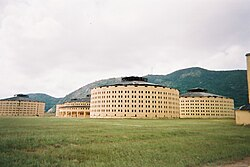
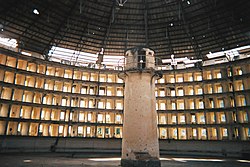
Another interesting aspect is how people behave when they feel like they are not being observed. They might feel more at peace with themselves because they don’t need to perform for anyone. They might even do something that goes against certain social conventions. On the other side of that is what happens when someone is constantly observed. It can put a lot of pressure on somebody. A very drastic example that comes to my mind is the Panopticon, an architectural concept for prisons or factories that are built in a way that all the inmates / workers can be observed at any time. The building is circular and has a tower in the centre, from where all the prison cells could be watched. The backlighting makes it easy for the observer to see all the inmates while the observer stays hidden in the dark tower, so the inmates never know if they are currently being watched or not. Jeremy Bentham, a philosopher and founder of Utilitarianism, who invented the concept, assumed that this would make the inmates behave in a more disciplined way, as if they were constantly being watched. Several prisons were built based on this model, including some in Germany and the Presidio Modelo on Isla de la Juventud in Cuba.
1) Panopticon observation tower, Presidio Modelo, Kuba2) Presidio Modelo, Isla de la Juventud, Kuba
I found further information on Wikipedia on how the Panopticon concept was reflected on by other philosophers. The philosopher Foucault described the Panopticon as a central concept of the Western liberal world and its surveillance society. Building on this, Zygmunt Bauman presents the Panopticon as a symbol of territorial power and transposes it into the postmodern era, in which power is slowly being redistributed and shifting into the digital world, namely the Internet and smartphones, and refers to this phenomenon as “post-panoptic.” In the 2000s, information theorist Branden Hookway further developed the concept of the Panopticon into that of the Panspectron, in which there is no longer a predefined object to be monitored, but rather everything and everyone is monitored. Only in hindsight is the object defined by a specific question. [1] I think this is a very fitting description of the internet, where everyone is constantly being watched.
As I was reflecting on the act of observation, this very phenomenon of constant surveillance in our digital age also came to mind. I remember an exhibition during International Design Week at FH Joanneum where visitors could submit screenshots of the apps installed on their smartphones, and an AI then compiled personal data about them based on the installed apps. It was fascinating how much the AI could deduce based on the combination of apps – even though it had no access to the data within the apps themselves, only to which apps were on the phone. It was able to draw conclusions about a person’s age, place of residence, living circumstances, and interests. When you consider the data that is collected and processed on social media, for example, it’s hard to even imagine how accurate a picture of a person could be painted based on that data and what consequences this knowledge could have. This could become very dangerous for certain groups of people if the political situation were to change drastically. Even right now it is interesting to see how different people perceive the collection of their data, ranging from indifference to concern.
On top of that, it’s not only more or less abstract data about people that’s being collected. The rapid development of smart glasses means that, in the future, you can never be sure whether you’re being watched (= recorded) or not. These glasses are already barely distinguishable from conventional glasses. Once they become more widespread, this could lead to a Panopticon-like state of constant potential observation. This raises the question of how this will affect our society in the long term and whether there will be ways to protect ourselves against it. I think the feeling of being constantly monitored could cause a great deal of stress and anxiety.
An interesting question might be how people could be made more aware of this issue and what role design could play in this process.
Conclusion
I found it very interesting to shift the focus from active social interaction to passive social interaction, since this form of interaction is often overlooked. I’d like to learn more about social presence, since I only touched on this aspect briefly during the research for this blog post and don’t yet have a deeper understanding of it. I also found the digression on the feeling of being watched and the feeling of constant surveillance, as an extreme, to be very promising. I might do more research on how the inmates of the prison in Cuba, which was built on the model of the Panopticon, were impacted by the architecture. Maybe this provides some insights on the impact of digital observation.
When I looked up the term “unbeobachtet” to check whether I had translated it correctly, I came across the translation ‘unnoticed’ in addition to “unobserved.” This led me to wonder how observation relates to being seen or noticed.
Note
Parts of this text were translated from German to English by Deepl.com.
Continuing my research on the topic of “Slowness”from last semester, I will be doing further work on this topic as part of the Design & Research II course with Birgit Bachler PhD.
For the final assignment, I will need to record a 2-minute video of the final prototype — in my case, I plan to use prototyping in Figma, which each of you will be able to test. The research will again focus more on contextual analysis, as well as user testing, bibliography, and heuristic evaluation.
Information design, maps and my app 🗺️
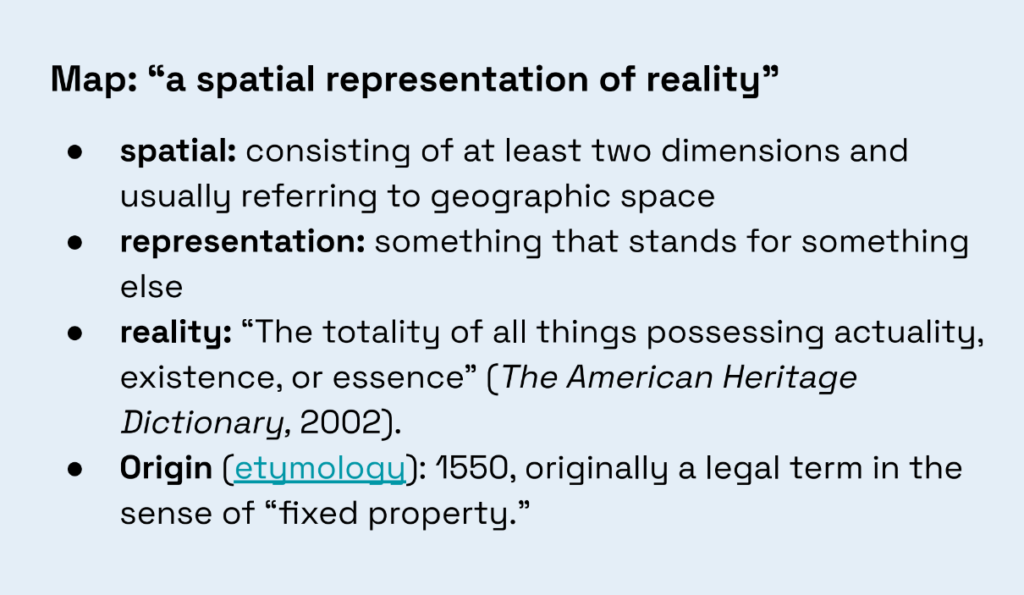
In this post, I want to connect my project to the topic of information design and to material from the “Commuting Cartographies” class. I found this PDF [1] very useful because it shows maps not just as a tool for finding your way, but as a way to understand, interpret, and even change our perception of the city. In the presentation, a map is defined as “a spatial representation of reality.” But another idea is particularly important for my project: maps don’t just show the world- they shape it.
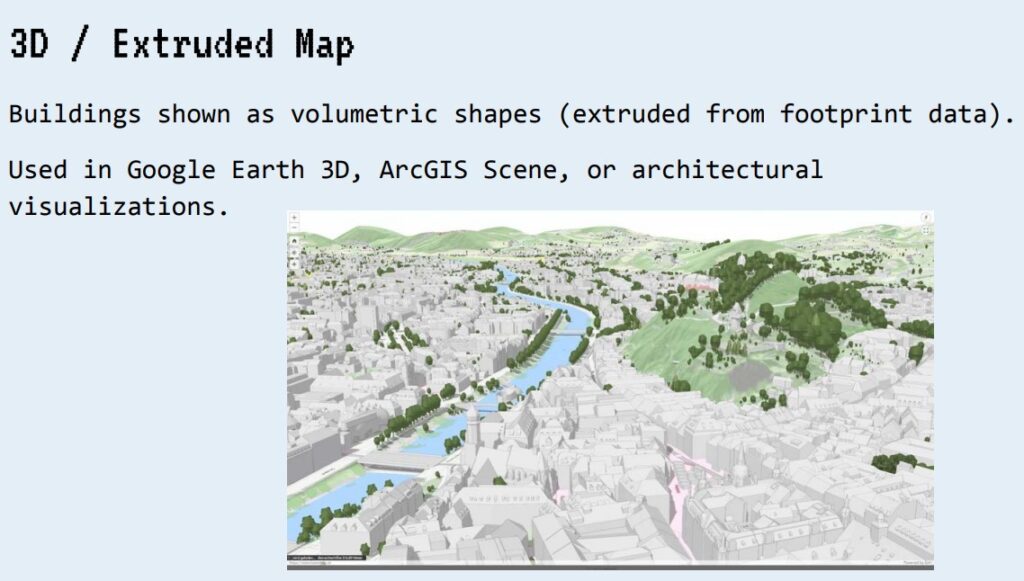
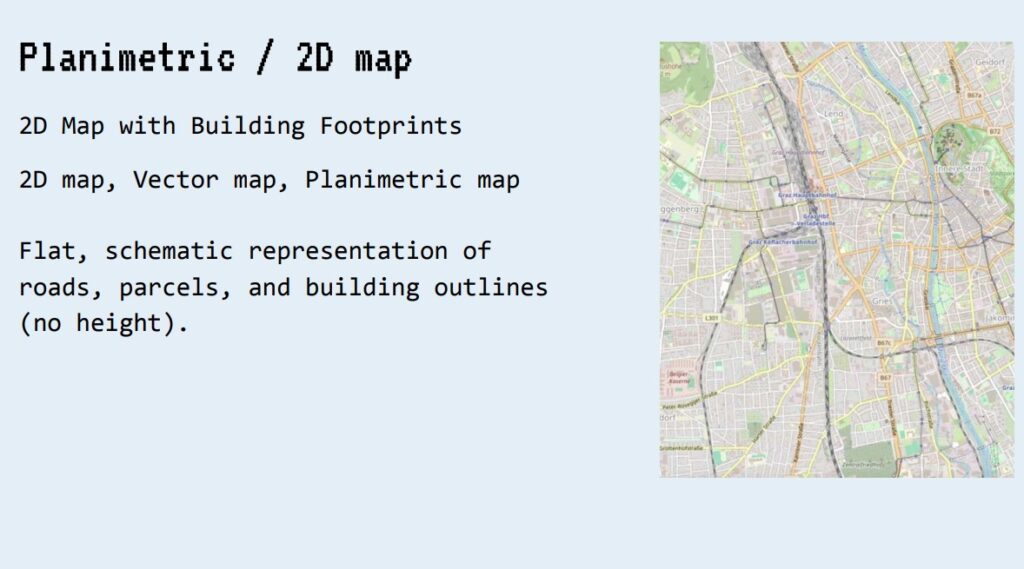
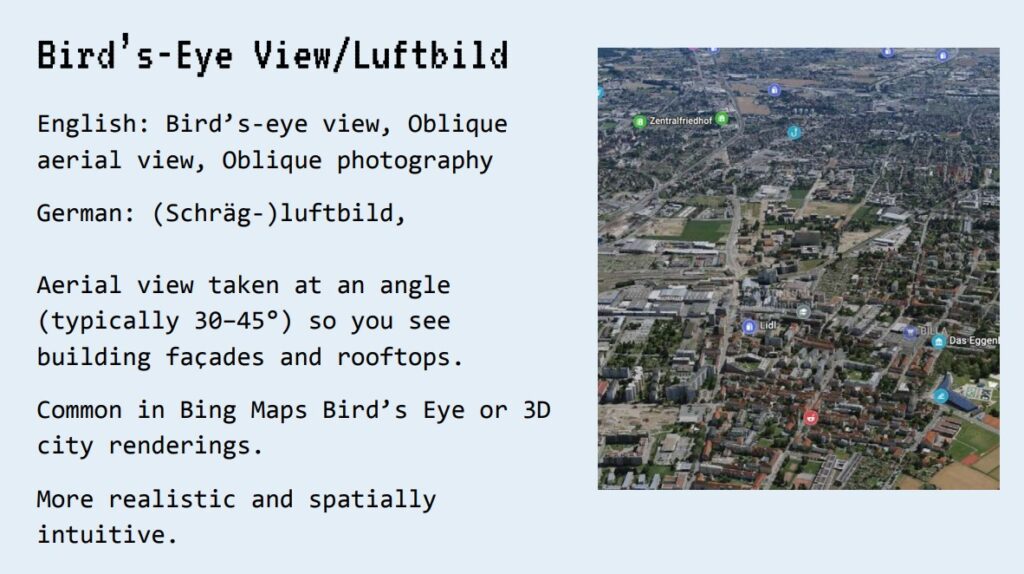
This is directly related to my idea for a “slow navigation app.” Usually, a map is perceived as a neutral tool: it shows where we are, where to go, and which route is the fastest. But in reality, a map always chooses what to show and what to hide. For example, a standard 2D map shows streets, buildings, and names. A 3D map adds a sense of scale and space. A bird’s-eye view helps you get a better visual feel for the city. Psychogeographic maps, on the other hand, may not show roads at all, but rather emotions, smells, sounds, or personal impressions of a place. This is clearly illustrated in the PDF using examples of different map types: top-down view, bird’s-eye view, 2D map, and 3D/extruded map.
For my app, this means I don’t have to design the map exactly like Google Maps [3]. I can think of the map as a system of layers. For example, one layer could show the most peaceful route, another could show green spaces, a third could show places to stop, and a fourth could show the emotional or sensory characteristics of the route. This helps shift the focus from “getting there faster” to “experiencing the journey better.”
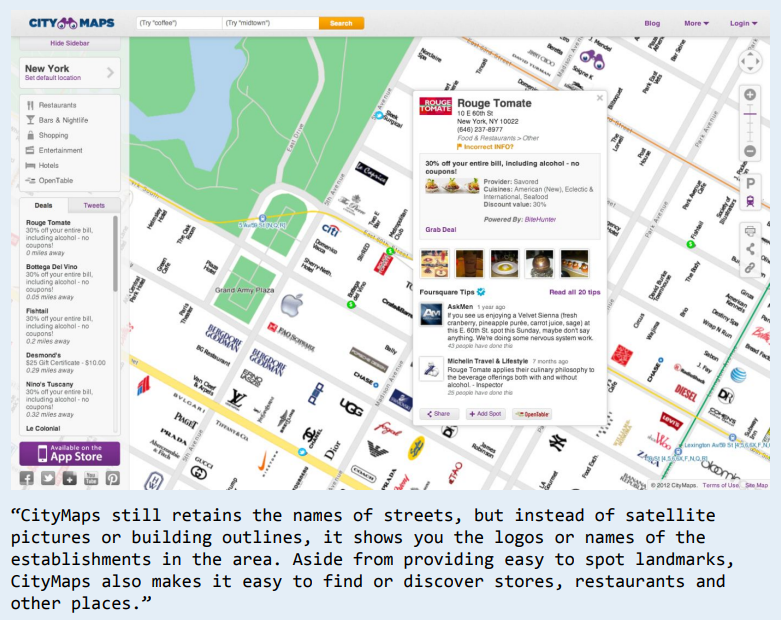
I also liked the CityMaps [4] example, where logos and place names are used instead of satellite images and building outlines. This shows that a map can be not only geographical but also social: people often navigate not by coordinates, but by cafes, stores, familiar landmarks, parks, or visual cues. This is important for my app because slow navigation should be closer to how people actually experience the city.
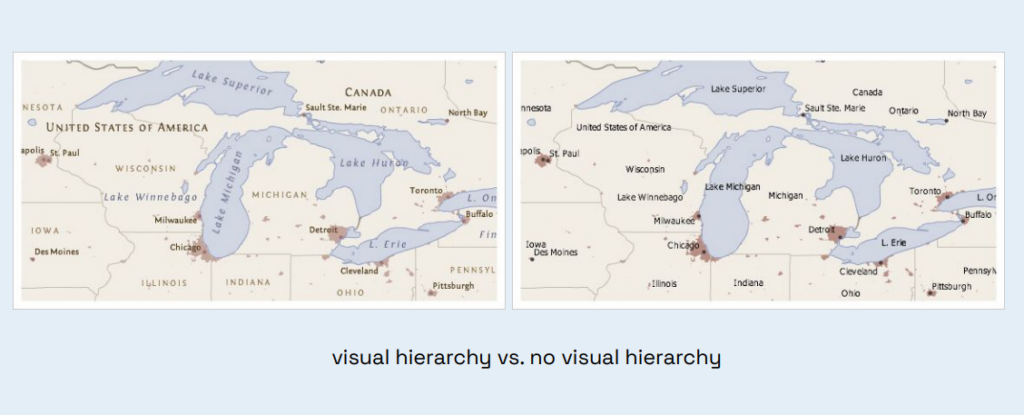
Another useful takeaway from the PDF is the importance of visual hierarchy. If everything on a map is equally important, it’s hard for a person to know where to look. In my interface, this means I need to carefully manage text, icons, colors, and layers of information. If I want to create a calm app, it shouldn’t overwhelm the user. On the contrary, it should gently guide their attention.
Thus, this material helped me realize that my project isn’t just a “map with pretty routes.” It’s an attempt to design a different kind of information system for the city. The map in my app should not only guide people but also help them notice, choose, stop, and build a more personal connection with the space.
Sources 🛈
[1] Bachler, B. Intro to Information Design – Session 5: Commuting Cartographies. FH JOANNEUM, 2025.
[2] Wood, D. Rethinking the Power of Maps. Guilford Press, 2010.
IRCAM was beautiful and of course it was interesting to see, but if I am honest, it was not my favourite sound-related experience in Paris. I actually liked the Hôtel de la Marine audio guide more than many of the things I saw at IRCAM. That surprised me a little, but it was simply a stronger experience for me.
The best part was not that the system was technically revolutionary. It was more about the taste and the artistic decisions. The way it told the history of the building, the atmosphere it created, and the attention in the sound design felt like a very well-made audio drama.
Walking through those old corridors while listening to the history of the place was genuinely impressive. You feel the building as something that has changed over centuries, not just as a museum room with objects inside. Hearing the stories while standing in those spaces made me feel closer to the history of Paris and to the people who had passed through that building. That part was honestly beautiful.
What I liked most was the artistic side of the audio guide. The voices, timing, background sounds and atmosphere worked together very well. It showed the history of Paris, the history of the hotel, and the way time changed the city in a way that felt natural and cinematic. For me, this was much more memorable than a lot of more “high-tech” things that try too hard but do not really create an emotional experience.
Of course, the system was not perfect. There were some headphone bugs and trigger problems. Sometimes xa sound started between rooms, and sometimes something did not trigger at all. But honestly, with such a large programmed system, I can understand that this happens. It was annoying in the moment, but it did not destroy the experience for me.
One detail I really liked was the headphone design. They did not fully close my ears. They stayed a few centimetres away from them, and I think this was a very smart choice. It made the sound feel less isolated and more connected to the actual room. The recorded sound and the real acoustic space could exist together, which made the atmosphere more believable.
There were also some interactive installations inside, but they did not interest me that much. They were fine, but compared to the audio guide they felt a bit bland. For me, the real strength of the visit was not the interactive technology. It was the combination of place, history, narration and sound design. That is what stayed with me.