The second impulse I got was at the World Usability Congress 2026. I listened to the talk: “Addiction vs. controll: How (not) to build habit-forming products” by Sebastian Castaneda.
Why companies build addictive products
According to the speaker the basis for companies designing interactions that are addictive lies in their business model (capitalism). Most companies goal is to create digital products that are as engaging as possible, because that creates value. In other words the more time a user spends in an app, the more ads they see and the more revenue the company generates.
Time management in social media apps
Additionally, the speaker was specifically talking about time-management features inside social media apps. In the past these apps genuinely tried to interrupt the user so they would stop using the app. Over the past few years this changed since most businesses are profit-driven.
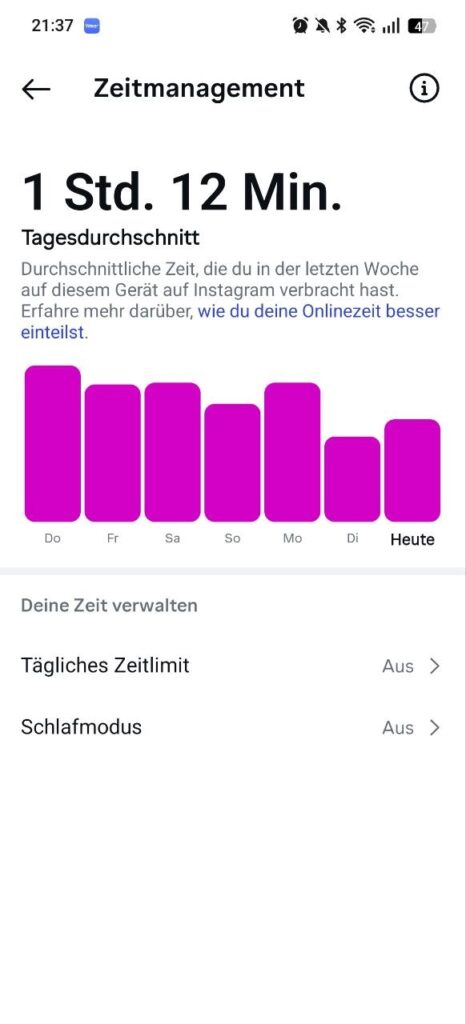


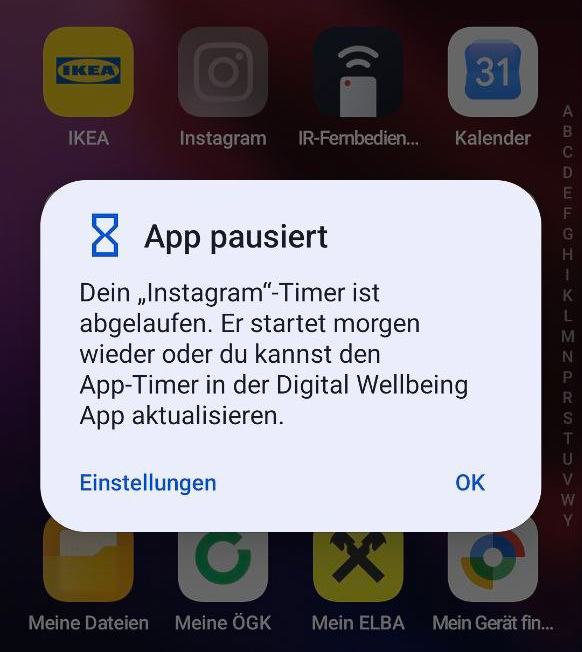
Until today I didn’t know that social media apps offered a time-management features. However, as shown in the previous images those features are not very effective. Why are there buttons for postponing the time limit but none for closing the app? At this point I want to mention that I use Android’s Digital Wellbeing feature, which actually works well for me. What helps me a lot through the day is that once I reach my time limit, the app icon gets grayed out. Even when I am searching for it I am having a trouble finding it. Besides that, adding more time is slightly more complicated, since I have to open the settings and click a few times.

Should we build habit-forming products at all?
One crucial question the speaker raised was: “Do we really need to build something that creates habits?”. He suggested that it sometimes makes sense to create habits. The following table shows a matrix for deciding whether it is ethical to build a habit-forming application.
| the maker does not use it | the maker uses it | |
| improves the users life | Peddler | Facilitator |
| doesn’t improve the users life | Dealer | Entertainer |
In brief, the Facilitator would be the ideal case. The creator (business) builds something that they believe in and would use themselves. The goal is to understand the user and their interests. In contrast, the Dealer (often social media platforms) is where the creator builds something that they do not use themselves and that does not help anyone, yet they still try to get people hooked on it.
What stood out to me
What stood out most to me were facts about the effects of social media. According to the speaker 45% of teen Instagram users find it difficult to manage their time on the platform. Studies show decreased cognitive capacity with the mere presence of a smartphone. Most importantly, people are two times as likely to get depression and anxiety if their social media use is more than five hours a day.
Accompanying links
Hooked: How to build Habit Forming Products – Book
James Clear – The Habbits Guide – Website
James Clear – Atomic Habits – Book
