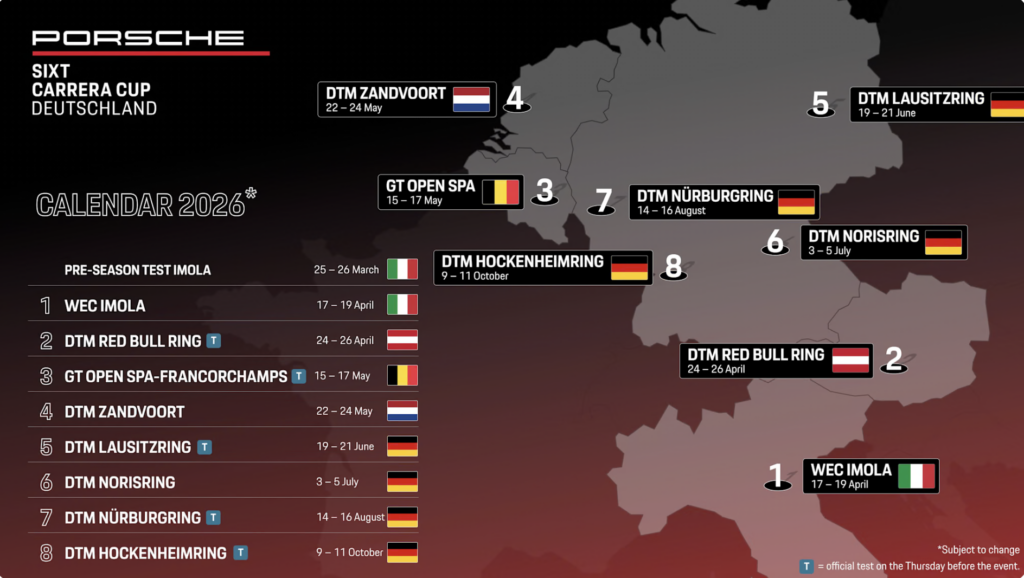
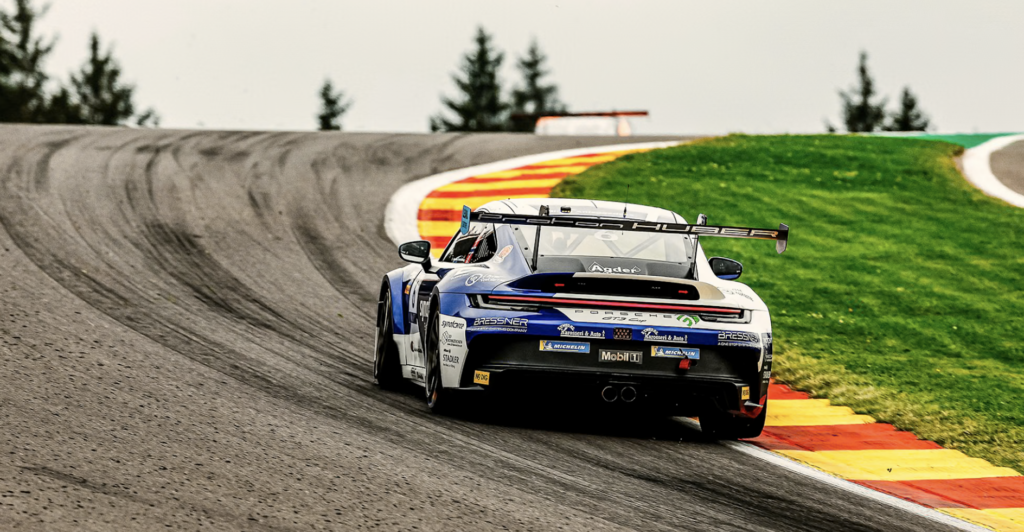
Für das Werkstück dieser Blogpost-Reihe über One-Shot-Produktionen und Sport-Dokumentationen wurde endlich eine Sportart auserwählt: Motorsport. Motorsport umfasst allerdings eine große Bandbreite an verschiedenen Disziplinen. Eine davon ist der Porsche Sixt Carrera Cup Deutschland, der von 24. bis 26. April als Teil der DTM (Deutsche Tourenwagen Masters) am Red Bull Ring in Spielberg stattfindet. Im Rahmen des Werkstücks wird dabei ein spezifisches Team begleitet und der Protagonist des Videos sein: das deutsche Team Proton Huber Competition.
Was ist der Porsche Sixt Carrera Cup Deutschland?
Bereits im Jahr 1990 startete die Rennserie „Porsche Sixt Carrera Cup Deutschland“, wie der Name schon sagt, in Deutschland als Markenpokal des Porsche-Modells 911. Dabei handelt es sich um ein 30-minütiges Sprintrennen in einem professionellen Umfeld. Es ist der älteste Porsche Markenpokal der Welt und ist bekannt für spannende Duelle zwischen ambitionierten Nachwuchstalenten aus dem Motorsport.
Dieses Jahr gibt es einige Änderungen und der neue Porsche 911 Cup feiert im April in Imola, Italien, im Zuge der Langstrecken-Weltmeisterschaft (WEC) seine Premiere. Am Start stehen 31 Fahrer:innen von neun Teams, die teilweise an zwei voneinander getrennten Meisterschaften teilnehmen. Im Laufe des Jahres gibt es sechs weitere Stationen im Rennkalender. Unter anderem auch die DTM in Spielberg oder am Nürburg- und Hockenheimring.
Die neuen Änderungen beziehen sich vor allem auf das Auto selbst: Das neue Porsche 911 Modell erhielt umfangreiche Modifikationen im Design und wird von einem 4.0 Liter großen Sechszylinder angetrieben. Dadurch steigert sich die Performance des Autos. Gleichzeitig gibt es ein vereinfachtes Handling sowohl für die Teams als auch für die Fahrer:innen. 18 der 31 Teilnehmenden stehen zum ersten Mal vor einer vollen Saison im deutschen Carrera Cup.
Insgesamt gibt es zwölf Porsche Carrera Cup Serien, die in verschiedenen Teilen der Welt. Alle Rennautos dieser Serie sind ident, da sie ausschließlich dem 911 GT3 Cup vorbehalten sind.
Proton Huber Competition
2016 gründete Christoph Huber „Huber Racing“, nachdem er bei Porsche-Rennlegende Walter Lechner bereits seit sechs Jahren agierte. Lechner half Huber auch dabei den Traum vom eigenen Rennstall wahr werden zu lassen. Seit der Gründung ist Huber Racing ein fester Bestandteil der Porsche Carrera Cup Serie und konnte bereits unzählige Podeste, Siege und Titel einfahren. Mit Beginn der Saison 2024 schloss sich Huber Racing mit Proton Competition in einem Joint Venture zu Proton Huber Competition zusammen. Unter diesem Namen geht das Team seither an den Start. Mit dem Fahrer Larry ten Voorde verlief die Porsche Carrera Cup Deutschland Saison dabei mehr als erfolgreich: Sowohl in der Fahrer- als auch in der Teamwertung krönte sich der Rennstall zum Champion. Im August 2025 zog sich Teamgründer Christoph Huber aus dem operativen Geschäft zurück, nachdem Huber Racing bzw. Proton Huber Racing mehr als ein Jahrzehnt an der Spitze stand und sah die erfolgreiche Saison als guten Ausstiegspunkt. Für die 2026 Saison gehen Youngster Theo Oeverhaus, Jaap van Lagen und Gustav Burton an den Start.
Warum Motorsport?
Im Jahr 2021 wurde der Dokumentarfilm „Schumacher“ auf Netflix veröffentlicht, die sich um den ehemaligen und erfolgreichsten Formel 1 Fahrer der Geschichte dreht: Michael Schumacher. Die Dokumentation liefert Eindrücke in die Persönlichkeit und das Leben des seit 2013 im Koma liegenden Deutschen. Obwohl ich, die Autorin dieser Blogpostreihe, zuvor wenig mit Motorsport zu tun hatte, fesselte mich diese Dokumentation und noch in derselben Nacht wurde ich eine von Vielen. Denn nach „Schumacher“, schaute ich „Drive to Survive“, die Netflix-Serie über die Formel 1. Seit diesem Tag – bzw. dieser Nacht – ist der Motorsport für mich persönlich nicht mehr wegzudenken. Dabei war ich nicht die einzige: Wie bereits in früheren Blogposts erwähnt, brachte Drive to Survive unzählige Tausend neue Fans in den Sport. Die Formel 1 gilt als Königsklasse des Motorsports und ihre Wurzeln reichen bis in die 1920er Jahre zurück. Seitdem ist nicht nur das Publikum enorm gewachsen, sondern auch die Popularität von Motorsport im Allgemeinen ist gestiegen. Das zeigt sich auch durch die Präsenz in den sozialen Medien bzw. im Internet generell. Außerdem ist Motorsport auch eine der Schlüsselkomponenten im ESport.
Nachdem ich mit Beginn meines Studiums auch dem Studierendenverein der FH JOANENUM, „Joanneum Racing Graz“, beigetreten bin, war für mich klar, dass ich am liebsten im Motorsport arbeiten würde. Sport im Allgemeinen – dazu gehörten Fußball, Reiten, Turnen, Tennis und Schwimmen – war seit meiner Kindheit ein fester Bestandteil des Unterhaltungs- und Freizeitprogramms. Auch wenn der Motorsport erst viel später dazugekommen ist, ist er nun trotzdem einer meiner liebsten Interessen. Ein weiterer Punkt, der dafürspricht, ist, dass Motorsport neben dem Reitsport die einzige Sportart ist, in der Frauen und Männer gleichberechtigt gegeneinander antreten dürfen (trotzdem gibt es aus biologischen bzw. körperlichen und auch patriarchalen Gründen sehr wenige Frauen im Motorsport).
Action, Zusammenarbeit, Köpfchen und Teamgeist ist für mich die perfekte Mischung für eine Sportart. Das Werkstück für ein professionelles Racing-Team zu machen (noch dazu für meine liebste Automarke) ist für mich ein großer Schritt in Richtung meines Traumberufs, der nicht nur meine Interessen, sondern auch die Themen meiner Blogposts bestens miteinander vereint.
Quellen & Abbildungen:
Porsche AG. (2026). Porsche Sixt Carrera Cup Deutschland: Saison-Vorschau. https://newsroom.porsche.com/de/2026/motorsport/porsche-sixt-carrera-cup-deutschland-saison-vorschau-42001.html
Porsche AG. (o. D.). Carrera Cup Deutschland – About the series. https://racing.porsche.com/de-DE/carrera-cup-deutschland-about-the-series
Porsche AG. (o. D.). International one-make series: Carrera Cups. https://racing.porsche.com/de-DE/international-one-make-series/carrera-cups
Huber Racing. (o. D.). Über uns. https://huberracing.de/ueber-uns/
Porsche AG. (o. D.). PMSC Proton Huber Competition. https://racing.porsche.com/de-DE/teams/pmsc-proton-huber-competition
Motorline.cc. (2022). Warum Motorsport für uns kaum mehr wegzudenken ist – Die Faszination der Geschwindigkeit. https://www.motorline.cc/motorsport/2022/Last-but-not-least/Warum-Motorsport-für-uns-kaum-mehr-wegzudenken-ist-Die-Faszination-der-Geschwindigkeit-259280.html
Dieses Literaturverzeichnis wurde von ChatGPT erstellt.