Interviewing my colleague

Design&Research 2 with Ursula Lagger

I interviewed one of my colleagues about gamified apps and their feelings about it. I wanted to share the interview and my thoughts because I reckon that it is relevant to my topic.

Notes 
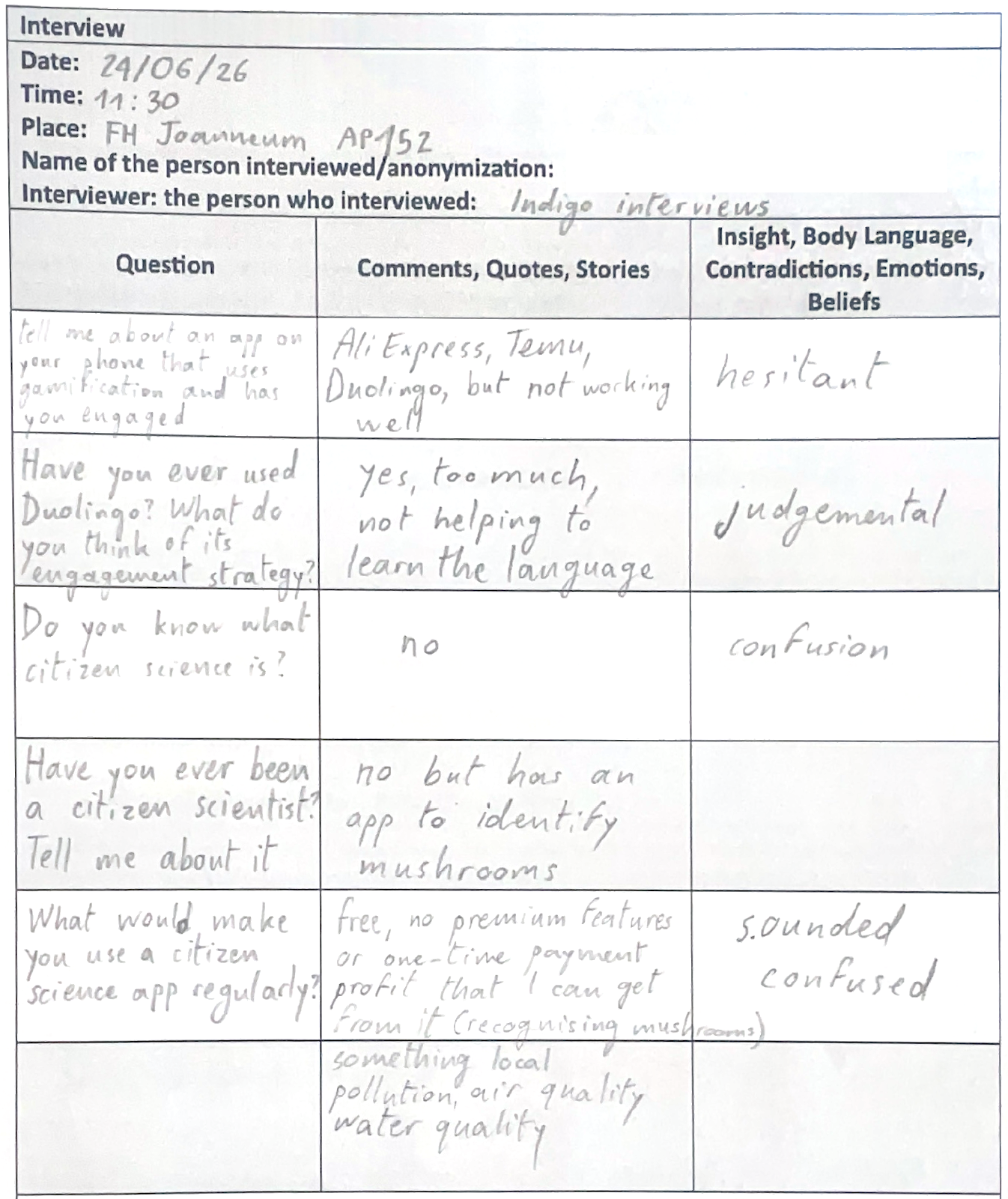
Transcript

Thank you for letting me interview you. 

What is this about?

It’s about apps, engagement and gamification. Please tell me about an app you have on your phone that uses gamification and has you super engaged.

Let me check. What do I have? I mean, totally Duolingo, like the best example ever and also the features that we were doing for our financial app (App Design course) that was also for engagement and I think you can do any app engaging and funny but honestly like it shouldn’t be a good example. 

It’s fine if you tell me about Duolingo. 

I think for instance sometimes I use AliExpress and they use this like “oh you want this?” or “try to use this” with coins or something, that always pisses me off when when I open the app and I see like “oh, you want €10? Let’s buy something” or something like this. I never check and it just an example but honestly, I don’t really have any. Like, it is not working. 

Is Duolingo working for you? 

Yes, I don’t really use it because I think it does not really complete the goal of learning a language. It’s not for this sense of like learning something, you get it? But you don’t really learn so they give me vacation and that helps I guess.

What do you think about Duolingo‘s engagement strategy with the notifications and the passive aggressiveness?

I mean, this is probably why I’m not using it because I’m too tired of this and like I think generally just learning the language in this way it’s not helping. I was always quitting the Duolingo, but I know people who are on it every day and they see these notifications, they set it up. They put a big widget on their menu so they see the streak and like the announcement. I don’t know. I think not inappropriate for that or maybe they’re just bad levels. I think that it could be better too, so you actually go to a level and don’t see a random sentence. 

Let’s switch this up a little bit. Do you know what citizen science is? 

Citizen science… a person who lives in certain place and I don’t even know what? Maybe it’s some like studies that are local and like you can actually study the community somehow. 

I’m gonna explain what it is. So citizen science is a project where normal people just like you, citizens, they can participate in science and become a scientist and they can for example report a plant species they see on their hike and submit it to this application and this data gets forwarded to scientists who can track where this plant is spreading but it can be done with many different things. It usually involves reporting because there’s a lot more citizens than scientists, so it makes sense that the population also helps with science. 

Have you ever been a citizen scientist? 

I don’t think I have ever had the opportunity.

It’s usually also done on applications, for example I have one. It’s called iNaturalist, where you take photos of plants and animals and identify them and it sends the data. 

Why do you say it’s like you’re becoming a scientist? 

Not an actual scientist, but contributing to science. You’re just sending data. You take a picture of a mushroom and then you see it on a map. 

I didn’t know that, because I also have a mushroom app but I didn’t know that picture is actually being sent, like I don’t remember. 

It depends on the app like some projects are just to help you identify the species, other are sending data and are citizen science projects. 

What would make you use a citizen science app regularly? 

I’ll describe it to you: something free, not using this kind of effect and then in two weeks you need to pay for it, to get use certain properties you should have a subscription. Or make a one time payment so you would be contributing some money and then you have it for you. What else? What in the app would keep you engaged to use it regularly? 

Maybe you can think of some communication features. Other features that you like in apps that make you use them regularly is make some profit that I can get from it. I don’t know. I honestly don’t really get this concept very well. Is there any other example? Except recognising plants? 

For example, there is another project that you use during the night and you report the light pollution, so you say “I can’t see any stars in the sky tonight” although there are no clouds, you send it and then they know that in that area there’s a lot of light pollution going on. 

for example something else except It’s possible to put it should be more limited locally. I think maybe it should be about climate pollution, about the air quality or plants like vegetation, or water quality.

Alright, thank you!

Postscript

I forgot to make an introduction about the topic, but the questions slowly lead into it. I tried to actively listen and find some key concepts in my interviewee’s answers, while also improvising some questions (follow-up questions) based on their answers. Next time I would try to explain less and learn more from my interviewee.

Summary 

To make my citizen science platform more engaging, I want to research how people perceive gamification and if it affects their usage of an app. I first asked questions about gamified apps the interviewee has used. Then I shifted to citizen science, in order to find out how I could make a reporting app more engaging.

Reflection

The interview made me realise that a concept I am already familiar with due to my research might not be so clear for other people, so it is important to always briefly explain key concepts. I also think that some questions caused confusion or were not answered, so I could have formulated them differently or broken them down into easier concepts. For instance, instead of saying “ tell me about an app that uses gamification and has you engaged” I could have said “how do you feel about streaks?” or “What emotions do you feel when using Duolingo?”. 

The last answer was the one that gave me the most important information. The interviewee mentioned that they like when they get something from an app, like information about mushrooms. In my app I definitely need to add some educational content so users can learn about the stars. The interviewee also likes it when an app is free without any locked features, which is also important to me. They finally said that they appreciate it when something feels “local”. In my case, this could be tips on where to stargaze in your area, tasks to go explore a certain area that needs more reports and the option to read reports that were submitted close to you.
✿3 Design Research 2 – Interview

When I started looking into digital literacy among older adults, I thought the easiest way to find out where the problems are would be to simply ask people. So, taking some previous feedback into account, I spoke to around ten older people and asked questions like: What do you struggle with when using technology? What was easier back in the day? Is there anything you’d like to get better at?

(Not) to my surprise, I didn’t get many useful answers.

Most people either said they didn’t really have any problems or found it difficult to explain what exactly they struggled with. Thinking about it afterwards, that actually makes a lot of sense. Many issues only appear while someone is actively using a device or trying to complete a task. Once the moment has passed, it can be hard to remember what happened.

Because of that, I started wondering if directly asking people about their problems is even the best approach. Maybe observing people while they use technology would show much more than interviews alone. Since I didn’t get many concrete insights from those conversations, I started asking colleagues and friends about their experiences with parents, grandparents and other older relatives. Almost everyone had some kind of story. It became clear that many younger people end up being the unofficial tech support person in their family.

Interview Results

One thing that stood out was how important familiarity seems to be. One colleague told me that their mother shops online all the time and actually prefers doing it on her phone rather than on a computer. For me that sounded a little backwards, since a larger screen and analoge input usually feels easier to navigate. But because she’s used to her phone, that’s simply the device she feels most comfortable with.

Another interesting example was someone working as a secretary. They use digital tools all day long at work, manage documents, handle bookings and deal with various systems without any issues. But when it comes to doing similar things in their private life, like booking a flight for themselves, they would rather avoid it. At work there is always a process, a colleague or someone responsible for helping. At home, that safety net isn’t there. It made me think that confidence might also sometimes be a bigger factor than actual technical skills.

Some observations weren’t really about technology itself but about how people communicate online. Multiple colleagues mentioned that their parents or grandparents completely ignore grammar, punctuation and spelling when sending text messages. As some young people do as well. The goal seems to be getting the message across rather than worrying about how it looks.

Trust was another topic that appeared again and again. Several people mentioned that their parents or grandparents still prefer traditional banking methods. Instead of making a transfer online, they would rather fill out a paper form at the bank. Whether that’s actually safer isn’t really the point. The important thing is that it feels safer and more understandable to them.

Communication preferences also seem to differ quite a bit. According to several people, older adults often prefer calling someone instead of sending an email or a message. A phone call gives immediate feedback. You know the other person received the information and understood it. With emails or messages, there’s always a bit more uncertainty.

One thing I found particularly interesting was the role curiosity seems to play. People who are naturally curious often continue exploring technology regardless of their age. They click around, try things out and aren’t afraid of making mistakes. Others seem much less interested in learning something new, not necessarily because it’s difficult, but because they don’t see enough value in putting in the effort.

At this point, these are still just observations rather than real conclusions. But they already change some of my assumptions. Maybe the issue isn’t simply that digital products are too complicated. Familiarity, confidence, trust, habits, motivation and curiosity all seem to have a huge influence on how people interact with technology.

For the next step, I think it would be much more useful to actually observe people while they perform digital tasks instead of only asking them about their experiences afterwards. I also already have a direction I would like to go to.

*14 Interview mit Grafik Designerin 

Im Rahmen einer Lehrveranstaltung hatten wir die Möglichkeit, ein Interview mit jemanden aus dem Design Bereich zu führen. Ich habe mich für Selina Pichler entschieden, eine Designerin, die einen klaren Blick für das hat, was gestalterisch funktioniert und wo ich wusste sie hat einen Bezug zu Illustrationen, Storytelling  und interaktiven Elementen. Sie geht regelmäßig durch Buchhandlungen, stöbert in der Kinderbuchabteilung und hat sich schon selbst Gedanken dazu gemacht was ein gutes Kinderbuch ausmacht. Genau das sie für mein Projekt interessant gemacht, denn ich wollte nicht nur die Perspektive von Eltern oder Pädagog:innen hören, sondern auch von jemanden, der gestalterisch denkt.

Das Interview hat in einer ruhigen Atmosphäre stattgefunden und Selina war von Beginn an offen und gesprächsbereit. Ich habe ihr ähnliche Fragen gestellt wie schon in der Umfrage nur diesmal mit den Fokus durch das persönliche Gespräch mehr erfragen zu können. Die Fragen waren: „Hast du noch manchmal Kinderbücher in der Hand?“, “Hast du Kinder in deinem Umfeld?“, „Glaubst du, dass Kinderbücher einen Einfluss haben, wie Kinder die Welt sehen?“, „Stört es dich, wenn Inklusion und Diversität in Kinderbüchern als zentrales Thema eingesetzt werden?“, „Sollten Kinderbücher deiner Meinung nach erkläre oder einfach zeigen?“, „ Glaubst du, dass interaktive Kinderbücher das Verständnis vin Kindern beeinflusst?“, „Wenn du ein Kinderbuch gestalten würdest, welche interaktive Elemente würdest du einbauen?“

Was mich an Selinas Antworten am meisten überrascht hat, war wie klar sie zwischen zwei verschiednen Arten von Büchern unterschiedet. Sie sagte, es soll ruhig Bücher geben, die Inklusion aktiv erklären und ins Zentrum stellen. Aber es soll auch Bücher geben, die Diversität einfach zeigen, ohne es jedes Mal extra herausheben. Ihre Formulierung dazu war sehr direkt und hat mich zum nachdenken gebracht: “Wenn Inklusive Details jedes Mal herausgepusht werden, normalisieren sie sich nie.“ Das ist im Grunde genau das, was ich mit meinem Projekt erreichen will, und es war sehr spannend, dass jemand der sich nicht tagtäglich mit Kinderbüchern beschäftigt, die gleiche Meinung hat.

Beim Thema interaktive Elemente hatte Selina eine klare Meinung. Am liebsten mag sie Dinge, die Kinde selbst und alleine bedienen können. Sie hat die rot-blauen Lupenelemente erwähnt, mit denen man Dinge verschieben und entdecken kann, also Sachen bei denen keine Erwachsenen helfen müssen. Das deckt sich gut mit meiner Überlegung, denn auch die Umfrage hat gezeigt, dass einfache Klappmechanisemen als besonders beliebt gelten.

Was das Interview für mich außerdem wertvoll gemacht hat, war das Feedback danach. Für meine Masterarbeit werde ich auch Interviews führen und hier ist es dann sehr wertvoll, wenn ich davor schon Erfahrungen sammeln kann und Feedback bekomme um Fehler zu vermeiden. Im Nachgespräch wurde mir gesagt, dass ich manchmal Dinge doppelt formulier habe oder zu viel Inhalt auf einmal gefragt habe. Zum Beispiel habe ich gefragt, ob ein Buch Inklusion erklären doer zeigen soll, aber die Frage war eigentlich schon  in sch zweigeteilt. Selina hat das im Interview beantwortet, aber in einem anderen Gespräch hätte das vielleicht zu Verwirrungen geführt. Für die nächste Interviewsituation nehme ich mit, dass ich Fragen klar und einzeln stollen soll und schauen muss ob eine Antwort schon in der nächsten Frage steckt. 

Insgesamt war das Interview für mich eine Bestätigung. Die Gedanken, die Selina mitgebracht hat decken sich mit dem, was ich auch in der Umfrage analysiert habe und mit der Richtung, die ich für das Projekt einschlagen machte. Inklusion zeigen, nicht erklären und Interaktivität so gestalten, dass sie Kindern Selbstständigkeit bietet und nicht Abhängigkeit

#1 Informal Research

Interview

This week I started working on some research. I talked to a few people, just an informal interview, so I could get a feeling of the topic. I wanted to know if they would do more on their smartphones if they felt it was easier to use and also what makes some digital products hard to use. I also asked if there is a particular app they feel really confident with and why they feel that way.

One example that stood out to me was WhatsApp. Everyone was using WhatsApp. Someone also told me that she felt safe using it because she understands how the app works and that it feels more like a finite system they could oversee. What was more interesting to me was that she mentioned that the app is more understandable and feels more secure to use because it is linked to her phone number. She mentioned that only people who have her number, that are usually people she already met in real life, are able to contact her or see what she posts. This is what makes the app feel more predictable to her.

I found this really interesting, because its not just about usability, it is more about the feeling in control and having a familiar structure that connects to her real world experiences. “Giving someone the your phone number is something she always done, long before smartphones existed.”

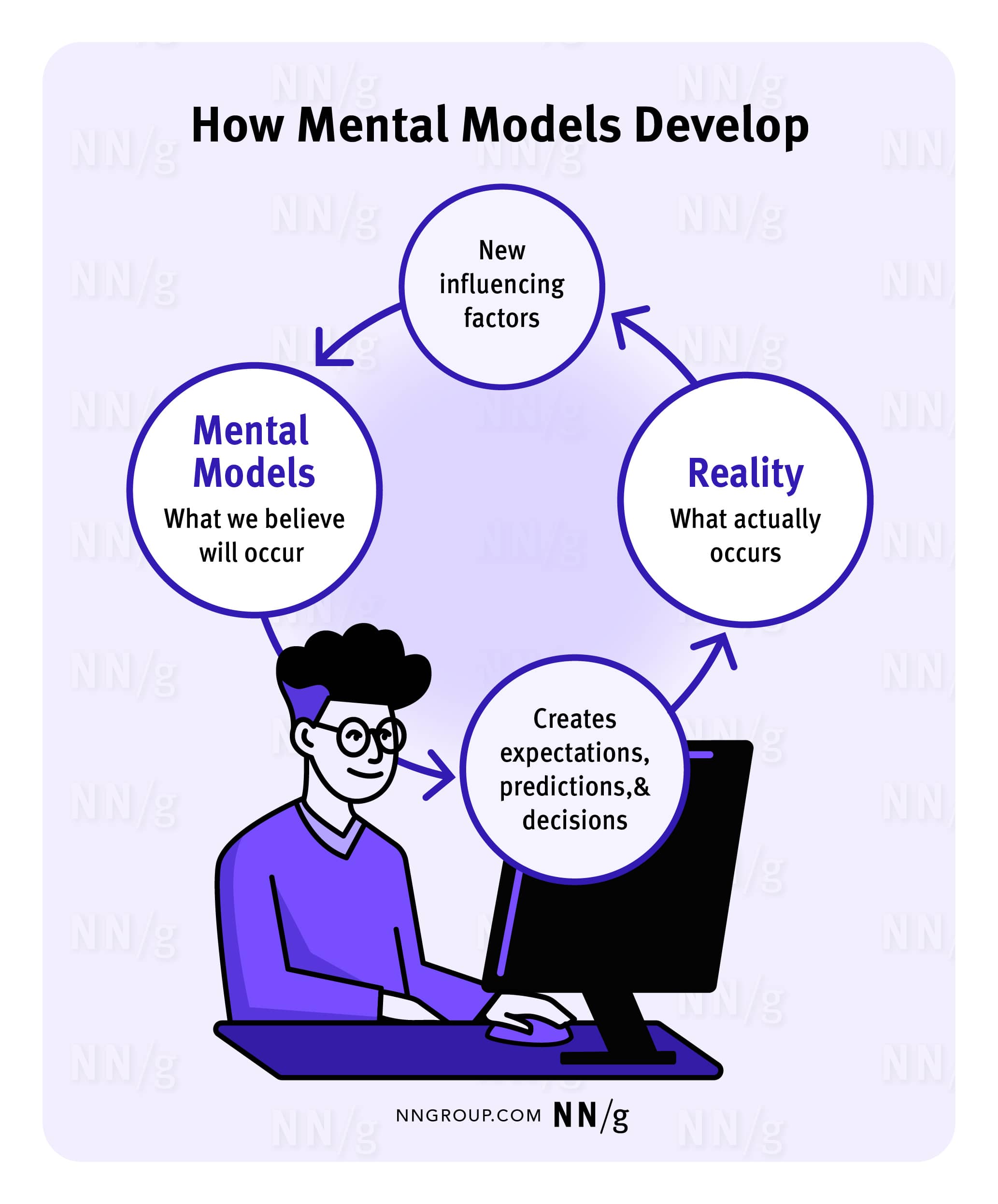
Mental Models

I think this was a great example for mental models. When a digital product works in a way that feels familiar, it’s easier to understand and trust. In this case, WhatsApp builds on an old habit (not sure if on purpose), which helps users feel safe and capable in a digital environment.

A cycle depicting how our mental models shape our expectations, predictions, and decisions, while being simultaneously reshaped by what actually occurs.
Source: nngroup.com: https://www.nngroup.com/articles/mental-models/

After talking to a few people, I noticed that them using digital products depends on how much they trust them. Some felt unsure about what happens in the background or who can see what they do online.

At the same time, I think usability plays an important role. It was mentioned that digital products should be easy to use and that this would encourage them to engage with these products more often. In connection with this, one person said, “I’d use apps more if someone showed me how,” which highlights the idea that either the app itself needs to provide guidance, or a person needs to take on that role.

For my next steps, I would like to explore this concept of ease of use and the guidance aspect further. I want to research what makes a system feel simple enough to use and what kind of support helps people feel confident when trying something new.

References

M. Chan, “Mental Models and User Experience Design,” Nielsen Norman Group, Jan. 26, 2024. https://www.nngroup.com/articles/mental-models/

“Jakob’s Law of Internet User Experience,” www.youtube.com. https://www.youtube.com/watch?v=wzb4mK9DiHM (accessed Apr. 29, 2022).