#slowness #slowliving #slowinteraction #digitalcalm #calmtechnology #navigation #urbanexperience
In October, I attended the World Usability Congress in Graz. On the very first day, I looked at the program and spotted a talk that felt closely aligned with my own work on “slow navigation”, even though it didn’t explicitly focus on maps.
The speaker was Elizabeth Rosenzweig, a design researcher and educator. She served as one of the opening speakers at the WUC [1]. Her core message was quite simple, yet I made sure to jot it down in my notes in big, bold letters:
👉 Prioritize people before data.
🤖 What is Human-Centered AI (HCAI)?
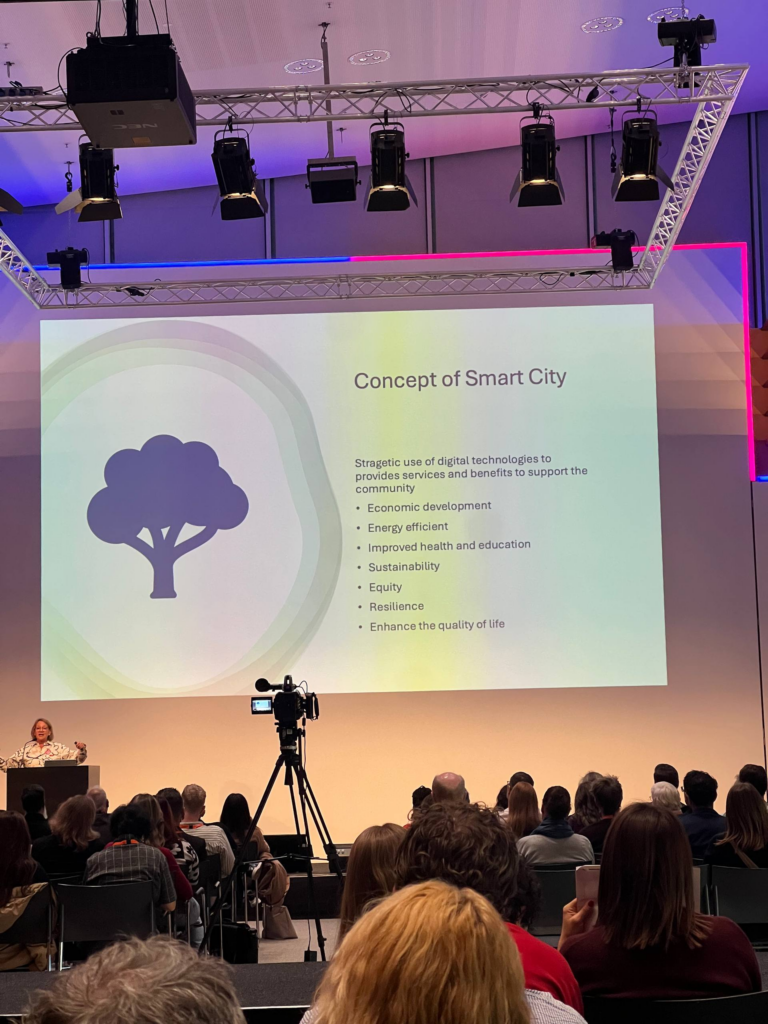
The lecture revolved around fairness, transparency, privacy, and inclusivity. Elizabeth presented 4 principles of HCAI, and as I jotted them down, I found myself applying each one to a navigation app:
👉 Explainable – the human understands what the AI is doing.
In navigation: Why was I offered this specific route? Is it faster? Quieter? Who decided this?
👉 Predictable – the system’s behavior can be anticipated.
In navigation: I don’t want the route to recalculate every 30 seconds, pressuring me to “hurry up, hurry up.”
👉 Controllable – the human can intervene.
In navigation: I get to decide what the “best” route is for me right now, rather than having an algorithm decide on my behalf.
👉 Accessible – people can successfully use the system.
In navigation: The route should work not just for those who walk quickly, but also for people with strollers, the elderly, or those who might need a bench along the way.
And that’s when it clicked for me. In my previous post, I mentioned that Google Maps and similar apps optimize for speed. But from an HCAI perspective, the issue isn’t necessarily the speed itself, it’s that the user often doesn’t know why the system prioritized speed, and they can’t easily change that.
🏙️ Technology Should Serve the Community
Elizabeth argued that urban technology should serve people, not the other way around. A few examples she shared really stuck with me:
- Singapore – Smart Nation
A national strategy that leverages digital technology, big data, and the IoT to benefit the economy, the government, and urban life. It was launched in 2014, when Prime Minister Lee Hsien Loong announced plans to make Singapore the world’s first “Smart Nation” [2]. It sounds incredibly ambitious-but it raises a question for me: does a “smart” city necessarily have to be a “fast” city? - AI in Medicine – A Surprising Example
Elizabeth mentioned a UK study involving 1,298 adults who were presented with medical scenarios and assisted by AI models-GPT-4o, Llama 3, or Command R+. On their own, the models correctly identified the medical condition 94.9% of the time. However, when people used these same tools, they arrived at the correct diagnosis less than 34.5% of the time-performing no better than the control group [3].
In other words, even though the model “knows” the answer, the human fails to benefit. The issue isn’t the technology itself, but the interaction-this is a classic UX challenge! To me, this suggests that navigation systems shouldn’t just be tested for “route accuracy”; they should also be evaluated based on what the user understood, what they remembered, and how they felt along the way.
- Humans in the Loop (HITL)
This refers to a process where a human reviews, corrects, or approves the output generated by an AI. An example from the lecture: a doctor verifying a diagnosis before finalizing a treatment plan. I believe that in “slow navigation,” the human should also remain “in the loop”-making their own decisions rather than simply following an arrow.
🌐 Digital twin – a digital replica of a city
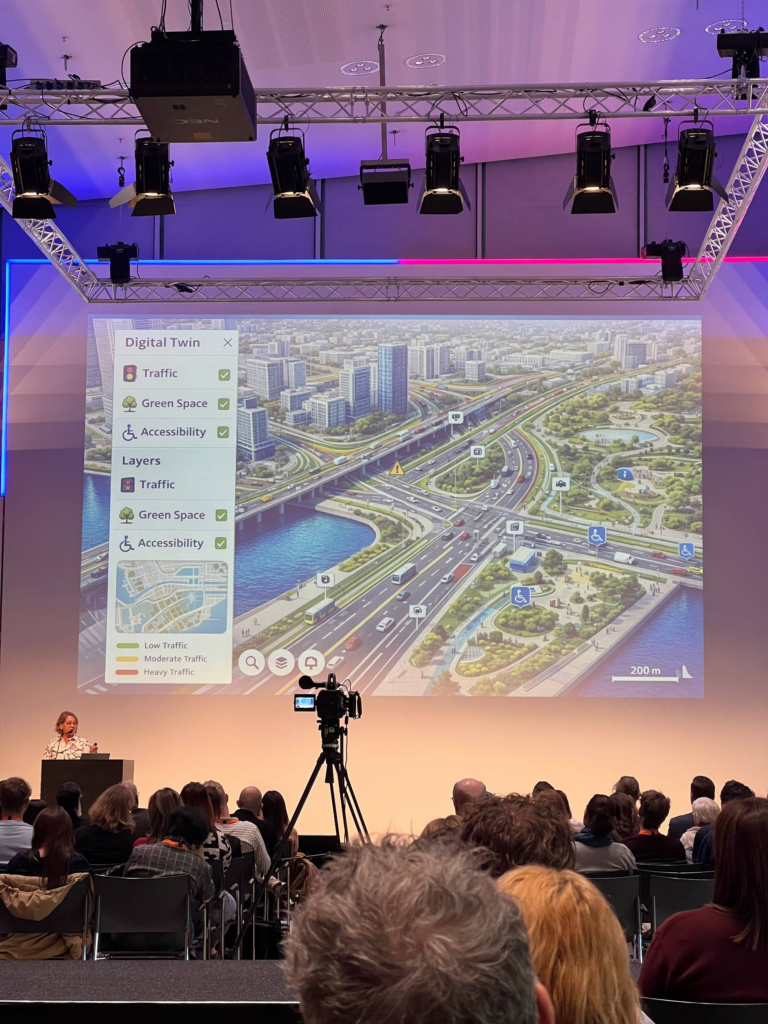
It is a simulation of an urban environment powered by sensors, IoT, GIS, and AI analytics. You can model low, moderate, or heavy traffic and see what happens when changes are made.
My first thought was: what if a digital twin were used not just for vehicular traffic, but for pedestrians as well? For instance, you could model where people tend to stop, where it’s too noisy, or where there’s a lack of shade or benches. This essentially provides the data needed to plan a “slow” route.
🔁 The process: discover → adjust → design → deploy → monitor
And at every stage, there’s an “ethics check.” I really like that ethics isn’t just an afterthought or a final step-it’s a continuous, ongoing assessment.
🦥 How does this relate to my topic of “slow navigation”?
After the lecture, I realized that “slow navigation” isn’t just about a “slow route”-it’s a question of who controls the pace.
Currently, the pace is set by an algorithm that optimizes for time. If we were to apply HCAI (Human-Centered AI) principles, a navigation app could:
➕ explain why a route is chosen (explainable)
➕ avoid jittery, constant recalculations (predictable)
➕ offer a choice of “route moods” rather than just a single “best” option (controllable)
➕ account for different types of people, rather than just an “average, fast-moving pedestrian” (accessible)
➕ provide recommendations instead of making the final decision (as seen in the Barcelona example)
Sources 🛈
[1] Interview with Elizabeth Rosenzweig – Founder of World Usability Day and Opening speaker at the WUC. German UPA, 2026. Available at: https://germanupa.de/mediathek/interview-elizabeth-rosenzweig-founder-world-usability-day-and-opening-speaker-wuc
[2] Our milestones. Smart Nation Singapore. Available at: https://www.smartnation.gov.sg/about/milestones/
[3] AI Medical Assistants Fail due to User Misinterpretation. European Medical Journal (EMJ), 2026. Available at: https://www.emjreviews.com/general-healthcare/news/ai-medical-assistants-fail-due-to-user-misinterpretation/
[4] Barcelona, the capital of technological humanism. Cities for Digital Rights. Available at: https://citiesfordigitalrights.org/city/barcelona
[5] San Francisco Taps Technology to Manage Waste and Recycling Smarter and Faster. Waste360. Available at: https://www.waste360.com/fleet-technology/san-francisco-taps-technology-to-manage-waste-and-recycling-smarter-and-faster
[6] Rethinking GPS navigation: creating cognitive maps through auditory cues. Scientific Reports, 2021. Available at: https://pmc.ncbi.nlm.nih.gov/articles/PMC8032695
