#slowness #slowliving #slowinteraction #digitalcalm #calmtechnology #navigation #urbanexperience
The second lecture I attended was by Sabrina Duda, a UX Research Leader at SMILING Ltd. She has over 25 years of experience in user research [1]. I went into it with a question that’s almost always on my mind these days: if everything around us is accelerating, what happens to research-a process that is, by its very nature, slow?
🕰️ Tools are getting faster
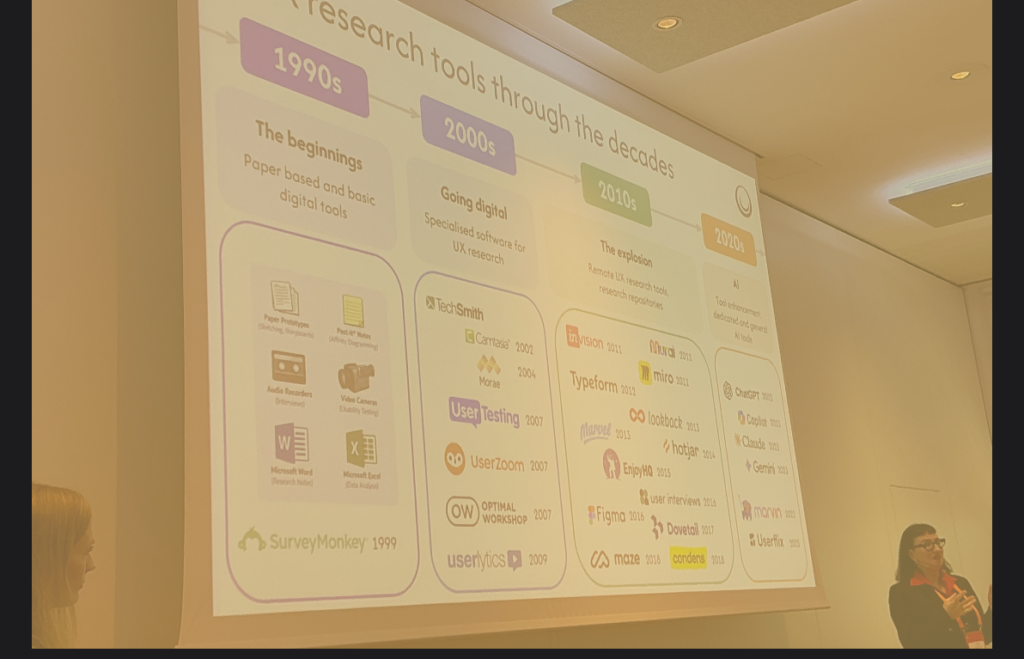
Sabrina showed how tools have evolved over the decades:
👉 1990s – paper prototypes, sticky notes, voice recorders, Excel
👉 2000s – specialized software: Camtasia, Morae, UserTesting
👉 2010s – remote testing, Miro, Figma, Maze, research repositories
👉 2020s – AI: ChatGPT, Copilot, Claude, Gemini
Each phase promises the same thing: greater speed. This is a lot like the maps I mentioned in my previous post—where the “best” route is almost always the fastest one, too.
🤖 AI speeds things up-but what do we lose?
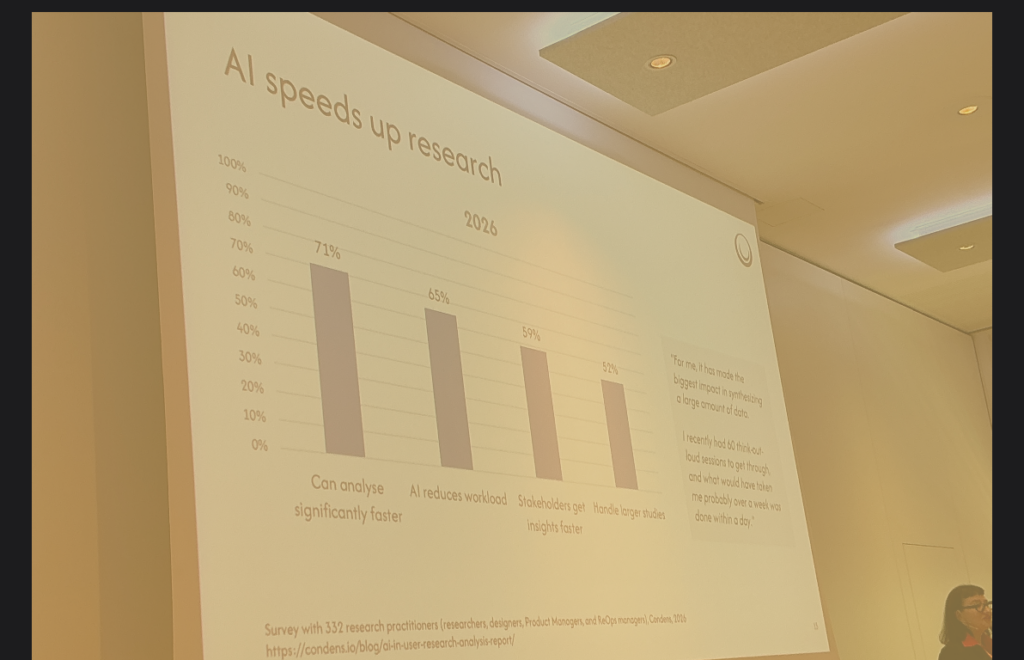
In a 2026 survey by Condens involving 332 practitioners, 71% of respondents reported that they are now able to conduct analysis significantly faster. 65% noted a reduced workload, and 59% mentioned that stakeholders receive insights more quickly [2]. One researcher shared that they were able to process 60 “think-aloud” sessions—a task that would have previously taken a full week—in just one day.
That sounds great. However, the report itself carries a subtitle about the gap between speed and trust, which I believe is the crucial point. Spending a week on 60 sessions isn’t just “lost time.” It’s a period spent living with the data—revisiting it and noticing the small details. It’s much like walking through a city instead of following turn-by-turn navigation: you might arrive more slowly, but you end up remembering far more.
Sabrina noted that the overall impact of AI on research is essentially neutral—neither inherently good nor bad. Furthermore:
❗ AI cannot forge a single, shared vision that a team can truly believe in. That is the role of design sprints, where people sit together and think together.
❗ AI cannot replace the experience of observing users and being there alongside them.
🦥 Core skills = “slow” skills
Sabrina suggested getting back to the essentials:
👉 communication
👉 empathy
👉 active listening
👉 teamwork
👉 the ability to connect people
👉 teaching/learning
👉 storytelling
Looking at this list, I realized that none of these skills can be accelerated. You can’t practice active listening at 2x speed, and empathy doesn’t function “in the background.” It’s about presence, not throughput-much like what Gail said regarding cities.
According to a salary report from Zebra People [3] that Sabrina shared, the share of time spent communicating with stakeholders has grown from 12% in 2019/2020 to 18% in 2023. In other words, the market itself is shifting toward the very things that AI cannot do.
📈 The Market
According to Jakob Nielsen’s estimates, the UX profession grew from approximately 1,000 people in 1983 to 1 million by 2017 [4]. The market is still expanding, though it has become more crowded over the last 2–3 years.
🙋 The Concept of “Slow Research”
For me, the key takeaway is this: AI can handle the “fast” aspects-transcription, sorting, and initial clustering-which frees up time for the “slow” aspects. The real question is whether we dedicate this extra time to the users, or simply take on even more projects.
I choose the former. After all, whether we’re navigating a city or conducting research, the most valuable moments happen when we pause.
Sources 🛈
[1] Sabrina Duda — SMILING. Available at: https://www.smiling.club
[2] AI in User Research Analysis: What 332 Practitioners Told Us About the Gap Between Speed and Trust. Condens, 2026. Available at: https://condens.io/blog/ai-in-user-research-analysis-report/
[3] Zebra People — Digital Salary Survey. Available at: https://zebrapeople.com
[4] A 100-Year View of User Experience. Jakob Nielsen, Nielsen Norman Group. Available at: https://nngroup.com/articles/100-years-ux/
