Wie viel Storytelling verträgt Lernen?

Faktenbasiertes Lernen ist oftmals anstrengend und langweilig, besonders wenn es um striktes Auswendiglernen für den nächsten Test geht. Es gibt einige Strategien und Tools, die dafür eingesetzt werden können, Lernmaterialien interessanter aufzubereiten, damit sich die Inhalte

1. besser gemerkt werden und

2. der Lernprozess angenehmer ist.

In einem anderen Blogartikel schrieb ich bereits über den Einsatz von Humor. In diesem möchte ich auf didaktisches Storytelling eingehen.

Storytelling kann die Wissenschaftskommunikation enorm stärken, wenn die Geschichte exakt auf das Lernziel ausgerichtet ist. Wichtig dabei: Sie darf nicht ablenken. Solche Ablenkungen in Lernmaterialien, wie es auch Bilder, Hintergrundmusik oder ein Cartoon-Streifen sein können, nennt man auch „Seductive Details“. [1] Diese Details werden von Wissenschaftskommunikator:innen oftmals aus gutem Grunde eingesetzt: Um Aufmerksamkeit zu erregen. Jedoch lenken sie meist nur ab. Didaktisches Storytelling muss also mit Achtung gesetzt sein. Entscheidend für das Lernen ist also weniger das quantitative Storytelling, als wie eng Narrativ und Information aufeinander abgestimmt sind. [2]

Warum Storytelling in der Wissenschaft funktioniert

Die Geschichte ist eine der grundlegendsten Formen, in denen Menschen Erfahrungen habe und Wissen sammeln. [3] Schon seit Kindheit an kommunizieren wir mit Einsatz von Narrativen. Geschichten helfen dabei Ereignisse emotional, kausal und zeitlich zu verknüpfen, wodurch komplexe Informationen zugänglich gemacht werden können. [2]

Tatsächlich gibt es einige Studien über die positiven Auswirkungen von Narrativen auf das Lernen. Diese Studien zeigen, dass Narrative Formate

  • Interesse und Aufmerksamkeit steigern können. [4]
  • Verständnis und Einfühlung, sowie Merkleistung fördern. [3]
  • Soziale Normen, Einstellungen und Verhalten in Bezug auf medizinische Informationen beeinflussen können. [5 & 6]

Gibt es bei Storytelling ein „zu viel“?

Mayer beschreibt die „Cognitive Theory of Multimedia Learning” [7], die von einem verbalen und einem visuellen Kanal ausgeht, sowie einer begrenzten Kapazität aktiv Informationen zu verarbeiten. In der Wissenschaftskommunikation bedeutet das, dass zusätzliche Elemente, die nicht unbedingt zur Erklärung des Lernstoffes beitragen, eher kognitiv überlasten, als dass sie zum Lernen beitragen. (Siehe „Seductive Details“). Für Schüler:innen bedeutet das eine verschlechterte Verständnis von Zusammenhängen. Witzige Anekdoten, Nebenhandlungen oder irgendwelche Backstories in der Erzählung scheinen vielleicht interessant, können aber, wenn schlecht eingesetzt, total vom eigentlichen Lerninhalt ablenken. [1]

Im Kontext zu einem guten Erklärtext oder -video bedeutet das, dass Storytelling kein „Deko-Element“ sein darf. Jede Figur, Metapher, Nebenhandlung sollte eine klare Funktion haben und darauf abzielen, den Fachinhalt verständlich zu machen.

Der Leitfaden zu gutem Storytelling für Fachinhalte

Ich habe hier ein paar Tipps und Tricks aufgelistet, die dabei helfen können ein richtiges Gefühl für den Einsatz von Narrativen in der Wissenschaftskommunikation zu bekommen (basierend auf meinen bereits angeführten Quellen):

  1. Klare Hauptaussage: Gleich am Anfang der Geschichte wird eine Kernfrage in den Raum gestellt. Die Geschichte dreht sich um das beantworten dieser Frage und weicht davon nicht ab.
  2. Charaktere als Identifikationsfiguren: Charaktere nehmen die Perspektiven der Schüler:innen ein. Das macht Entscheidungen und Emotionen nachvollziehbar. Schüler:innen werden so selbst zum Teil der Geschichte und finden sich in der Rolle der lernenden Charaktere wieder.
  3. Konflikte, Probleme, Wendepunkte: Das macht eine gute Story einfach aus. Eine Hürde könnte z.B. durch neu erlangtes Wissen der Charaktere überwunden werden. Wichtig hierbei ist das Lernziel nicht aus den Augen zu verlieren.
  4. Reduktion von „Seductive Details“: Nicht zu viel Ablenkung schaffen. Sonst wird sich nur die Nebenhandlung gemerkt, nicht der eigentliche Inhalt.
  5. Zusammenarbeiten von Narrativ und Visualisierung: Bei simultaner Verwendung von Bildmaterial und Text (in geschriebener oder auditiver Form) sollten diese parallel eine Geschichte erzählen, nicht als Add-On dienen.

Zusammenfassend: Storytelling soll so viel wie möglich eingesetzt werden, da es Zusammenhänge sichtbar machen kann und auf Emotionen anspielt, die sich positiv auf Merkfähigkeit und Verständnis auswirken.

Quellenverzeichnis

  1. Malamed, Connie (o.D.): Watch Out For Those Seductive Details. In: The eLearning Coach, https://theelearningcoach.com/learning/seductive-details/ (zuletzt abgerufen am 04.01.2026)
  2. Norris, Stephen P. u.a. (01.06.2005): A Theoretical Framework for Narrative Explanation in Science. In: Wiley InterScience, <https://doi.org/10.1002/sce.20063> (zuletzt abgerufen am 04.01.2026)
  3. Hinyard, Leslie J./Kreuter, Matthew W.: Using narrative communication as a tool for health behavior change: a conceptual, theoretical, and empirical overview. In: Health Educ Behav. 2007 Oct;34(5):777-92. <doi: 10.1177/1090198106291963>
  4. Riedlinger, Michelle u.a. (2019): Telling stories in science communication: case studies of scholar-practitioner collaboration. In: JCOM 18(05), N01. <https://doi.org/10.22323/2.18050801> (zuletzt abgerufen am 04.01.2026)
  5. Moran, Meghan u.a.(2015): The Ability of Narrative Communication to Address Health-Related Social Norms. In: International Review of Social Research 2013, 3(2): S. 131–149.
  6. Bekalu, Mesfin A. u.a.: The relative persuasiveness of narrative versus non-narrative health messages in public health emergency communication: Evidence from a field experiment. In: Preventive Medicine 2018, Vol. 111, S. 284-290, https://doi.org/10.1016/j.ypmed.2017.11.014.
  7. Mayer, Richard E.: Cognitive theory of multimedia learning. In: The Cambridge Handbook of Multimedia Learning, S. 85-139. Source: Kapitel als PDF-Auszug „Multimedia Learning“, chrome-extension://efaidnbmnnnibpcajpcglclefindmkaj/https://www.jsu.edu/online/faculty/MULTIMEDIA%20LEARNING%20by%20Richard%20E.%20Mayer.pdf (zuletzt abgerufen am 04.01.2026)

Blog Post 8: Planning a public survey

Public survey

The next step in this project is to develop a survey strategy that enables me to gather insights into train travel in Germany from the perspective of other travelers. To achieve this, I will first establish a solid research foundation and prepare the necessary framework to begin conducting interviews in the coming weeks.

Survey planning

A crucial starting point for any survey is defining its purpose and objectives. It must be clear why the survey is being conducted, what goals it aims to achieve, and which hypotheses or questions it seeks to answer. A well-defined purpose helps ensure that the survey is goal-oriented and produces meaningful results (Public Affairs, 2026). In the context of this project, conducting a survey is essential because individuals experience train stations in very different ways, resulting in a wide range of needs and expectations. These insights cannot be fully understood without engaging directly with users on site. The primary goals of the survey are to identify key pain points, explore potential solutions, and broaden my understanding of user experiences at train platforms. The main questions guiding this research are how travelers currently experience train stations, which problems they encounter, and how these issues might be addressed.

Once the purpose is defined, identifying the target group becomes the next important step. A clearly defined audience helps ensure that the collected data is relevant and representative of actual users (Team, 2025). For this project, the target group is broad and diverse, encompassing anyone who interacts with the German rail system. However, particular attention will be given to those who regularly use or work on train platforms, such as travelers, station staff, conductors, and onboard personnel. These groups are most directly affected by platform design and are therefore likely to provide valuable and experience-based insights.

The next step is developing the survey questions. A helpful approach is to initially collect all potentially relevant questions and then organize them into a logical structure that allows for smooth questioning and clear answers. It is also important to determine the appropriate question formats and response types (Team, 2025). Both the questionnaire and the chosen survey method must suit the target group as well as the project’s time and resource constraints (Public Affairs, 2026). For this study, I have chosen an in-person interview format conducted directly at selected German train stations. While the final set of questions is still being developed, it will be completed before the next blog post.

Before launching the survey, testing and finalization are essential. Conducting a pilot test with a small group helps identify unclear questions and areas that require adjustment (Public Affairs, 2026). I plan to carry out this test run with people in my immediate surroundings, who can provide honest and constructive feedback to improve the questionnaire before it is used in a public setting.

Once all preparations are complete, the survey can be conducted. Here the questions are brought out to the public and are closely monitored while they’re active, to ensure a smooth and targeted process (Public Affairs, 2026). During this phase, the survey will be carried out in person at multiple train stations and on several dates. While conducting the interviews, I will observe which questions are easy or difficult to answer, how willing people are to participate, and the nature of the responses provided. This ongoing reflection will help assess the effectiveness of the survey design.

The final step is the analysis and presentation of the collected data. At this stage, the information will be processed, interpreted, and structured using appropriate analytical methods. The results will then be transformed into a clear and accessible format to make them understandable for others (Public Affairs, 2026). The specific analytical approach will be determined once the interviews are completed and the nature, scope, and quality of the data are fully understood.

Information Gathered

By taking a closer look at survey methodology and the process of conducting surveys, I gained a clearer understanding of the necessary steps involved and how these can be applied to my project.

Next Steps

The next step will be to develop the concrete survey questions and determine the locations where the research will be conducted. Once these aspects are clearly defined, I can carry out the survey and collect the intended data. After the results have been gathered, they will be combined with the insights obtained so far to begin developing concepts aimed at improving the user experience at German train stations.

References

Public Affairs. (2026). What are the most important steps in conducting an opinion poll? Von LinkedIn: https://www.linkedin.com/advice/0/what-key-steps-conducting-public-opinion-7yphf abgerufen

Team, Q. E. (13. November 2025). How to Conduct a Survey: 7 Steps That Actually Work. Von ProProfs Qualaroo: https://qualaroo.com/blog/how-to-conduct-a-survey/ abgerufen

What Can We Conclude About Alien Life Through “The Zoologist’s Guide to the Galaxy”?

About the Book

The book was written by the zoologist Dr. Arik Kershenbaum, who’s also a member of the international board of advisors for METI.org, a think tank on the topic of Messaging Extra Terrestrial Intelligence. The book is an exploration of what aliens could be like based around what we know about our current eco-system.

Aliens, Animals and Alien Animals

After giving a brief insight into the topic – what the current position of science is, what we can infer about aliens with our knowledge of zoology on earth, the book goes into the discussion of what is common in life on earth.

Kershenbaum declares that “If the nature of the universe is the same everywhere, then life conforms to the same rules everywhere.” Meaning there should be biological, universal laws, that form the absolute basics of what constrains life, and dictates its nature. If we find these, we can make general assumptions about life on other planets.

Form vs Function

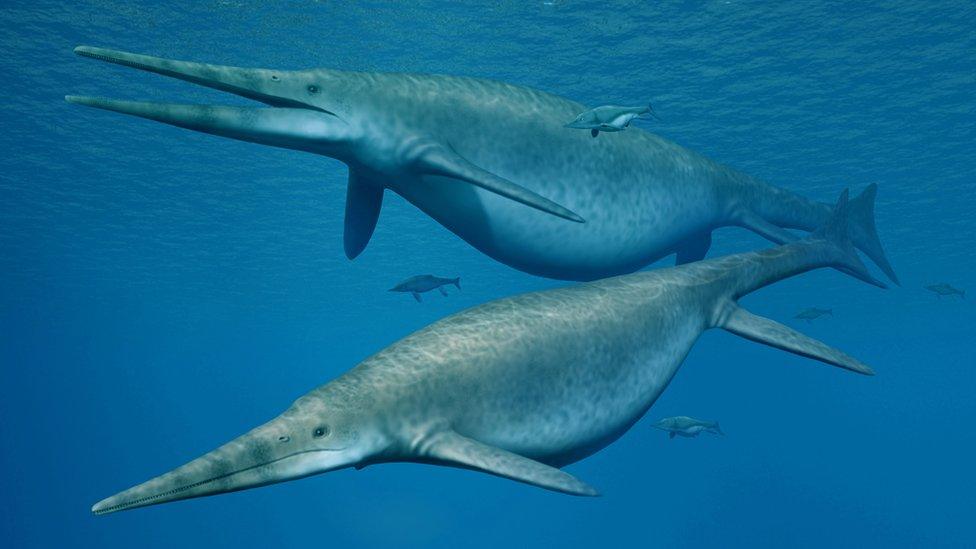
Convergent Evolution – Sometimes different animal species evolve into similar shapes because evolution tends to work similarly in similar environments (ichthyosaur and dolphin pictured here)

First, it’s important to separate form and function. Why are certain characteristics and behaviours prevalent? What purpose do they serve? What evolutionary role? Almost all the forms we see in animals have some function that improves the animal’s ability to live, thrive and survive.Sure, sometimes evolutionary “accidents” do occur, where a form has no proper function. But maybe it used to serve a purpose that’s not needed anymore.

Whales still have hip bones even though they don’t need them anymore because they used to be land mammals.

It’s also important to define what exactly an animal is. What separates us from other lifeforms like fungi for example? And in turn what would we perceive as an alien lifeform?

Movement

Animals need to move to survive, it’s an evolutionary pressure. Hunting, escaping predators, travelling from point A to point B (to find more food) – we need to move to achieve any of these things.

Communication

The senses – sight, hearing, smell, touch and taste – aren’t just for taking in our surroundings. Some of these signs and signals are directed at similar or other animals to communicate. The world is full of signals being transmitted through different physical means, though sight and sound are the most obvious to us. Even if alien life might communicate in completely different ways and wavelengths, they would still need to communicate somehow.

Intelligence

Humans and animal don’t outwardly share the same level of intelligence, but does that mean there is a qualitative difference between our cognitive abilities? And what if anything is fundamental to intelligence? What particular behaviours or abilities do we view as a sign of intelligence? Or should we focus on the brain itself? Its shape, size, the way it’s programmed? It’s not easy to measure intelligence, especially when we do it in a way that doesn’t just apply to humans. And if we can’t do it in a way that applies to life on earth, how could we possibly hope to measure the intelligence of alien life?

Instead, we should find a common basis. Fundamentally, intelligence is about solving problems. Energy, space, time are limited. So what’s the best way to make use these limited resources and gain an advantage over others? That’s what intelligence is.

Sociality

Humanity would not have come as far as it did if we hadn’t been social creatures. Building communities, advancing technology, none of it would have happened if we weren’t social animals. When applying the question of sociality to alien life there’s three things important to consider: Firstly, why do animals live in groups and what makes them actively participate? Secondly, which conditions will lead to cooperative societies and which might prevent them? And thirdly, what are the expected outcomes and consequences of this?

Information

We have talked about communication itself, but it’s also important to consider what kind of information lifeforms share and how much of it. Life or death can turn on the right or wrong piece of information for an animal; it’s a key factor in natural selection. Acquiring and transferring information, be it reliably or deceptively can be key to survival.

Language

Language is what separates us humans from animals. Every other feature like tools, culture, emotions, planning, even humour we share, but language is sole to us. Language allows us to glimpse into the minds of other people in a way we will never achieve with animals. It also shapes the way we think and makes us who we are. It drives and enables our ability to cooperate.

Language can’t be clearly defined, however. It has no clear-cut characteristics. We don’t even know whether language is an ability that a particular species either has or doesn’t have, or if some have more than others. We don’t know if language is a single thing or a structure shared by every civilization. Or maybe just an ability, a functionality, which could be implemented in any kind of way.

To understand what alien language could be like, first we must ask ourselves what language is on Earth. And whether this is how language must be everywhere else in the universe. Or if an alien language would be totally incomprehensible to us.

Biological Laws – What rules does all life abide by?

  1. Complex life evolves by natural selection.
  2. Adaptions happen for a reason and serve a specific purpose. Usually these purposes are finding food, avoiding becoming food, and reproducing.
  3. Organisms need to move to find food and avoid becoming someone else’s food.
  4. Senses are necessary to take in the world but also to communicate with other members of the species.
  5. The ability to solve problems is fundamental to life.
  6. Life thrives in social communities.
  7. Information is key, in every ecosystem, on every planet.
  8. Language allows for complex communication and is a sign of civilisation.

Sources

  • Kershenbaum, Arik: The Zoologist’s Guide to the Galaxy. What Animals on Earth Reveal About Aliens – and Ourselves. UK u.a.: Penguin Books 2020 [E-Book]

Life in a Distant Galaxy

We’ve talked about life that will come after us, and what life before us looked like. But what about life on other planets? How do we imagine alien life? And where does the reality differ from the image we created in media?

Small Green Men

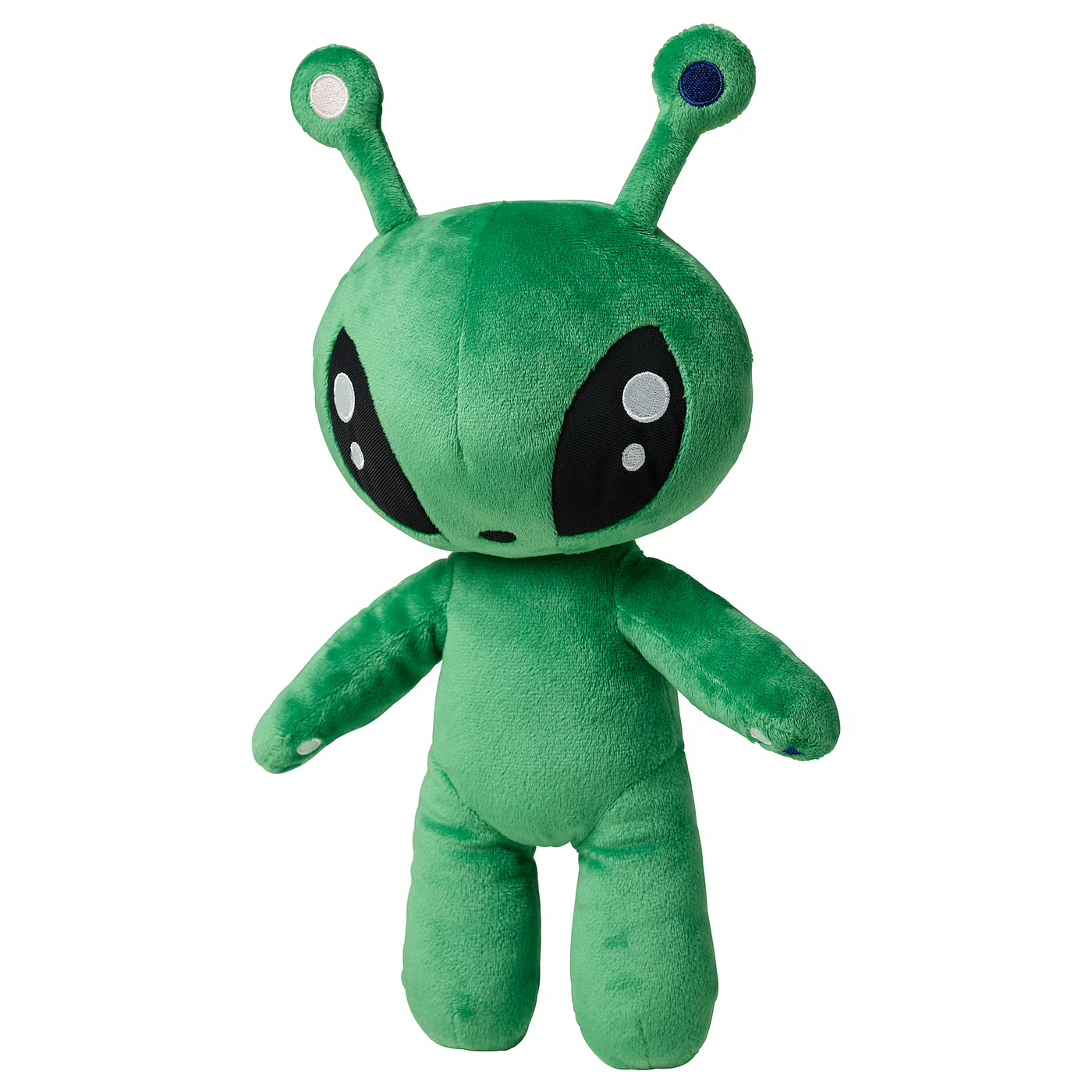
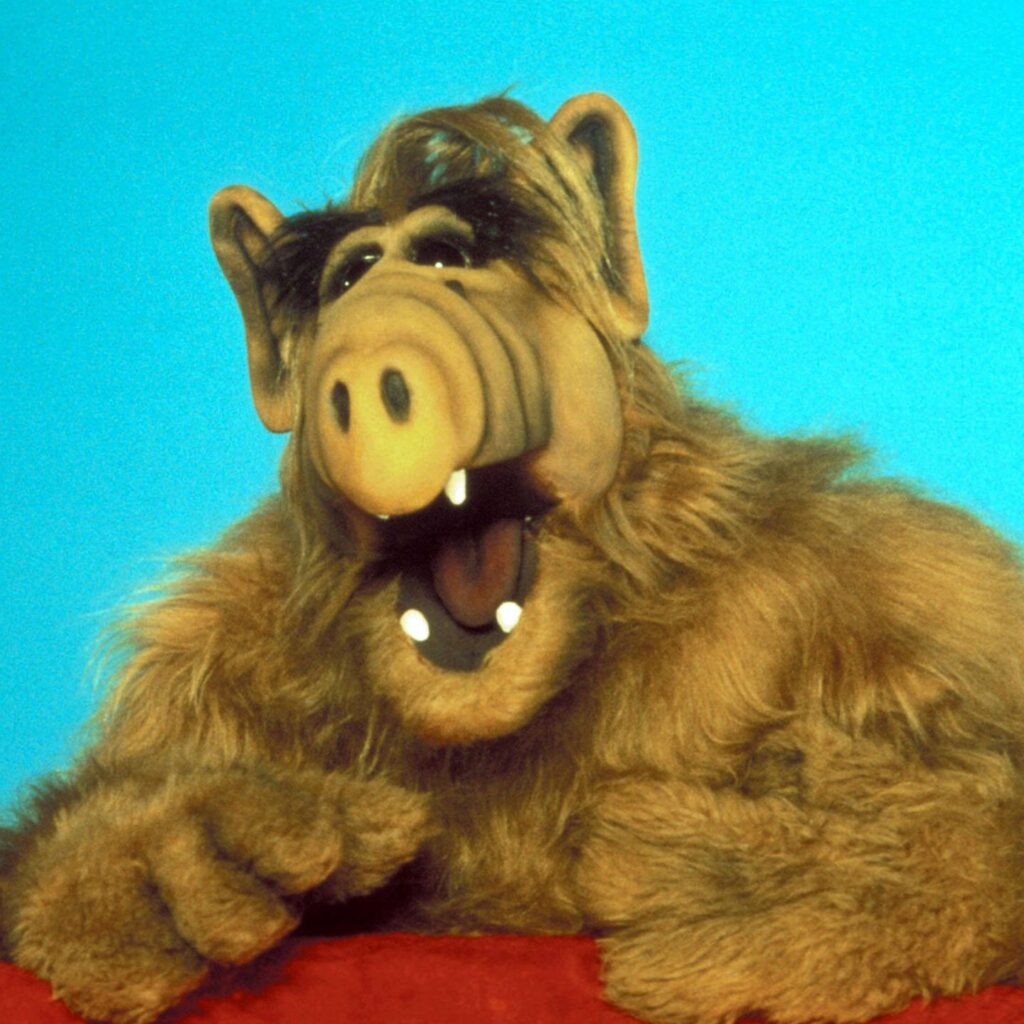
Aliens are used as a classic embodiment of the other in media. From small green men to furry monsters and incomprehensible shapes – aliens are an unknown kind of people who appear grotesque and strange, who might be exactly like us, even become or friends or allies. Or might just be our doom, the total destruction of or race. Or who might be so incomprehensible to us that we can’t even begin to understand them.

“Aftonsparv” plush from IKEA, Alf from the TV show Alf (1986) – Jean Jacket from Nope (2022)

Where Is Everyone Else?

Of course, for us to meet aliens, there would need to be aliens. But where are they? The universe is infinite, it’s preposterous to say we’re all alone.

We can make an educated guess about what environments support life, using our own planet as a basis. Habitability requires certain conditions like the availability of water, energy and carbon. Thus, allowing life to be established, but also allow to sustain it and make it flourish. It sounds simple enough, but Earth is in fact a rarity out in the universe. We have yet to discover a world that would be suitable or even remotely habitable for a human being without extensive artificial help. Even planets that count technically as habitable have such extreme environmental conditions that earth-like life could never exist there. Additionally, environments are not static. They change over time and the conditions present during the appearance of life might not be those needed to maintain life or are even capable of supporting it long-term. This also assumes that any planet that has or had the ability to support life will definitely have contained it.

Life is surprisingly fickle and habitable environments are rare. When imagining alien life, we not only need to consider what environment might sustain life, but what type of life would even be able to life there. Here the defining factors are temperature, acidity and salinity. We can study these conditions on Earth, though they will never be able to accurately copy environments on different planets given factors like gravity and atmosphere.

That doesn’t mean it’s not worthwhile to explore. Intelligent life elsewhere might not look like anything we’re even capable of imagining, but it’s still up to us to try. To wonder what else is out there and if we ourselves could one day settle on a planet far away.

“Nowhere in space will we rest our eyes upon the familiar shapes of trees and plants, or any of the animals that share our world.” – Arthur C. Clarke, Author of 2001: A Space Odyssey

Sources

  • Wolfschlag, Claus M.: Traumstadt und Armageddon. Zukunftsvision und Weltuntergang im Science-Fiction-Film. Graz: Ares 2007
  • Preston, Louisa: Goldilocks and the Water Bears. The Search for Life in the Universe. London, New York: Bloomsbury Publishing 2016 [E-Book]
  • Kershenbaum, Arik: The Zoologist’s Guide to the Galaxy. What Animals on Earth Reveal About Aliens – and Ourselves. UK u.a.: Penguin Books 2020 [E-Book]

How Do Artists of Today Depict Dinosaurs? – A Look at “The Palaeoartist’s Handbook”

About the Book

The book was written by the British vertebrate palaeontologist, author and palaeoartist Dr. Mark P. Witton and is meant to be an introduction to paleoart, as well as its history and the processes accompanying it.

Leaping Laelaps by Charles R. Knight, 1897

Reconstructing Extinct Animals

After briefly introducing the subject, the book goes into the history of palaeoart. It started back in the late 1700s, originating along with palaeontological science. Though it might have begun long before, influencing the depictions of many different mythical animals (e.g. the head of a cyclops was inspired by a fossil elephant skull). A lot of early paleoart has been lost over the years, however, since many depictions weren’t preserved after they became scientifically obsolete.

The next chapter discusses the process of researching, resource gathering and planning that goes into creating a piece of palaeoart. It’s not just anatomy that matters, but also the time and place of the fossil find. For this the latest information on the subject species is gathered, along with its contemporary fauna and flora and its habitat to create the closet possible depiction.

Fossils

The fossils are crucial glimpses into the proportion, size and appearance of an extinct animal. Not just skeletons, but also exoskeletons, shells and preserved tissue of corals and plants. These findings can be used to make predictions about the skeletal form, proportions and articulation. A lot of species were only partially preserved – here its necessary to know what goes into the reconstruction of a skeleton.

Techniques like phylogenetic bracketing are used here, where the position in the evolutionary tree is used to infer things about the extinct animal. Cross-scaling is also a useful tool, hereby bone elements common to two species are scaled to the same size – assuming that non-common elements can be scaled to the same degree, too. Here the most reliable bones to use for would be those of the upper limb.

Tissue

Musculature is one of the most critical aspects in reconstruction, as it provides major contours of the animal’s bodies. It’s essential to have a good understanding of the muscle distribution and bulk to create a realistic depiction of an extinct animal. Fatty tissue overlying the musculature is much more difficult to predict, but nonetheless important and thus should be considered. There are trends we can observe when it comes to the distribution of fat, however. Reptiles for examples often have fat behind their heads, around their torsos and around their tails, while mammals and birds tend to mostly deposit their fat around their torso, as well as neck and face. Aquatic species have fat tissue around their whole body – here it is used to minimize heat loss.

Only leaning on the skeletons as reference can lead to making the reconstructed animals seem underweight, or forgoing their internal organs completely. As a rule, the curvature of the stomach should be a gentle arc between the sternal and the pelvic region.

Skin

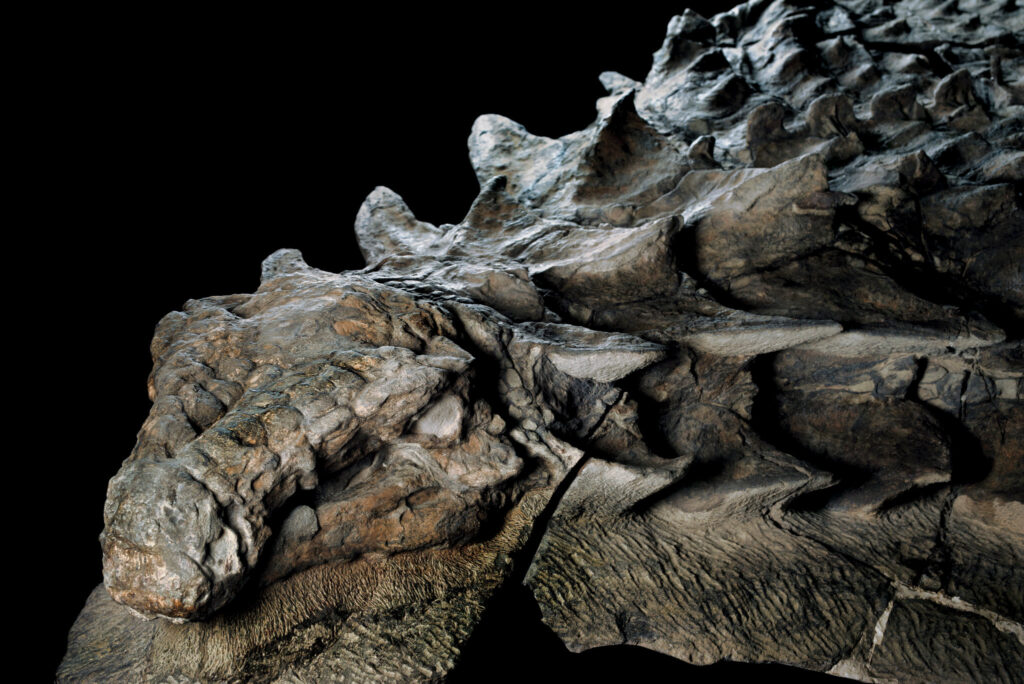
Skin type and colouration are among the most debated, controversial and seemingly unknowable components of palaeoart, given how rarely skin gets preserved. Data about this has made many leaps forward however, updating how we view certain extinct animals frequently. Skin can vary in toughness and texture, while fur and feathers rarely get preserved.

mummy of a nodosaur found in Alberta, US – one of the best preserved dinosaur skin and armor ever found

Dermal tissue can be as tough as resistant as cartilage, while not being reliant on bones like other armoured skin. Instead it can be inferred from evenly-distributed projections growing out of the bone. Many horns and crests have no bony components, instead being formed from stiffened, toughened skin. They are rarely preserved, because of which they are reconstructed based on the bony structures that once supported them. The same goes for fins, flukes and flippers if they aren’t supported by limb bones.

What can we take away from this?

A lot of the knowledge in this book can not only be used for palaeoart, but creature design overall. Its important to understand what we’re depicting when trying to create a believable animal. Nothing happens in a vacuum, evolution goes hand-in-hand with its environment. Knowing not only the basics of anatomy, but also why certain physical attributes developed and for what purpose can aid us in creating immersive (fictional) worlds.

Sources

  • Wikipedia. Die freie Enzyklopädie (07.12.2025), s.v. Mark P. Witton, https://en.wikipedia.org/wiki/Mark_P._Witton (zuletzt aufgerufen am 30.12.2025)
  • Witton, Mark P.: The Palaeoartist’s Handbook. Recreating prehistoric animals in art. Ramsbury, Marlborough: The Crowood Press 2018 [E-Book]

Who is in Control? The Battle for Agency

Design & Research | Master Thesis Log 06

For the last few weeks, I have analyzed photography through the lens of philosophy. But as an Interaction Designer, I need to understand the user.

This week, I interviewed two distinct photographers. My goal was to investigate a core design problem: When the machine (AI) takes control of the image, do we lose the art?

The data I collected was surprising. One photographer sees a new evolution of tools, while the other sees a moral battle for truth.

The first subject is a working digital photographer who uses modern tools. In our discussion, we talked about features like Generative Expand—where AI creates the background for you.

For him, this isn’t about “faking” reality; it’s about utility. He explained that sometimes you don’t have the budget for a studio or the right location, so the AI helps you “fix” the background. He is willing to give up control of those pixels to solve a problem.

I pushed him on the question of Agency: If the camera is digital, is the computer doing the work?

He clarified a crucial distinction across several of his answers. For him, the human is absolutely still in control, provided one condition is met: Manual Settings.

He emphasized that as long as the photographer is manually managing the technical variables—White Balance, Shutter Speed, Aperture, ISO—the human is the “Pilot.” Even if the image is digital, the decisions are human.

This is a vital finding for my thesis. It suggests that for digital natives, “Agency” is located in the Settings Menu, not the film roll.

However, he admitted that as AI improves, this balance might shift. He expressed a real uncertainty about where the line will be drawn in the future:

“I don’t think it will ever die honestly it’s a form of art that’s been around forever I think it may change in ways I hope it doesn’t get so reliant on AI but who truly knows.”

Then, he offered a profound prediction. He believes that the definition of “Authenticity” is about to shift. Just as Film became the “vintage” alternative to Digital, he believes standard Digital cameras will become the “Authentic” alternative to AI:

I think you will always have it around even if one day ai takes over you will have those who will still shoot film and those who will use digital as the new form of film vs AI which scary to think about but true

This suggests that “Agency” is relative. In 2030, holding a digital camera and manually setting the White Balance might be seen as the ultimate act of human control, because it proves a human was there.

On the other side, I interviewed a legend in the New York film photography scene. He is known for capturing the “Madness” of NYC—raw, unedited, and chaotic.

I asked him if the perfection of AI images offends him. His answer ignored the utility argument entirely. He focused strictly on Value.

“I ignore it. Work done by a human will always be worth more”

He believes that the “Apparatus” (the machine) cannot create value. Only human labor creates value. When I asked if the public will eventually be fooled by the shiny look of AI, he gave a final verdict:

“The truth always prevails”

For the Purist, “Control” is binary. You either have it, or you don’t. He refuses to let the AI fix his backgrounds or clean up his noise, because those imperfections are where the “Truth” lives.

This field research has clarified the conflict I am studying. We have two user groups with opposing definitions of “Control”:

  • Group A (Evolution): Believes in Selective Control. As long as they control the technical settings (Manual Mode), they feel like the artist—even if AI helps generate the background.
  • Group B (Resistance):  Believes in Total Control. They reject machine intervention entirely because they believe value comes from physical truth and human labor.

Refining the Question:
If we allow AI to take over parts of the process (as Group A accepts), do we eventually destroy the “Value” that Group B cherishes? Or is controlling the “Settings” enough to keep the human soul alive?

Next Steps

To answer this, I need to find the middle ground. Next week, I am interviewing “Hybrid” creators—people who use both manual film cameras AND high-tech Cameras. To see how they navigate the balance between Control and Automation.

Die systematische Unterrepräsentation von Frauen in der Wissenschaftskommunkation

In meinem ersten Blogartikel zu der Unterrepräsentation des weiblichen Körpers in didaktischen Erklärvideos habe ich bereits über den Bechdel Test geschrieben und diesen neu erfunden. Unterrepräsentation von Frauen gibt es jedoch nicht nur in Erklärvideos, sondern in sämtlichen Bereichen der Wissenschaftsdarstellung. In diesem Blogeintrag möchte ich vertieft darauf eingehen und einen Leitfaden für Mediendesigner:innen darlegen, wie sensible Wissenschaftskommunikation funktioniert.

Wir leben in einer androzentrischen Welt, die von einer „männlichen Norm“ ausgeht. Dies hat nicht nur soziale und gesellschaftliche Folgen, sondern auch wissenschaftliche und medizinische. In vielen Lernmaterialien, Videos, Büchern und E-Learning Plattformen wird der „neutrale“ Körper mit männlichen Geschlechtsmerkmalen dargestellt. Wie bereits in meinem ersten Blogeintrag zu dem Thema, sowie in dieser Studie: (Are stereotypes in decline? The portrayal of female anatomy in e-learning – PubMed) festgestellt, werden “geschlechtsneutrale” Erklärungen des menschlichen Körpers (Funktion Verdauung, Atmung, Herz-Kreislauf etc.) in einer überwiegenden Mehrheit anhand eines männlichen Körpermodelles dargestellt. Der weibliche Körper wird vor allem dann herangezogen, wenn es um sexualisierte oder reproduktive Kontexte geht (Reproduktionssystem der Frau, Sexualkunde etc.).

In 2008 veröffentlichte Science Daily eine Statistik zur Visualisierung von Geschlechtern in medizinischen Textbüchern, die ähnliches offenbarte. Die Darstellung neutraler Körperteile fand um bis zu 83% öfter am Modell eines männlichen Körpers statt. Außerdem wurden zu 75% nur Modelle vom kaukasischen Menschen (helle Haut) gezeigt. Die Studie ging auf Transpersonen nicht ein, doch es ist davon auszugehen, dass hier ebenso eine große Unterrepräsentation vorliegt. [2]

Warum ist Repräsentation so wichtig?

Die mediale Unsichtbarkeit einer Personengruppe bringt die Festigung von Stereotypen mit sich. Verzerrte und sexualisierte Darstellungen gehen mit Body Shaming und internalisierten Schönheitsidealen einher, sowie mit einer höheren Toleranz für Sexismus, Belästigung und Gewalt. Im medizinischen Kontext kann sie zu fehlerhaften Diagnosen und falschen oder verzögerten Behandlungen führen. [3,4] Und das kann tödlich enden.

Wie die KI den Stereotyp weiter befeuert

Ich habe ein kleines Experiment gewagt. Ich fütterte ChatGPT mit dem Prompt „Erstelle mir 10 anatomische Bilder des menschlichen Körpers“ mit dem Ergebnis: 2 von 10 Bildern ließen weibliche Körperformen erahnen. Auch bei weiteren Suchanfragen – „Anatomie menschlicher Körper“ – kam ich zu keinem anderen Ergebnis. Auch andere Analytiker:innen beschreiben ähnliches: Bei generischen Prompts, wie bei dem Wort „athlete“ werden in 9 von 10 Fällen männliche Körper erzeugt. [5] Doch warum ist das so?

Online-Bilderplattformen und Bildergeneratoren holen sich ihre Vorlagen aus dem von der männlichen Norm dominiertem Internet. Geschlechterstereotype werden ungefiltert und manchmal gar verstärkt ausgegeben. Und nicht nur die KI, sondern auch Mediendesigner:innen, die oft auf Stock-Material oder Inspiration aus dem Internet zurückgreifen, fallen in diese Falle. [5] Wer mit solchen aus dem Internet heruntergeladenen Inhalten arbeitet befindet sich in einem Ökosystem, in dem eine ganz bestimmte Norm herrscht: Männlich, weiß, jung, sportlich, heterosexuell, cis und ohne Behinderungen. Diese Norm wandert dann in Erklärvideos, Grafiken, Buchgestaltungen und anderen Wissenschaftsdarstellungen. [6]

Guidlines für Designer:innen zur Darstellung wissenschaflticher Inhalte

Designer:innen tragen große Verantwortung. Letztendlich sind sie es, die den größten Einfluss auf die visuelle Darstellung in der Wissenschaftskommunikation haben. Der erste Schritt ist das kritische Hinterfragen aller aus dem Internet gezogenen Inhalte.

Das Projekt Supera (Supporting the Promotion of Equality in Research and Academia) [6] veröffentlicht ein Paper mit “Guidelines for gender sensitive communication in research and academia”. Ein paar Guidelines daraus:

  • Vermeide irrelevante Information über Aussehen und Geschlecht einer Person.
  • Vermeide Auslassungen in visueller und verbaler Kommunikation. (Beispiel: Kommen in einer Illustration mehrere Menschen vor, achte auf eine angemessene Anzahl an Frauen, Männern, sowie androgynen Personen)
  • Präferiere die Darstellung von Frauen/Männern in nicht-traditionellen Rollen und Berufen.
  • Achte auf eine gender-sensitive Sprache.
  • Vermeide stereotype Farbgestaltungen (Frau – Rosa).
  • Hinterfrage Icons kritisch. Frauen werden auf Icons meist mit einem Rock dargestellt. Denke immer über Alternativen nach.

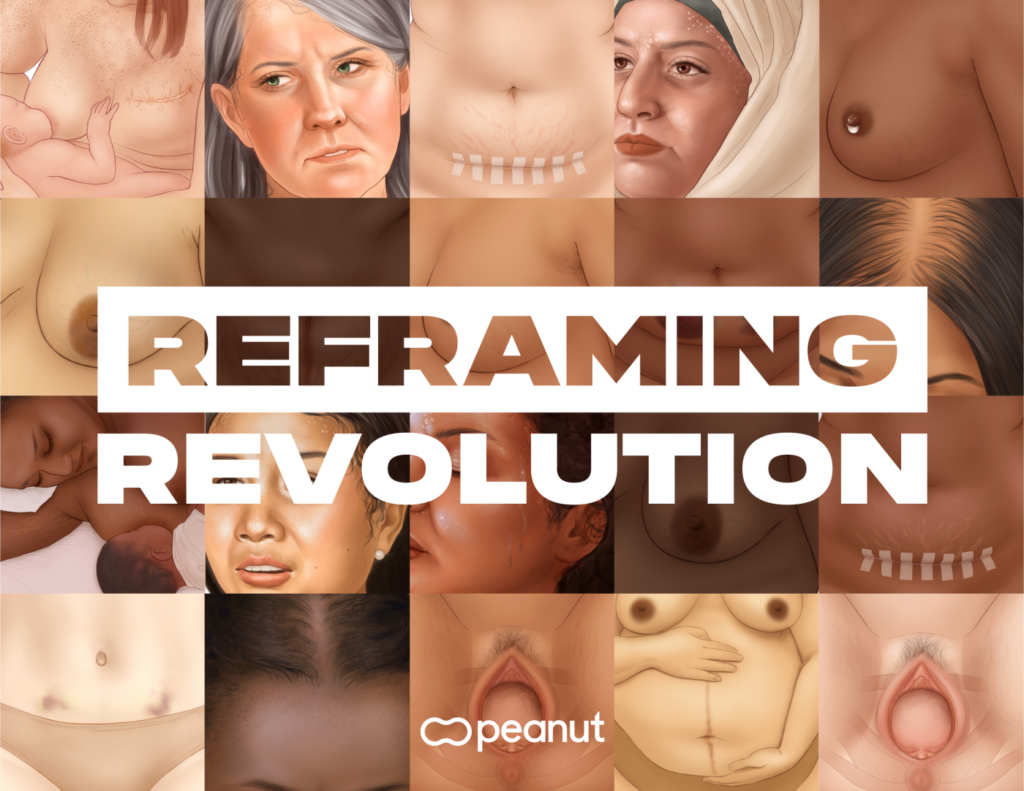
Es gibt bereits Initiativen, die versuchen aus dem „genormten Ökosystem“ auszubrechen. Hier werden gezielt medizinische Stock-Illustrationen erstellt, die ein realistisches Frauenbild erzeugen sollen. So sind darauf etwa weibliche Körper mit Dehnungsstreifen, Hautkrankheiten oder Geburtennarben abgebildet. [5]

Quellen:

  1. Are stereotypes in decline? The portrayal of female anatomy in e-learning – PubMed
  2. Heffernan, Aishling (03.06.2022): Gender-Blind Medicine. How Images Affect Diagnosis and the Health of Women. In: femLENS, https://femlens.com/blog-post/gender-blind-medicine-how-images-affect-diagnosis-and-the-health-of-women/ (zuletzt abgerufen am 01.01.2026)
  3. Santoniccolo, Fabrizio u.a. (09.05.2023): Gender and Media Representations: A Review of the Literature on Gender Stereotypes, Objectification and Sexualization. In: National Library of Medicine, https://pmc.ncbi.nlm.nih.gov/articles/PMC10218532/ (zuletzt abgerufen am 01.01.2026)
  4. Navlakha, Meera (04.05.2022): These illustrations are challenging the lack of representation in women’s healthcare. In: Mashable, https://mashable.com/article/reframing-womens-healthcare-illustrations (zuletzt abgerufen am 01.01.2026)
  5. Damjanovic, Jelena (26.11.2025): Study asks AI to generate male and female body images—with predictable results. In: Phys.org, https://phys.org/news/2025-11-ai-generate-male-female-body.html (zuletzt abgerufen am 01.01.2026)
  6. H2020 SUPERA & Gender-SMART: Guidelines for gender-sensitive communication in research and academia. In: supera, https://www.superaproject.eu/wp-content/uploads/2020/05/SUPERA-guidelines-gender-sensitive-communication.pdf [PDF], (zuletzt abgerufen am 01.01.2026)