Die Geschichte darüber, wie ich mich auf die künstlerische Bühne bringen will ._. (Part 5)

Hallo! Eine Woche habe ich gefehlt. Ich hoffe, niemand hat mich allzu sehr vermisst. (Falls doch jemand das hier überhaupt liest: Ja, danke, mein(e) teure(r) Leser(in)!)

Heute geht es (wieder) um Self-Branding, ein Thema, das auf den ersten Blick nach Freiheit und Selbstverwirklichung klingt, bei näherem Hinsehen aber ziemlich kritisch ist. Self-Branding suggeriert, dass wir unser Schicksal selbst in der Hand haben und Erfolg allein davon abhängt, wie gut wir uns „vermarkten“. Whitmer kritisiert jedoch, dass diese Vorstellung eine ideologische Täuschung ist.

In der Realität profitieren nur wenige tatsächlich davon. Die meisten erzeugen Inhalte, die den Plattformen nützen – nicht ihnen selbst. Die Versprechen von Selbstverwirklichung und Selbstkontrolle motivieren vor allem zu ständiger Produktivität. Wie Whitmer schreibt: „The discourse assumes that a worker’s successes—and failures—are attributable to their own passion and hard work.“ Gleichzeitig warnt sie: „Living up to that ideal is impossible, and when branding themselves on social media, workers risk irrelevance, invisibility, and discreditation.“ (Whitmer 2018, S.7)

Stefan Scheidt, Carsten Gelhard und Jörg Henseler weisen darauf hin, dass es bislang keine universell gültigen Modelle oder Theorien gibt. Die existierenden Ansätze sind fragmentiert, uneinheitlich und lassen sich nur schwer auf alle Menschen übertragen. Ein zentrales Problem besteht darin, dass Branding-Modelle generalisierbar sein sollen, gleichzeitig aber auf völlig einzigartige Individuen angewendet werden müssen – ein Paradoxon, das die Übertragbarkeit von Rezepten für Self-Branding stark einschränkt. (vgl. Scheidt/Gelhard/Henseler 2020)

Zudem mangelt es an empirischer Evidenz: Viele Fragen bleiben offen, insbesondere wie sich Human Brands über die Zeit entwickeln und wie ihre Nachhaltigkeit gesichert werden kann. Auch geschlechtsspezifische Unterschiede werden bisher kaum berücksichtigt. Die Autoren betonen, dass Self-Branding bislang oft stark aus der Marketing-Perspektive untersucht wird, während die menschliche und psychologische Dimension zu kurz kommt. Fragen nach den sozialen Mechanismen, der Selbstwahrnehmung und möglichen Ungleichheiten – etwa in der Selbstpromotion zwischen den Geschlechtern – werden bislang nur unzureichend erforscht. (vgl. Scheidt/Gelhard/Henseler 2020)

Insgesamt zeigen Scheidt, Gelhard und Henseler, dass Self-Branding ein komplexes und vielschichtiges Phänomen ist, das weit mehr Aufmerksamkeit in der Forschung verdient. Ein besseres Verständnis erfordert sowohl mehr empirische Studien als auch die Integration psychologischer, sozialer und langfristiger Perspektiven, um den individuellen und menschlichen Aspekt von Personal Branding stärker in den Fokus zu rücken. (vgl. Scheidt/Gelhard/Henseler 2020)

Self-Branding wird oft als Möglichkeit zur Selbstverwirklichung gesehen, doch einige Forscher*innen warnen vor idealisierten Vorstellungen. Nicht alle profitieren gleichermaßen, und die existierenden Modelle sind noch fragmentiert und wenig empirisch abgesichert. Auch psychologische, soziale und langfristige Aspekte werden bislang nur teilweise betrachtet. Insgesamt zeigt sich: Self-Branding ist ein vielschichtiges Phänomen, das Chancen bietet, aber zugleich differenzierte Betrachtung und weitere Forschung verlangt.


Quellen:

Whitmer, Jennifer M.: You are your brand: Self‐branding and the marketization of self. In: Sociology Compass (2019), https://doi.org/10.1111/soc4.12662

Scheidt/Gelhard/Henseler: Old Practice, but Young Research Field: A Systematic Bibliographic Review of Personal Branding. In: Frontiers in Psychology (2020), doi: 10.3389/fpsyg.2020.01809


[DesRes 1] Agile_x_SelfCheckout No. 2 :Creating User-Centered Strategies that align with Business and IT Goals in an innovative Agile Environment

In my first blog post I explained my motivation on the topic of Creating User-Centered Strategies that align with Business and IT Goals in an innovative Agile Environment.

Within the post I already mentioned that I might have the possibility to collaborate with a company for my thesis topic. Now I have gotten the confirmation from REWE Digital to support them during my studies as a working student. I will be working on various projects concerning the design and UX of cash registers and the checkout strategy of POS registers.

As off today it seems my focus will be on the development of the design and UX. I am excited to see what the projects have to offer for me and how I can use my skills and grow. The specific path of my thesis will therefore heavily depend on what’s going to happen at my future workplace, where I will start in January.

In the interview sessions and meetings I already discussed my tasks. However, as the line between confidential and public information is still a bit difficult to grasp I will try to stay as general as possible. One major aspect of the work in the UX Team is “aligning business, IT and UX goals” – so exactly what I want to focus on in my thesis. While this is not a specific topic the company is working on, it is one of the top priorities.

Concerning my next steps of action I will do deep dives into the topic Agile and Management. Here are some of the resources and literature I am planing on having a look at:

  1. Appelo, Jurgen. Management 3.0 : Leading Agile Developers, Developing Agile Leaders. 1. ed.., 2010.

2. Cooper, et al. About Face 3 : The Essentials of Interaction Design. Completely rev. and Updated., 2007.

3. Boston Consulting Group. Flores, Yu. Placing Desirability at the Center of Innovation. 2024  Flyvbjerg, Gardner. How Big Things Get Done: The Surprising Factors That Determine the Fate of Every Project, from Home Renovations to Space Exploration and Everything in Between. 2023

4. Laloux, u. a. Reinventing Organizations „visuell“ : ein illustrierter Leitfaden sinnstiftender Formen der Zusammenarbeit. 2017.

Source Nr. 1 was recommended to me by the Chief Agile Manager at my previous internship. I am looking forward to discover more about Agility – as off today I’m only familiar with this topic on the surface. I would like to gain deeper knowledge. Furthermore, I might consider some of the Lean UX and Lean StartUp Principles. I am excited to start my first literature screening sessions. I will outline my results and key points as well as findings in the next blog entry.

Concerning the cash registers I will stay curious whenever I go grocery shopping. I want to get a better grasp about different kinds of checkout possibilities in supermarkets. I might as well do some benchmarking and observations by myself.

What is up, down, left, and right when you’re airborne and spinning? Where is my body and where should it go? 

In the last post, I proposed the question: have there been experimental tests to try to overcome [learning body and silk awareness off the ground] in a different way?  

Consider the following image of a split in the air [1]: 

Image from Silks Stars, 2025. [1] 

To get into a Carpenter’s square (unstandardized name), the first step the aerialist must do is turn her body in between the 2 pieces of fabric. Then, she must go in front of one piece of fabric and then hook her foot in it, like so: 

Own gif, 2024. 

However, this begs the question that this post is titled after, and exemplifies the interaction design problem once again. In this specific example, the direction of the 2 turns is explained as “towards the pinky toe you see”, since this is a reference relative to your body and not relative to the environment. The next moves are explained as “stand up, bring your hand up to the silk as if you had a fever, go in front of it, and bring the foot that you’re standing on to the top of the silk.” 

3 other experimental studies address the body awareness problem through external stimuli regarding vision, sound, or both. These are explained in the next paragraphs.  

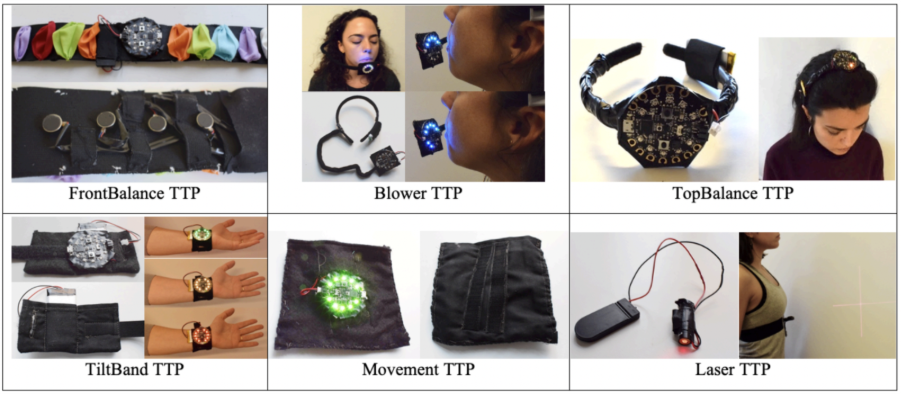
In an experimental study, [2] created technology training probes to “augment proprioceptive information and make it available through exteroceptive senses.” These consisted of an embedded system sewn into different wearable fabrics, each designed specifically for different body parts and circus disciplines [2].  

Image from Márquez Segura et al., 2019. [2] 

In training with the wearable devices, [2] discovered that focusing on external stimuli made children enjoy the exercise more and improved their overall performance, specifically: children were focused more, were more aware and in control of their posture, were more aware of their movement patterns, could maintain challenging positions longer, were able to engage and relax different body parts easier, had more endurance, could move past fear, and enjoy the exercise more. This study wasn’t focused on aerial silks specifically, but it proved that, in floor acrobatics, externalizing proprioception through a range of lights and sounds helped children with sensory-based motor disorder [2]. 

In another study, [3] created an aerial hoop which “generates auditory feedback based on capacitive touch sensing.” They added electrodes to a normal hoop in order to detect different touch data, which is then turned into auditory feedback through non-obstructing hardware housed in a wooden box [3]. 

Image from Liu et al., 2021. [3] 

The study found that the extrinsic auditory feedback helped artists to be more aware of the quality of their movements, including details that they would normally not pay attention to [3]. However, this study was done with expert hoop artists, which mentioned it would not be an accessible tool for beginners who are at first barely learning what their body must do [3].  

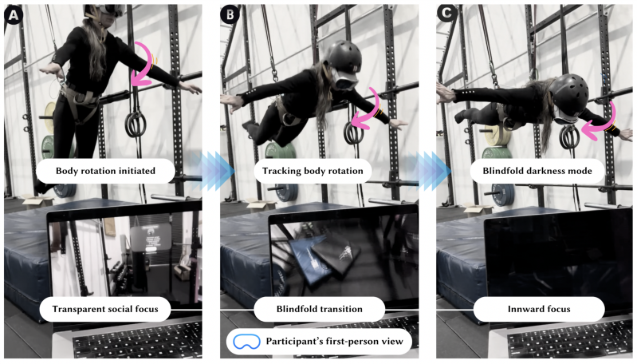
In a third experiment, [4] used a head-mounted VR headset to partially blind participants while being suspended from a 2-point harness, as shown in the picture.  

Image from Topaz et al., 2025. [4] 

While not specifically designed for circus disciplines, the study found that when they took vision away from participants, they were forced to focus more on their internal sensations, muscles, and body movements, increasing their bodily awareness [4]. Two relevant quotes from participants of the study were as follows: “The black environment helped me focus on the muscles to regain balance” and “When I used to perform, I was far above the audience. Using the blindfold application reminded me how stimulating and distracting I find the outside world. It felt very peaceful and focused to be in the virtual world alone with my body” [4]. 

– 

[1] “Flexibility,” Silks Stars. Accessed: Nov. 23, 2025. [Online.] Available: https://www.silksstars.com/category/foundations/flexibility/ 

[2] E. Márquez Segura, L. Turmo Vidal, L. Padilla Bel, and A. Waern, “Circus, Play and Technology Probes: Training Body Awareness and Control with Children,” Proceedings of the 2019 on Designing Interactive Systems Conference, vol. 1, pp. 1223-1236, June 2019.  

[3] W. Liu, A. Dementyev, D. Schwarz, E. Fléty, W.E. Mackay, M. Beaudouin-Lafon, and F. Bevilacqua, “SonicHoop: Using Interactive Sonification to Support Aerial Hoop Practices,” Proceedings of the 2021 CHI Conference on Human Factors in Computing Systems, vol. 1, pp. 1-16, May 2021. 

[4] A. Topaz, M.F. Montoya, R. Patibanda, J. Andres, and F. Mueller, “Blindfolded in the Air: Towards the Design of Interactive Aerial Play,” Proceedings of the First Annual Conference on Human-Computer Interaction and Sports, vol. 1, pp. 1-16, November 2025. 

The personification of Death

The classic Western image is the Grim Reaper: a cloaked skeleton with a scythe, usually male‑coded, mysterious, and frightening, symbolising death as an evil, inevitable force. Many modern stories give Death a more human look: an “average Joe” worker, a beautiful woman, or a vague humanoid presence, allowing audiences to relate to death as if it were a person. Personified Death often has a job: collecting souls, making deals, or enforcing “rules”, which makes death feel like a structured process rather than pure chaos. Personality can range from villainous predator to gentle guide, caring sibling, or reflective narrator, shaping whether death feels terrifying, comforting, or strangely neutral. These characters mirror cultural attitudes: in much Western media, Death still leans toward the frightening and violent, but there is a clear trend toward more nuanced, empathetic, everyday interpretations as well.

Characteristics: Death, Grim Reaper, Charon, Thanatos

Death is an abstract, flexible figure representing the inevitability of dying. Depending on the narrative, it may appear frightening, neutral, or even compassionate. Forms of Death vary widely, from the Western Grim Reaper to a genderless presence, a beautiful figure, or a mundane bureaucrat.

The Grim Reaper, shaped by Western and Christian traditions, is depicted as a hooded skeleton wielding a scythe. Its primary function is to arrive at the moment of death, sever the thread of life, and occasionally escort the soul onward. In modern media, the figure is sometimes softened into a humorous or “working” character while retaining its essential role.

In Greek mythology, Charon is the ferryman of the dead who transports souls across the River Styx (or Acheron). Charon does not cause death but functions as a psychopomp, guiding already‑deceased souls within the structure of the Greek afterlife. His role highlights the procedural or bureaucratic aspects of death in myth.

Thanatos, also from Greek mythology, personifies peaceful or natural death. Unlike violent death deities, he is calm, inevitable, and not malevolent. Sometimes sent by higher gods, Thanatos acts as a reaper‑type figure, bridging the role between divine authority and human mortality.

Characters

  1. Puss in Boots (2022): Death

Death was briefly mentioned in the previous blog post. The personification of Death in Puss in Boots: The Last Wish combines characteristics of both “Death” and the “Grim Reaper”. The wolf wears a cloak and wields two scythes, but is no skeleton. He is blood‑thirsty, menacing, and frighteningly self‑assured, accompanied by a distinctive whistling motif.

2. Supernatural (2010-2015): Death

Death in Supernatural first appears stepping out of a pale grey 1959 Cadillac Series 62 coupé with the licence plate “BUH‑BYE”, also known as “Pale Horse”, while “I Am No One…” by Gemini Killer plays. (cars are an important thing in Supernatural idk) This is a homage to the Four Horsemen of the Apocalypse, each with their own horse. Death is portrayed with an irreplaceable sense of weariness and disinterest in mortal affairs and is so ancient that he cannot remember whether he or God came first. He personifies death itself, similar to Thanatos, embodying the mortality inherent in all living beings.

3. The Sandman (2022): Death

A woman! She fulfils the duties of a Grim Reaper, visiting those who have died and guiding them to the other side. She is friendly and empathetic towards humans, acting as one herself to stay in touch with their experiences and understand how death feels.

4. The Adventures of Baron Munchausen (1988): Angel of Death

The line of imagination and reality is blurry. A skeletal grim reaper with black wings, a dark cloak and a scythe (and red hair?) pursuits the main character. Baron Munchausen safes himself with his imagination, but as soon as he has doubts the grim reaper comes back. It’s job is similar to the one in Puss in Boots – relentlessly trying to kill the main character.

5. Death Parade (2015): Decim

Decim is emotionless and lacks understanding of human feelings. His task is to decide the fate of each human through the results of the games they must play. The characteristics of Thanatos suit him best – calm and inevitable.

Source

Lammon, Marissa. (2024). The Big, Bad… Grim: Personification of death in Puss in Boots: The Last Wish. Mortality. 1-13. 10.1080/13576275.2024.2308881.

Moore, K. (2006). The Grim Reaper, working stiff: The man, the myth, the everyday (Master’s thesis). Bowling Green State University.

O’Connor, A. M. (2024). Death is whoever does Death’s job: The gender of death personifications in contemporary fantasy literature (Master’s thesis). University of Helsinki.

What Will the Future of the Human Species Look Like?

Last time we took a glance at the beginning of the speculative evolution artistic movement almost 50 years ago. Set in motion by the book After Man. But what do the scientists of today say? Let’s take a look at mankind’s future and what the world will look like after us.

Human Evolution

Evolution is a fickle thing, it doesn’t happen linear, rather it occurs in fits and starts. Life gets simpler, more complex, smaller, bigger, adapts to its environment or perishes completely; it’s hard to predict in which direction the human species will be taken. We might not change at all, or even branch off in a new species in the family Hominidae. The later could only truly occur in geographic isolation of a population of humans, which given globalisation seems very unlikely.

Thus, the predictions of Man After Man, interesting as they may be, have little possibility of ever occurring.

The End of the Anthropocene

The Anthropocene describes our current epoch, defined by human interference in our ecosystem. And this epoch might come to an end sooner than we like, given the rapid progress of climate change. Should we burn through all our fossil reserves, the climate will rise up to 18 degrees Celsius and raise the sea levels by hundreds of feet. It’s likely this warming spike will be more devasting than the one that caused the End-Permian mass extinction. This event, also known as the Great Dying, killed 90% of marine and terrestrial lifeforms. It would be a return to the climate of the Eocene, where none of the poles had ice, being instead home to swamps and tropical forests. A lot of mammals will die out or be forced to migrate pole-wards, though reptiles and birds will be fine for the most part. Life in the oceans will be devasted and won’t properly recover for a few thousand years.

The temperatures would rise for a long time in this green house and stay consistently hot for at least a hundred-thousand years. Afterwards we will plummet into a new ice age. If humanity has survived until then, this is where the sixth mass extinction will take place. Although its more likely civilisation will collapse long before.

Next in Line

Who will come after us then? That seems to be the big question, but the answer isn’t clear. We have no way of knowing who would survive the sixth mass extinction and who wouldn’t. Whoever is left would fill in the niches of those species, who didn’t make it.

The docu-miniseries The Future is Wild, based on Dougal Dixon’s work is an exploration of this. Released in 2002, the show explores life on Earth millions of years in the future.

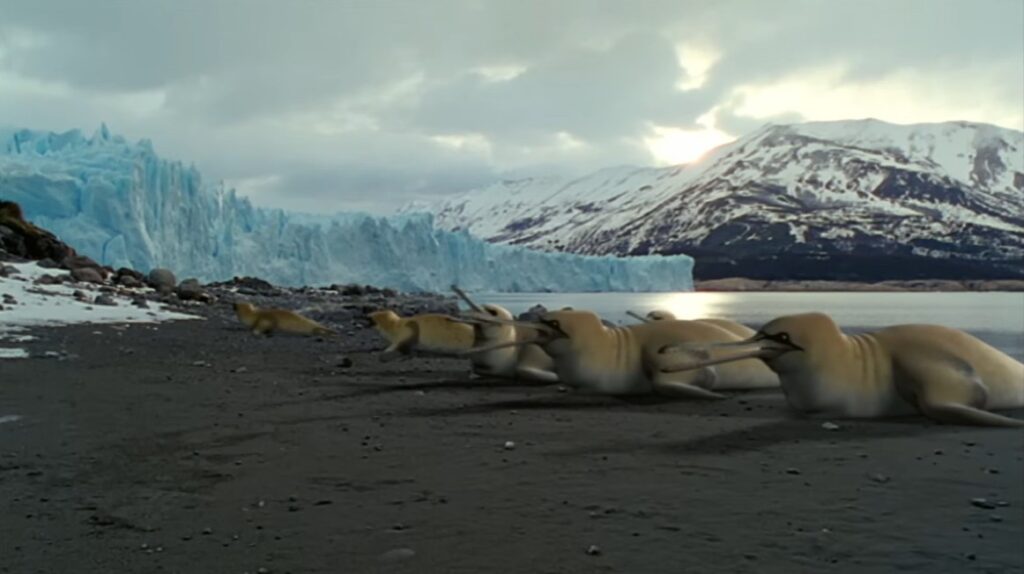
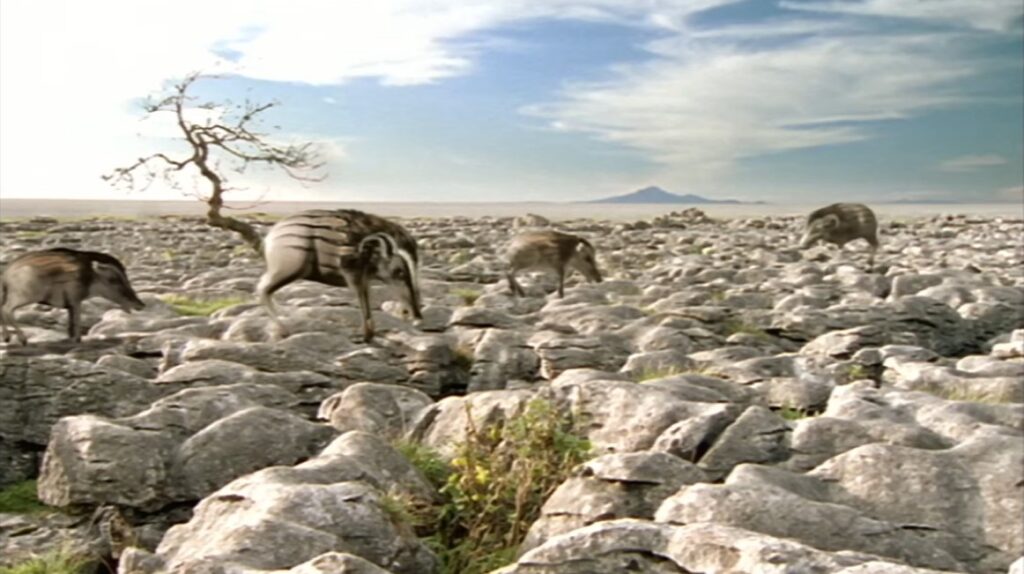
The first part, taking place 5 million years after our extinction, takes a look at how life changed in the second ice age. Ice sheets range all the way to central Europe, rain forests have dried up and turned into grasslands while the North American plains have become a cold desert. The shifting continents have closed off the Mediterranean Sea, turning it into near uninhabitable salt flats. The climate is cold, dry, megafauna have once more taken control of the Earth.

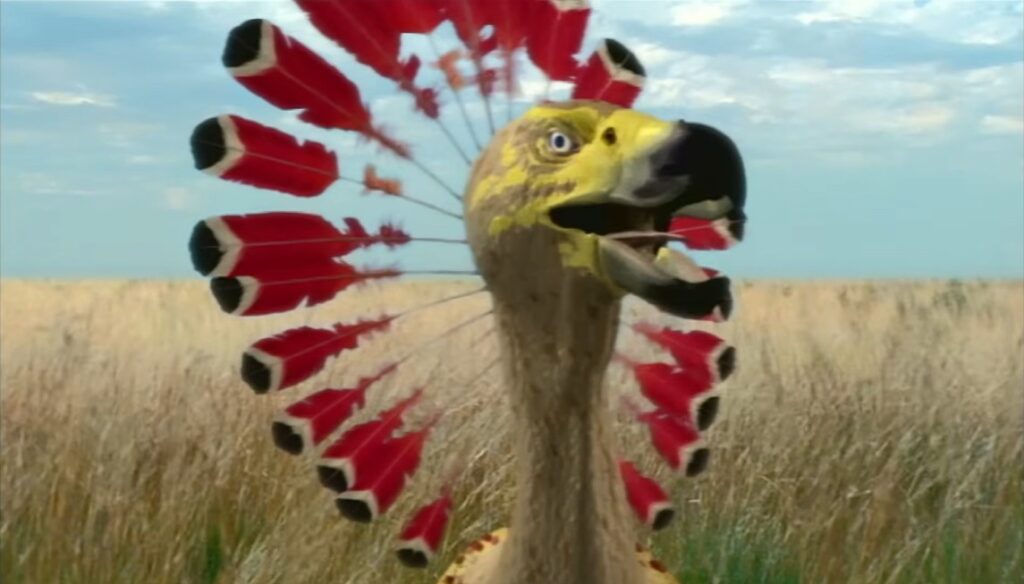
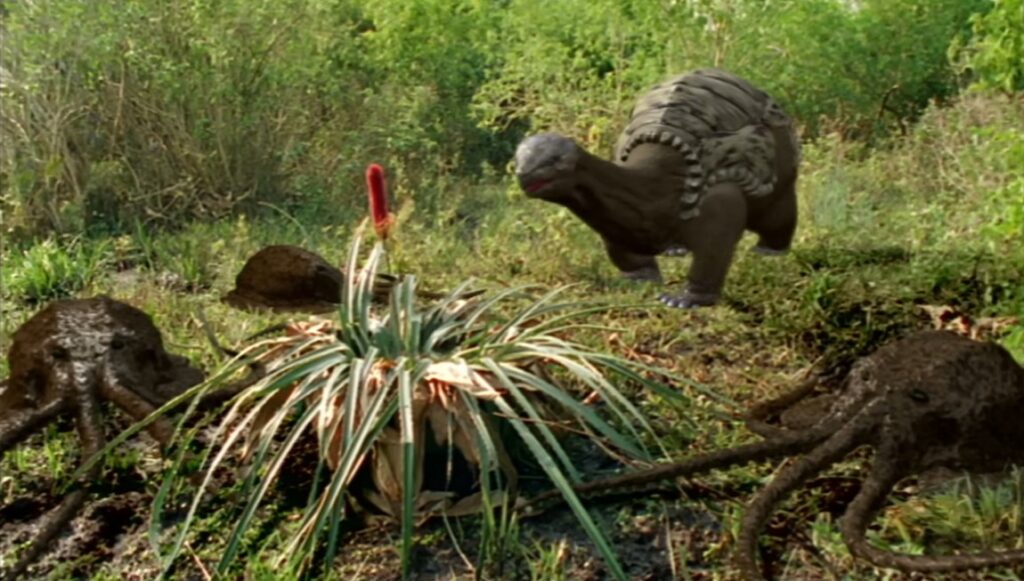
A 100 million years later, we return to a global hothouse. The climate is warm, humid. The land is flooded by shallow seas, turning everything into swamps. Rain forests sprawl across the globe, even Antarctica. The shifting continents created a kilometre-high mountain plateau, dwarfing the Himalayas. The Sahara Desert has become a rich grassland.

200 million years after our time the world is once again recovering from a mass extinction event. 95% of the species on the planet have been wiped out, with marine life and insects taking over. The last mammal has long since died out. The continents have collided in a second Pangea, a supercontinent plagued by extreme weather conditions.

While still only a prediction, this show considers how the climate changes, the continents shift and what that means for the environment. Which species will most likely thrive and which will perish. While our species will almost certainly meet its end one day, that doesn’t mean life won’t go on, with new species adapting and evolving.

Sources

Different Types of Playgrounds and Their Contributions to Children’s Development

Playgrounds have long been recognized as essential environments supporting children’s physical, cognitive, and social development. In the academic literature, playgrounds are commonly categorized into three main types: traditional playgrounds, adventure playgrounds, and contemporary playgrounds (Barbour, 1999; Campbell & Frost, 1985; Hayward et al., 1974). Each category reflects distinct design philosophies, material choices, and forms of play engagement.

1. Traditional Playgrounds

Traditional playgrounds typically consist of standardized, manufactured equipment such as metal swings, seesaws, climbing ladders, and slides. Because these structures are usually mass-produced and selected from catalogues, their design tends to be predictable and uniform.
Although they support fundamental motor activities, research shows that these fixed structures offer limited flexibility and often constrain children’s play to predefined movements. Coffin & Williams (1989), for instance, found that children spent very short periods in areas where equipment lacked complexity and plasticity, suggesting that static structures may not sustain long-term engagement or imaginative play.

Figure 1 (traditional playgroun)

2. Adventure Playgrounds

Adventure playgrounds represent a contrasting philosophy. Originating in Europe and still widely implemented—approximately 1,000 adventure playgrounds exist today, with over 400 in Germany, and many in England, Holland, France, and Denmark—they emphasize flexibility, creativity, risk-taking, and child autonomy (Solomon, 2005; IPA, 2007).

These playgrounds typically include loose parts, such as wood, ropes, tires, and moveable objects that children can manipulate, combine, or repurpose. This dynamic environment “multiplies the opportunities” for exploration and problem-solving. Research strongly supports their value: Hayward, Rothenberg & Beasley (1974) found that children spend more time in adventure playgrounds and display higher levels of cognitive play compared to traditional and contemporary playgrounds. Similarly, Strickland (1979, cited in Hugh, 1995) emphasized that adventure playgrounds facilitate greater cognitive and social development.

Loose parts, in particular, appear central. Both Hayward et al. (1974) and Brower & Williamson (1974) (cited in Maxwell et al., 2008) demonstrated that mobile, manipulable materials are preferred by children and encourage more complex play behaviors than fixed equipment.

Figure 2 (adventure playground)

3. Contemporary Playgrounds

Contemporary playgrounds blend elements of traditional structures with more innovative, multi-functional designs. Barbour (1999) describes these playgrounds as including linked, multi-purpose structures that allow varied points of entry and exit. They often incorporate features that stimulate dramatic play, such as platforms, tunnels, themed structures, or interconnected climbing systems.

Coffin & Williams (1989) observed that multifunctional play structures encourage richer social, verbal, and psychomotor behaviors compared to single-use equipment. These findings indicate that contemporary designs—by expanding children’s choices and encouraging imaginative engagement—occupy a middle ground between the fixed nature of traditional parks and the flexibility of adventure playgrounds.

Figure 3 (contemporary playground)

Across studies, several consistent themes emerge:

  • Flexibility and manipulability support cognitive and social development.
  • Complex, multi-functional equipment fosters richer interaction and longer play duration.
  • Traditional playgrounds, while valuable for basic motor skills, offer limited opportunities for creativity and problem-solving.

References

Barbour, A. C. (1999). The impact of playground design on the play behaviors of children with differing levels of physical competence. Early Childhood Research Quarterly, 14(1), 75–98.

Brower, D., & Williamson, D. (1974). Loose parts and creative play. In Maxwell et al. (2008)

Campbell, S., & Frost, J. L. (1985). The effects of playground type on children’s play behaviors. In J. L. Frost & S. Sunderlin (Eds.), When children play.

Coffin, G., & Williams, G. (1989). The influence of playground equipment on children’s play. Journal of Environmental Psychology, 9(1), 15–20.

Hayward, D. G., Rothenberg, M., & Beasley, R. (1974). Children’s play and urban playground environments: A comparison of traditional, contemporary, and adventure playgrounds. Environment and Behavior, 6(2), 131–168.

Hugh, S. (1995). Play environments and cognitive development.

IPA (International Play Association). (2007). Playground statistics and global overview. IPA Publications.

Maxwell, L. E., Mitchell, M. R., & Evans, G. W. (2008). Effects of play equipment and loose parts on preschool children’s outdoor play. In Children, Youth and Environments,

Solomon, S. (2005). The science of play: How to build playgrounds that enhance children’s development. University Press.

Strickland, E. (1979). Cognitive play in adventure playgrounds. I

Blog Post 2: General Research

General Research

To begin my investigation into User Experience Design in German train stations, I first explored the broader field of UX and UI design within physical environments. Understanding how design influences real-world experiences was essential, as it allowed me to build a foundation before narrowing my focus to the train-station contexts. This early phase of research helped me recognize that user experience in physical spaces is shaped by a complex interaction of visual, spatial, and functional elements. It also highlighted how design decisions can significantly affect how people navigate, interpret, and emotionally respond to a given environment.

Several core factors repeatedly emerged in the literature as central to effective physical-space design. Among the most relevant for my project are signage, visual communication, user flow, user feedback, technology integration, and accessibility (Kaarwan, 2025). Signage and visual design support wayfinding and orientation, while user flow relates to how intuitively people can move through a space. User feedback and the integration of technologies present opportunities to enhance clarity and convenience. Accessibility, of course, remains a fundamental requirement, ensuring that environments can be used by people with diverse physical, cognitive, or sensory needs. Additional aspects that influence user experience in public transport hubs include spatial organization and safety considerations (Coughenour, 2025). These dimensions will be examined in greater depth later in the design process, once the project goals and scope are more clearly defined.

To support my analysis, I also evaluated established design principles that could guide my approach. I chose Jakob Nielsen’s Ten Usability Heuristics because they are widely recognized in UX practice and can be applied not only to digital interfaces but also to physical systems. This makes them an appropriate framework for evaluating a hybrid environment like a train station, where digital and physical elements intersect. Nielsen’s heuristics include: visibility of system status, match between the system and the real world, user control and freedom, consistency and standards, error prevention, recognition rather than recall, flexibility and efficiency of use, aesthetic and minimalist design, support in recognizing and recovering from errors, and accessible help or documentation (Heurio, 2023). By adapting these heuristics to the context of a train-station environment—where users must make quick decisions, interpret information under time pressure, and often navigate unfamiliar surroundings, I will be able to develop a structured method for identifying issues and generating improvement strategies. This framework will guide my evaluation as I begin defining how each heuristic can be meaningfully applied during the design process.

Information Gathered

The insights gained so far form a foundation for the planned research. These two approaches complement one another: while physical-environment principles help identify broad design challenges, the heuristics offer a concrete evaluative tool for analyzing more specific aspects of the user journey. Together, they provide an entry point into the complex field of physical user experience design and will be instrumental in shaping the direction of the project.

Next Steps

My next steps will involve deepening my understanding of both frameworks. I plan to continue expanding my research on physical-environment UX principles and to further explore how Nielsen’s heuristics can be adapted for real-world contexts. Once I have established a solid methodological base, I will focus more directly on German train stations and platforms. This will include investigating user behavior, spatial organization, signage systems, and potential pain points specific to railway environments. Based on this research, I aim to define the primary areas of interest for the project and identify opportunities for targeted design interventions.

Reference

Coughenour, A. (2025). User Experience in Physical Spaces. Von Orbis Cascade Alliance: https://www.orbiscascade.org/programs/dux/documentation/user-experience-in-physical-spaces/ abgerufen

heurio. (2023). Nielsen’s 10 Usability Heuristics. Von heurio: https://www.heurio.co/nielsens-10-usability-heuristics abgerufen

Kaarwan, T. (18. June 2025). How Does UI-UX Design Transform User Experience in Physical Spaces. Von Kaarwan: https://www.kaarwan.com/blog/ui-ux-design/ui-ux-design-transform-user-experience-in-physical-spaces?id=541 abgerufen

NSW Government. (2025). Sydney Trains environment and sustainability. Von Transport for NSW: https://www.transport.nsw.gov.au/projects/environment-and-safety/sydney-trains-environment-and-sustainability/why-rail-travel-a abgerufen

How “Puss in Boots: The Last Wish” depicts anxiety

Psychological Foundations

Fear acts as a bridge between detecting a threat and the behaviours that follow, initiating a chain reaction of events. Ralphs Adolphs, professor of psychology, neuroscience, and biology at the California Institute of Technology, concluded the distinction between fear and anxiety. Fear is the immediate reaction to a present danger, for example, a spider in the room, while anxiety is about anticipating and preparing for potential threats, as in worrying that a spider might be in the room.

In the brain, the amygdala serves as the starting point for fear, receiving sensory information and responding by sending signals to other areas in the brain. The prefrontal cortex regulates the fear response by evaluating how imminent the threat is. The expression of fear is most likely a leftover action that was previously a crucial response for survival.

About Puss in Boots

Puss in Boots originates from a European fairy tale about an anthropomorphic cat who uses trickery and deceit to gain power, wealth, and the hand of a princess in marriage for his penniless and low-born master.

DreamWorks Animation adapted this fairy tale within the Shrek movies, and in 2011 Puss received his own standalone film, Puss in Boots. In this movie, Puss is a Spanish-speaking anthropomorphic cat and a fugitive on the run from the law, seeking to restore his honour.

Puss in Boots: The Last Wish

After 11 years, Puss returned in Puss in Boots: The Last Wish (2022). The story follows Puss as he teams up with Kitty Softpaws and Perrito to find the Last Wish of the fallen Wishing Star, in hopes of restoring eight of his nine lives. They race against other fairy tale characters seeking the same treasure, while a sinister wolf, the personification of Death, hunts Puss himself.

Depicting anxiety

Depicting internal feelings externally is difficult, but Puss in Boots: The Last Wish manages it remarkably well. There is a scene in which Puss hears Death’s iconic melody and has a panic attack.

It begins with everything around him slowing down. He hears the wolf’s whistle, and his fur stands on end. A dolly zoom is used, a technique designed to disorient the viewer. When the camera turns to reveal the wolf, there is a stark contrast in colour: the battlefield around Puss is brightly lit in red hues, while the wolf stands in shadows with darker, blue tones – even though the same space had a red hue moments earlier. The wolf’s red eyes intensify the effect. When Puss turns around, he too is cast in a blue tint.

The wolf is framed with a lot of negative space, creating a sense of stillness, while Puss is surrounded by chaos. Chromatic aberration becomes pronounced, simulating how detached from reality someone may feel during a panic attack.

Puss runs away mid-battle into the blue, foggy forest. As the camera follows him, the environment appears blurry and distorted, again enhanced by chromatic aberration. The wide-angle lens exaggerates the distortion of close-ups.

As Puss runs, he believes he sees the wolf in the forest, but these figures turn out to be shapes merely resembling the wolf. This reflects pareidolia, the human tendency to perceive faces in patterns where none exist.

Perrito then finds him lying at the base of a tree. This calm moment, following intense visual exaggeration, underlines how Puss is feeling and highlights the dissonance between his internal and external worlds.

Death

If one were to ask how another ‘sees’ death, there are overwhelming majorities: Death is male, Death is cloaked, Death is macabre. Literature as early as the 13th century feature the appearance of the Grim Reaper – a skeletal figure with black robes holding a scythe. The images of death ‘harvesting’ lives reflects the 20th and 21st century attempts to showcase death as something to be feared, that can simultaneously be conquered. Death remains the villainous obstacle to be overcome, and is personified in ways that demonstrate its wickedness, as well as its ability to fall at the hands of the story’s hero.

The wolf’s terrifying image, haunting laughter, and deadly weaponry demonstrate that Puss should be afraid of Death – because death is inherently frightening. The cloaked figure with blood-red eyes only ever appears in darkness, announces his presence through whistles or menacing laughter, and is always seen with sharp, deadly weapons in hand. Associated with colours signalling danger, morbidity, and violence (in addition to his sheer dominating size in comparison to the hero), Death is a frightening sight to behold for all viewers.

Source

Adolphs, R. (2013). The biology of fear. Current Biology(23(2)), R79–R93. doi:10.1016/j.cub.2012.11.055

Lammon, Marissa. (2024). The Big, Bad… Grim: Personification of death in Puss in Boots: The Last Wish. Mortality. 1-13. 10.1080/13576275.2024.2308881.

Nurcahya, Radhitya & Juanda, Juanda. (2024). Puss’ Anxiety and Defense Mechanism in The Puss In Boots: The Last Wish Movie. Mahadaya: Jurnal Bahasa, Sastra, Dan Budaya. 4. 187-196. 10.34010/mhd.v4i2.13748.

Die Auswirkungen und potenziellen Möglichkeiten von Sportdokumentationen 

In den letzten Jahren haben sich Sportdokumentationen sichtlich vermehrt und an Beliebtheit gewonnen. Vor allem das Zusammenspiel aus Realität und Emotionen, sowie ein Näherbringen der Athlet:innen und die zunehmende Rolle globaler Streamingplattformen haben dafür gesorgt, dass immer mehr Sportdokumentationen das Licht der Welt erblicken. Dabei besitzt dieses Genre nicht nur ein gesellschaftliches, sondern auch ein wirtschaftliches und kulturelles Wirkungspotenzial. 

Die Logik hinter Sportdokumentationen 

Nicht nur für das Storytelling, um das es in dem letzten Blogpost ging, sondern auch für die Auswirkungen und potenziellen Möglichkeiten von Sportdokumentationen sind die Logiken hinter dem Genre von großer Bedeutung. Dabei gibt es fünf Grundprinzipien: Sport ist narrativ, visuell spektakulär, von Kapital durchdrungen, besitzt seine eigene Ausdruckskraft und bringt das Publikum dazu, über Medien und ihre Funktionen nachzudenken. Fast alle Sportarten werden heutzutage medial vermittelt, sei es nun in Form von Social Media, Live-Übertragungen, Podcasts oder eben Sportdokumentationen. Dadurch nimmt das Publikum nicht nur den Sport an sich war, sondern beobachtet gleichzeitig immer, wie die Medien ihn darstellen: medial, narrativ oder durch die Bildsprache. 

Um dies auf das Genre der Sportdokumentationen zu übertragen: Durch diese wird der Sport nicht nur in seiner bestehenden Realität abgebildet, sondern ihm wird eine gewisse Struktur gegeben. Sportdokumentationen strukturieren die Sportarten aktiv, interpretieren Dinge hinein, geben ihm eine Geschichte und laden das Geschehene emotional auf. Dadurch entsteht ein Aufbau von Spannung, Konflikte, Höhen und Tiefen, ausgeprägte Charaktere (und manchmal Heldenfiguren) und Wendepunkte. So wird die Wahrnehmung der Zuschauer:innen aktiv geprägt und geleitet. Um zu den Logiken zurückzukehren: In Sportdokumentationen wird der Sport also nicht nur dokumentiert, sondern gleichzeitig inszeniert und wird somit ein bedeutender Teil der Kultur. 

Ökonomische Bedeutung 

Durch das Aufkommen und die große globale Rolle der Streamingplattformen, haben Sportdokumentationen eine andere Bedeutung bekommen. Sie werden nun von einem viel breiteren Publikum konsumiert. Dadurch wird das Genre zu einem strategischen Werkzeug für Medienunternehmen und Sportrechteinhaber:innen. Vor allem Netflix und Amazon Prime haben sich die steigende Beliebtheit von Sportdokumentationen zu Nutzen gemacht, um ihre Zuschauer:innen langfristig und binden. Ein weitere Vorteil durch die große Reichweite von Streamingplattformen ist die Anzahl an neuen Zielgruppen durch das breite Publikum. Gut produzierte Sportdokumentationen vermitteln Emotionen und individualisieren Vereine, Teams und die Athlet:innen, wodurch das Interesse an Sportarten außerhalb der klassischen Zielgruppe gesteigert wird. So breitet sich das Genre immer weiter aus und verlängert vor allem die Lebensdauer der sportlichen medialen Inhalte. Zusätzlich gibt es auch für den Sport selbst noch weitere Vorteile: Durch die wachsende Aufmerksamkeit profitieren auch Sponsor:innen, Markenbildung und das Image der Sportarten. So erhalten Athlet:innen mehr finanzielle und mediale Unterstützung, sowie größere Reichweiten und Vermarktungsoptionen, was wiederum die wirtschaftlichen Dynamiken innerhalb des Sports verändert. 

Wie bereits erwähnt, verstärken Streamingplattformen die Relevanz von Sportdokumentationen zusätzlich. Dadurch werden die Publikumsstrukturen und Zielgruppen der Sportarten erheblich verändert. Ein gutes Beispiel dafür ist „Drive to Survive“. Die Serie zeigt viele Einblicke in die Welt der Formel 1, die davor als „reicher Männersport“ gegolten hat. Durch die Sportdokumentation in Form einer jährlich wiederkehrenden Serie, erfuhr die Formel 1 eine deutliche Verjüngung des Publikums, die nach dem Konsumieren der Serie zu Live-Zuschauer:innen wurden. Das war vor allem bei den amerikanischen Rennen der Fall, die viel mehr Aufmerksamkeit und einen starken Zuwachs an Zuschauer:innen nach dem Release der Serie erfuhren. Außerdem änderte sich auch das Geschlecht des Publikums drastisch und besteht mittlerweile auch fast jeweils 50% Männern und 50% Frauen. 

Dieses Beispiel zeigt, dass Sportdokumentationen Sportarten große Chancen bieten, um neue Zielgruppen, Aufmerksamkeit oder Reichweite zu gewinnen. Sie schaffen Identifikation, in dem sie Sportler:innen tatsächlich als Menschen mit Geschichten, Problemen und Erfolgen zeigen und einen Blick hinter die Kulissen werden. Diese Form der Emotionalisierung und Identifikation kann nachhaltig das Image einer Sportart prägen und ihr internationale Aufmerksamkeit verschaffen. 

Weitere Möglichkeiten 

Sportdokumentationen haben aber auch ein bedeutendes Potenzial, Lernprozesse (vor allem Sozial- und Zeitgeschichtliche) zu fördern. Sportarten stehen stets in einem sozialen, politischen und ökonomischen Zusammenhang, sodass Sportdokumentationen als Brücken zwischen diesen Welten steht und somit neue Entwicklungen schaffen kann. Sie ermöglichen auch die Vergangenheit oder historische Prozesse in emotionaler oder narrativer Form für das Publikum zugänglich zu machen. Durch das Genre werden individuelle Schicksale, sportliche Konflikte oder Ungleichheiten, sowie gesellschaftliche Entwicklungen dargestellt, aufgearbeitet und verknüpft. 

Kritik am Genre 

Durch die große Aufmerksamkeit und Reichweite von Sportdokumentationen kamen natürlich auch kritische Stimmen auf. Auch wenn das Genre eine große Begeisterung erfährt, sollte das Publikum auch die Nähe zur Vermarktung reflektieren. Viele Produktionen leisten keine klassische journalistische Arbeit, sondern rücken vielmehr Marketing- oder Vermarktungsstrategien in den Vordergrund. Dadurch kamen immer mehr Fragen in Bezug auf Objektivität, kritischer Distanz und Transparenz auf. Es besteht die Gefahr, dass Konflikte, Probleme und kontroverse Themen unzureichend oder falsch beleuchtet werden. Auch hier ist „Drive to Survive“ ein gutes Beispiel, da die Serie mit den zunehmenden Staffeln immer weiter in die Kritik rückt. 

Fazit 

Sportdokumentationen haben definitiv an Bedeutung gewonnen und spielen eine große Rolle für die verschiedenen Sportarten, aber auch Streamingplattformen. Sie profitieren gegenseitig voneinander, sei es nun in Form von neuen Publikumsgruppen, großen Reichweiten oder emotionalen Geschichten. Außerdem eignet sich das Genre als gutes Vermittlungswerkzeug von Konflikten, Missständen oder historischen Prozessen. Trotzdem stellt die Kommerzialisierung ein Risiko dar, weshalb Sportdokumentationen immer mit Bedacht konsumiert werden sollten. Es ist jedoch deutlich zu sehen, dass Sportdokumentationen zu einem unverzichtbaren Bestandteil des modernen Sports geworden sind. 

Quellen: 

Malitsky, J.: Knowing Sports: The Logic of the Contemporary Sports Documentary.
https://people.southwestern.edu/~bednarb/capstone/capstone_materials/neal-reading.pdf

Sheard, R.: The Evolution of the Sports Documentary and Impact on the Media Ecosystem. https://www.linkedin.com/pulse/evolution-sports-documentary-impact-media-ecosystem-rob-sheard-4ohye

Brugar, K. A.: 30 For 30: An Inquiry into Sports Documentaries to Engage in Social History. https://societyforhistoryeducation.org/pdfs/F16_Brugar.pdf

Deutschlandfunk: Marketing-Experte zu Sport-Dokus: Netflix und Co. sind eine große Chance. https://www.deutschlandfunk.de/sportdoku-netflix-einfluss-tennis-100.html

Dieser Text basiert auf Literaturvorschlägen von Perplexity pro und wurde von ChatGPT korrigiert. Alle Inhalte wurden von mir selbst auf Richtigkeit und Relevanz überprüft und der Text selbst wurde von mir erstellt.

Design Activism and Socially Responsible Design (Part 1)

I am interested in areas that advocate for social change through projects. Thus, it is clear that the fields of design activism and socially responsible design are thought-provoking fields of research for me. I have already collected some material on these, which I will share with you in my blog articles.
The two directions of design activism and socially responsible design share corresponding values, although the second approach appeared much later. (cf. Cetin, Aryana 2015, p. 1)

Even though, both of them have similar backgrounds they differ in the details:

[…] main drivers of DA can be listed as social, political and economic factors Activist design is an act of generating a broad range of proposals for society. It is relatively more concerned with policies, dynamics of economy and social climate such as consumerism, sustainability, economic contradictions etc. Yet, SRD is mainly driven by ethical, humanitarian issues and benefits of the less-favoured society. Social, environmental and economic issues can be obtained as the basis for both approaches. SRD responds to the defined needs of society such as social discrimination, poverty, insanitation, conservation of natural resources, inequality and less favoured groups of a society. SRD focuses on the needs of the smaller segments of society whereas DA compasses a wider scope which contains the smaller segments. Because DA addresses a wider scope of society, its impact period is longer than SRD activities, which have a narrower scope and direct implementations and outcomes. (ibid., p. 3)

Designers raise awareness for their values and beliefs through their work and try to promote social change with their projects, within these fields. Additionally, design activism can not only be implemented in the field of communication design, but also in other areas, e.g. architecture, product design, landscape design, etc. Of course, these aspects of shared values are also used by businesses to position themselves and get access into the world of their target consumers. Therefore, it can be seen from a more commercial perspective, where corporations show their values and expect their customers to share them. This makes their target groups view them in a more positive light and usually people that do not align with these principles will then change their shopping habits, if it goes against their personal beliefs.

The Sociology dictionary defines social responsibility as “[…] the ethical obligation of individuals, groups, or organizations to act for the benefit of society as a whole. It involves making decisions and taking actions that positively contribute to the welfare of the community, environment, and broader social systems.” (The Sociology Dictionary 2025)

Cambridge dictionary has a more corporate approach on this subject and mentions it being “the practice of producing goods and services in a way that is not harmful to society or the environment” (Cambridge Dictionary, n.d.). While this is true as well, it focuses only on the economic side, disregarding the aspects of social responsibility that also include individuals. To add to that, this is a very broad definition, since products usually harm the environment in some ways, even though they are maybe not intended to.

Activism on the other hand is defined as “the use of direct and noticeable action to achieve a result, usually a political or social one” (Cambridge dictionary n.d.). This seems to be much more straightforward, even though in activism it often takes a while to achieve the wanted change.

The other dictionary only has a contribution to environmental activism, which states that it

refers to organized efforts by individuals, groups, or movements to protect and preserve the environment by addressing ecological issues such as climate change, pollution, deforestation, and biodiversity loss. This activism encompasses a range of actions, including protests, policy advocacy, community organizing, and educational campaigns, aimed at promoting sustainable practices and environmental justice. In sociology, environmental activism is analyzed as a social movement that challenges existing power structures, corporate practices, and government policies that contribute to environmental degradation. It is often intertwined with broader issues like social inequality, as marginalized communities disproportionately face the consequences of environmental harm. Sociologists examine environmental activism to understand its role in shaping public awareness, driving policy change, and fostering collective responsibility toward sustainable development. (The Sociology Dictionary 2025)

To conclude, there are various definitions for activism and social responsibility and depending on the context these differ slightly. Clearly, both areas touch upon topics differently and while design activism shows longer lasting change, socially responsible design focuses on more specific topics, showing immediate change that usually does not last as long.

Sources:

Activism. In: Cambridge Dictionary n.d. URL: https://dictionary.cambridge.org/dictionary/english/activism/.
Cetin, Özgür Deniz and Aryana, Bijan: An Analysis of the Influence of Design Activism and Socially Responsible Design Approaches on Design Education. Paris: Paris Descartes University 2015.
Environmental Activism. In: The Sociology Dictionary 2025. URL: https://thesociologydictionary.com/sociology-dictionary/e/environmental-activism/.
Social Responsibility. In: The Sociology Dictionary 2025. URL: https://thesociologydictionary.com/sociology-dictionary/s/social-responsibility/.
Social Responsibility. In: Cambridge Dictionary n.d. URL: https://dictionary.cambridge.org/dictionary/english/social-responsibility/.