In diesem Semester möchte ich mich darauf fokussieren zu recherchieren und vor allem zu testen, wie ich ein Kinderbuch gestalten kann, das für Kinder interaktiv sowie ansprechend und spannend ist. Zudem soll das Buch gleichzeitig Themen wie Inklusion und Diversität für Kindergartenkinder auf eine altersgerechte Art und Weise präsentieren. Die zentrale Frage dieses Semesters ist daher, was brauchen Kinder in diesem Alter wirklich und was interessiert sie überhaupt. Um das heraus zu finden, habe ich zu Beginn des Projekts eine Umfrage erstellt, die an Eltern, Großeltern, Verwandte und pädagogische Fachkräfte gerichtet ist. Also an all jene die tagtäglich mitbekommen, was Kinder begeistert, was sie beschäftigt und welche Themen in ihrem Alltag eine Rolle spielen. Ihre Perspektive ist für mein Projekt besonders wichtig, weil sie nicht nur wissen, was Kinder mögen, sondern auch, was im Alltag wirklich funktioniert.
Der Einstieg der Umfrage ist bewusst allgemein gehalten, um ein Gefühl für die Zielgruppe zu bekommen. Daher startet die erste Frage mit: „Welche Rolle hast du im Leben eines Kindes? Direkt gefolgt von der Frage nach dem Alter des Kindes. Denn ein Buch, das für einen Dreijährigen funktioniert, sieht ganz anders aus als eines für Sechsjähriger, sowohl inhaltlich als auch gestalterisch. Wo das eine Kind noch klar Bilder und kurze Sätze braucht, kann das andere schon komplexeren Gesichten folgen, Witze verstehen oder Rätsel lösen. Deshalb war es mir wichtig, von Beginn an zu wissen, über welche Altersgruppe die Befragten sprechen.
Von dort aus werden die Fragen etwas konkreter wie beispielsweise: „welche Themen sind im Alltag mit Kinder präsent?“ oder „Was macht ein Kinderbuch zu einem Guten?“. Außerdem wollte ich wissen, was Eltern und Pädagogen:innen bei schon bestehenden Büchern gefällt und was ihnen fehlt. Denn bestehende Bücher können zeigen, wo Lücken sind und wo es vielleicht schon viele Angebote gibt. Beides ist für mein Projekt seht wichtig, denn was fehlt zeigt mir, wo ich ansetzten kann und and dem was bereits gut funktioniert, kann ich mich orientieren.
Der dritte Schwerpunkt liegt auf Inklusion und Diversität. Mit diesen fragen wie: „Welche Fragen Rund um Inklusion und Diversität findest du für Kinder besonders wichtig“ oder „Sprechen Kinder von sich aus über Unterschiede zwischen Menschen“ wollte ich herausfindend, welche Inhalte besonders präsent sind und ob es für mich hilfreiche Referenzmaterialien gibt. Denn das Ziel dieses Projektes ist es, eine Geschichte zu schaffen, die Inklusion und Diversität nicht als belehrendes Thema verpackt, sonder als selbstverständlichen Teil der Handlung. Kinder sollen nicht das Gefühl haben, dass ihnen etwas erklärt wird, sondern sie sollen eine Geschichte erleben in der Vielfalt ganz normal ist.
Der vierte Abschnitt fokussiert sich auf interaktive Elemente. Mein Ziel ist es, ein Buch zu machen, das nicht nur gut ausschaut, sondern eines, das wirklich begeistert und funktioniert, eines das Kinder neugierig macht, Gesprächsstoff bietet und das im Alltag einfach praktisch ist.
Im letzten Abschnitt geht die Umfrage noch auf Wünsche und Anregungen ein und drauf was ein Buch auf keinem Fall machen sollte. Mit den Ergebnissen habe ich einen guten Überblick über das Thema gewonnen und kann mit dem gestalterischen Teil des Projekts starten.
As I was researching and looking for video edit ideas, I stumbled upon a big topic that is especially relevant for social media content: (visual) hooks. Hooks, in general, are a way of capturing an audiences attention at the very beginning of a piece of content.
Especially on social media and in the world of short form video content, it is vital to get people’s attention within an incredibly short amount of time, as content needs to stand out in order for people to stick with it and finish watching.
Usually, a hook happens within the first five seconds of a video or can be found in the first line of text in the caption or posting. Its purpose is to interrupt – for example – mindless scrolling and create enough curiosity for a viewer to consume the entire piece of content. On social media platforms it is crucial to keep people interested in one’s content as the algorithms reward longer playback times or replays with an increased distribution rate which in turn increased viewership numbers and public attention.
Various types of hooks can be used to garner attention, such as making a surprising statement, asking compelling questions or promising valuable information. Visual hooks (= something you show) can. be especially effective because our brains process images around 60.000 times faster than text.
The psychology behind hooks
Certain psychological triggers naturally cause human responses. One of the most important drivers here is curiosity and what happens within the human brain when what is called a curiosity gap occurs. It is an incredibly powerful tool when it comes to capturing peoples attention. Raising a question people want to know the answer to will keep viewers watching because the brain essentially registers incomplete information as a problem that needs to be solved. Sparking curiosity basically hijacks a person’s neural pathway because once a question has been asked, a sense of tension arises through with the brain’s desire of wanting closure.
Emotional Connection Factors
Emotions are human behavioral drivers – so hooks that manage to evoke emotions such as surprise, joy, the aforementioned curiosity or even fear are especially effective. Connecting with the audience emotionally can have a special appeal and compel the audience into watching or interacting with content.
The following paragraphs will look at some visual hooks and explain how they work.
Curiosity Gap or Open Loop Technique
As mentioned before, sparking curiosity is a very effective way of generating attention. When teased with potentially valuable information or asked a question one wants to know the answer to, the curiosity gap is in full effect.
A simple example would be something like:
“I discovered a weird productivity hack that tripled my output. You won’t believe what it involves…”
Or
“Most people use their phone charger wrong. Here’s why.”
Both these hooks cause an instinctive reaction from the viewer, who now is faced with unresolved questions: are they using their chargers wrong? What hack could there be that makes you so successful?
The „Wait for it“- Visual Hook
Visuals are extremely powerful and can serve as hooks by themselves. When a video is started with a dramatic or unusual visual instance, it suggests that something greater is about to happen which in turn, again, keeps the audience watching.
Examples for that would be a visual that suggests a massive object that is about to be dropped or something complex being activated – or even someone preparing for an extreme challenge. This works because humans respond intensely to visual tension and if something appears to be in progress or incomplete, we wait to see the outcome.
Bold Claims
A strong or controversial claim can be another effective strategy because they challenge assumptions. They signal to the viewer that they might learn something that could question or even change their existing views and that the content could cause their perspective to shift.
An example for this would be “This is the biggest mistake new creators make.”
Such as with curiosity, bold claims cause tension because a viewer – whether or not they agree with the statement – will stick around to either see if the argument that is being posed holds up or be validated in their views.
Story hooks
As humans, we are naturally made for stories. Therefore, when a piece of content introduces narrative tension, viewers instinctively will want to know how it unfolds.
Narrative structures create emotional responses or relatable scenarios, which is why this approach is so effective.
An example would be:
“I almost quit my job last year. Then something unexpected happened..“
Stories evoke empathy and curiosity at the same time. People want to follow through with a narrative once it has started, which is why story-based hooks are particularly useful for content or creators that want to build a strong personal connection with their audience.
Rapid-fire value hook
Leading with valuable insights or sharing a quick list right away can be an effective hook as well because it promises the audience immediate payoff without having to wait for slowly teased information.
This style works due to it signaling efficiency and valuing the audience’s time in terms of not making them wait long for promised information.
Examples for this kind of hooks:
„Three things every new filmmaker should know“
or
“Five apps that will make your life easier.”
Bandwagon Effect
Humans are naturally social beings, which is also why we tend to follow trends. When delivering statements that suggest many people are doing a certain thing, this can make for an effective hook. Showcasing popularity or social proof have the potential of making viewers think that they should do something because everyone else is doing it.
For example: “Join 10000+ savvy marketers who’ve boosted their ROI with this one simple trick!”
There are numerous types of hooks that have the potential of catching viewer’s attention and especially in the fast-paced environment of social media, I feel like it is almost impossible to not be aware of these strategies if one tries to build up a platform and wants their content to be seen.
In further video projects, I would like to try out some of these techniques just to see for myself what works and what gets people engaged in science-related content.
One of the most effective moves in Speculative Design is to take something familiar and push it beyond its usual limits. A habit, a social behaviour, a cultural value, something so ordinary that it barely attracts attention, is amplified until it becomes impossible to ignore. This is the logic behind what is often called cognitive estrangement: making the familiar seem strange enough that we can see it differently. Like hyperbole in rhetoric, exaggeration reveals contradictions, tensions, and assumptions that everyday familiarity tends to conceal.
Rather than inventing entirely disconnected futures, speculative projects usually start with something already present in the world. A technology, a social trend, a way of thinking, a system of values. The future that emerges is often less an invention than an extension. Existing tendencies are followed a little further, sometimes to the point of absurdity, sometimes to the point of discomfort. What appears unrealistic at first often feels unsettling for the opposite reason: it remains recognisable. The scenario may be exaggerated, but the logic behind it is already here. By creating a small distance from reality, speculative projects allow us to notice things that have become too familiar to attract our attention. This is what gives exaggeration its critical potential. Instead of describing the world as it is, it pushes certain aspects of it just far enough that they become visible again. Things that normally seem neutral or inevitable suddenly appear questionable. The familiar becomes strange, and once it becomes strange, it can be examined. In this way, speculative scenarios often function as a form of social commentary. They are not concerned with prediction so much as revelation. Their purpose is not to tell us what the future will be, but to expose the implications hidden within the present.
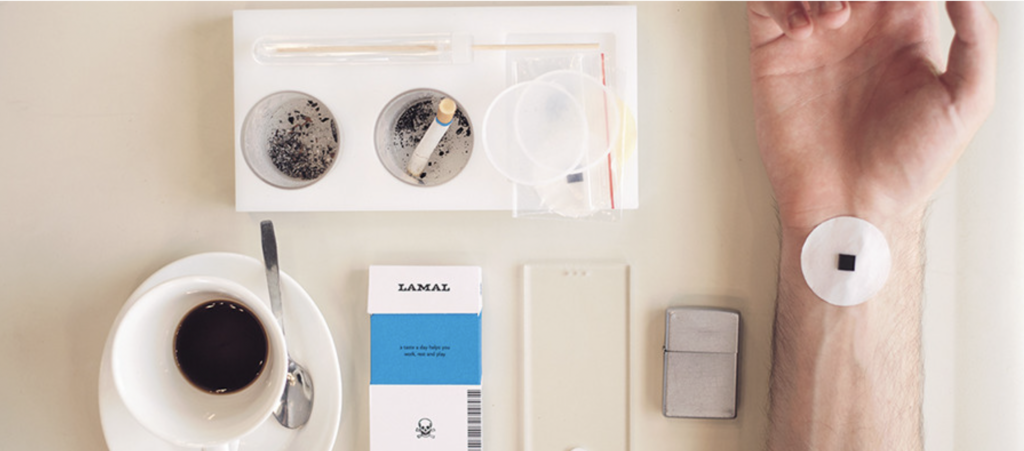
Eutropia and Quick Fix both work in this way. Conceived by Ivica Mitrović and Oleg Šuran, Eutropia imagines a Mediterranean city-state that has achieved prosperity, security, and social wellbeing through the complete monetisation of personal data. Privacy has disappeared. Surveillance is no longer controversial because it is understood as a reasonable exchange for comfort, efficiency, and stability. The collection of personal information is woven into every aspect of daily life and accepted as part of the social contract. The project takes the logic of today’s data economy and simply follows it to its conclusion. That is precisely why the scenario feels plausible. It is not difficult to imagine its world because parts of it already feel familiar. Quick Fix focuses on a different aspect of contemporary culture. Through an installation designed to resemble a vending machine, users can instantly purchase followers, likes, and online popularity. Social recognition becomes something that can be acquired as easily as a drink or a snack. The gesture is deliberately excessive, yet the logic behind it is immediately recognisable. The project takes a dynamic already present within social media platforms and turns it into a literal transaction. What is normally hidden behind algorithms, metrics, and platform design is brought to the surface and made visible. The result is both humorous and uncomfortable. We recognise the exaggeration, but we also recognise ourselves within it.
Neither project is really about the future. Both use fictional scenarios to talk about the present. Their worlds may be exaggerated, but they remain firmly connected to realities that already exist. Like a distorted mirror, they reflect contemporary society back to us in a form that makes certain details impossible to ignore. What emerges is often not something unfamiliar, but something we have stopped noticing.
In this sense, exaggeration becomes far more than a stylistic device. It becomes a way of thinking. By pushing existing tendencies beyond the limits of comfort, Speculative Design creates the conditions for a different kind of awareness. The audience is not asked to believe that these futures will happen. Instead, they are invited to consider why the scenarios feel plausible in the first place. The critical value of the project lies precisely in that moment of recognition, when an imagined future reveals something that has been present all along.
Believing in a well-constructed fiction, even if only for a moment, can change the way we see reality. But that shift becomes truly significant only when the fiction is shared, when it is embraced by many rather than experienced by just one person.
One of the greatest obstacles to genuinely new ways of thinking today is the widespread assumption that everything worth knowing has already been discovered, and that what is real, possible, or true has already been established. In this context, imagination can start to feel unnecessary, even naïve. Society often presents itself as the only version of itself that could exist. Yet much of what we consider true is not purely objective. It emerges from shared narratives, from stories that people collectively accept and pass on. These narratives shape the way we understand the world and provide the common ground on which societies are built. As Dunne and Raby point out, even our idea of reality can be challenged when we encounter a different way of seeing. Alternative narratives expand the boundaries of what feels possible, reminding us that there is never only one way to live, organize society, or interpret the world. This is the idea behind what they call micro-utopias: small imagined worlds that exist outside dominant narratives and suggest alternative ways of thinking and living. As they write, «They inspire us to ask why the real is “real” and the unrealistic is not — who decides? Is it market forces, an evil genius, chance, technology or secret elites? These projects celebrate people’s capacity to create their own imagination» (Dunne & Raby, 2013). The value of these speculative worlds does not lie in whether they can actually be realized, but in their ability to make us question assumptions that usually go unnoticed.
For a story to have this kind of impact, however, it cannot remain private. It has to circulate. It needs to be shared, repeated, and adopted by others. Stories become powerful not simply because they are original or compelling, but because they enter the collective imagination. Once enough people believe in them, they stop functioning as fiction and begin to shape reality itself. They become habits, convictions, social norms, institutions, and myths. Yuval Noah Harari develops this idea extensively in Sapiens: A Brief History of Humankind. According to Harari, what distinguishes humans from other species is not physical strength or individual intelligence, but our ability to create and maintain collective fictions. Human societies are built not only on tangible objects and material resources, but also on shared abstractions such as money, nations, religions, corporations, and human rights. None of these things exist in a physical sense, yet their effects are undeniably real because large groups of people collectively agree that they matter. These shared beliefs shape how we behave, the decisions we make, and the ways we organize our societies. Recognizing this changes how we think about reality itself. Reality is often not simply something that exists independently of us; it is also something that people continuously construct and sustain through shared belief. Once we understand this, it becomes easier to imagine that things could be otherwise.
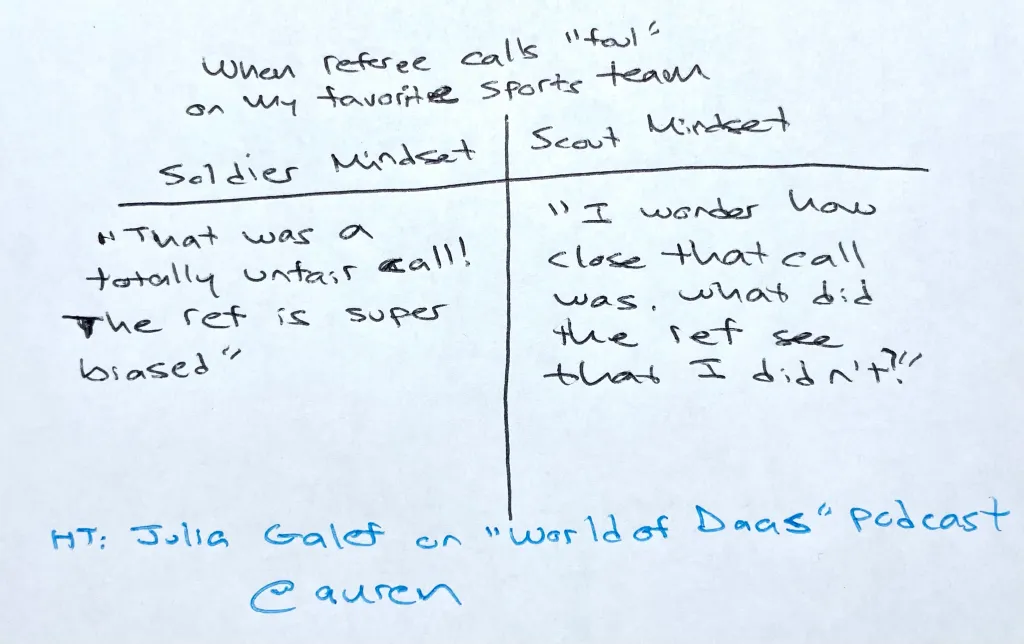
A similar point appears in Julia Galef’s The Scout Mindset, although she approaches it from the perspective of individual belief. Galef argues that our opinions are not always guided by a genuine search for truth. More often, they are influenced by what makes us feel safe, comfortable, or secure. When we want something to be true, we tend to ask ourselves, “Can I believe this?”, looking for reasons to accept it. When we do not want it to be true, we ask, “Do I really have to believe this?”, searching instead for reasons to reject it. She describes this tendency as motivated reasoning: the habit of interpreting information in ways that support our existing preferences and assumptions. To explain this process, Galef introduces two contrasting mindsets. The soldier mindset treats beliefs as territory that must be defended. Information that challenges those beliefs is seen as a threat. The scout mindset, by contrast, is driven by curiosity. Rather than defending a position at all costs, it seeks to understand reality as accurately as possible, even when doing so requires changing one’s mind. We move between these two attitudes constantly, but it is the scout mindset that allows us to remain genuinely open to unfamiliar ideas and alternative possibilities. In many ways, this is also the mindset encouraged by Speculative Design. Its purpose is not to predict the future, but to create enough distance from the present that we can begin questioning assumptions we normally take for granted. Galef also argues that beliefs become particularly difficult to challenge when they are closely tied to our sense of identity. This is why she suggests that we should “hold our identities lightly”. The phrase sounds simple, but its implications are profound. Being able to change our minds without feeling that we are losing ourselves is essential if we want to engage seriously with new perspectives. Speculative Design relies on this openness. It asks us not to decide whether a scenario will happen, but to consider what that scenario reveals about the present and about the beliefs we rarely stop to examine.
Figure 9. Comparison between the Soldier and Scout Mindsets, according to Auren Hoffman.
What does it really mean to believe in something? It is not simply a matter of accepting facts. Belief is also tied to stories, emotions, habits, and cultural values. Our understanding of reality emerges from all of these elements working together. This is why narrative is so powerful: it does not merely describe the world, it actively participates in shaping it. The stories that circulate through politics, media, religion, science, and design influence what we consider normal, desirable, or possible. In Speculative Design, these stories take the form of objects, scenarios, and visual languages that appear to come from the future while speaking directly to the present. Like myths, they do not simply describe the world as it is; they suggest what it might become. Understood in this way, design is about more than function or aesthetics. It becomes a way of proposing alternatives, a tool for making different realities imaginable and, for a moment, allowing them to feel real.
The term Design Fiction was first introduced by Bruce Sterling in Shaping Things (2005) to describe a practice that occupies a space between design and science fiction. While science fiction is often driven by narrative and imagination, Design Fiction remains more directly connected to design practice and to the possibility that what is imagined might one day become real. It is less concerned with predicting the future than with creating believable scenarios through which future possibilities can be explored. Today, Design Fiction is generally understood as a convergence of scientific inquiry, storytelling, and design. Like Speculative Design, it relies on speculation as a way of thinking about alternative futures, but it places particular emphasis on plausibility. The challenge is not simply to imagine a different world, but to make that world feel convincing enough to be taken seriously. This is why so much attention is given to diegetic prototypes: objects, products, and technologies that do not exist, yet appear within a narrative as though they already belong to it. They are far more than props or visual details. By giving material form to an imagined future, they help transform abstract speculation into something tangible and relatable.
This marks one of the key differences between Design Fiction and Speculative Design. Speculative Design often begins with an object, using it as a catalyst for questions, discussions, and critical reflection. Design Fiction, on the other hand, tends to begin with a story. The narrative establishes the world, and the objects are designed to support it, enrich it, and make it believable. Storytelling therefore becomes the primary vehicle through which ideas are explored and futures are experienced. Audiovisual media such as film, animation, sound, and digital environments are frequently used to deepen immersion, allowing audiences to engage with fictional worlds not as distant possibilities but as lived experiences. As Julian Bleecker writes, «Design objects are totems through which a larger story can be told, imagined or expressed. They are like artefacts from elsewhere, telling stories of other worlds» (Bleecker, 2009).
From this perspective, Design Fiction occupies a territory somewhere between empirical science and science fiction. Science defines what is possible through evidence, observation, and established principles. Design Fiction deliberately steps beyond those boundaries, creating space for possibilities that may appear unlikely, unattainable, or even impossible. Its value lies not in proving that a future will happen, but in exploring what that future might reveal about the present. Although Design Fiction has not yet achieved formal recognition as an independent discipline, it has become an increasingly important tool for designers, researchers, and futurists. As Gabriele Ferri argues, it enables the exploration of (im)possible scenarios capable of offering «a provocative contrast with our current society». Yet imagining alternative worlds is only part of the challenge. Making those worlds believable requires careful construction. As Jerry Jenkins observes, fictional worlds need their own rules, environments, populations, and cultures. These elements must be developed with enough coherence to allow audiences to engage with them without constantly questioning their logic. What often makes a speculative world compelling is not its distance from reality, but the balance it establishes between familiarity and novelty. We recognize something of our own world within it, while simultaneously encountering something unexpected.
James Auger explores this issue in greater depth in Beyond Speculative Design: Past – Present – Future (2021), where he identifies several strategies for making speculative narratives more engaging and credible. The Ecological Approachplaces unfamiliar or speculative technologies within ordinary contexts, allowing the strange to coexist with the familiar. The Uncanny operates through emotional resonance, drawing on themes such as death, loneliness, desire, and pain to create a sense of unease that lingers beyond the experience itself. Familiarities work by embedding everyday details into fictional worlds, reducing the distance between the audience and the scenario being presented. Finally, Alternative Presents shift attention away from distant futures by imagining parallel realities that branch from actual historical events. Rather than asking what the future might become, they ask how the present might look if history had unfolded differently.
What Auger’s framework makes clear is that credibility in speculative narratives rarely depends on technical sophistication alone. More often, it emerges from emotional and experiential proximity. The closer a fictional world feels to things we already know, recognise, or experience, the easier it becomes to step inside it and temporarily accept its logic. This principle sits at the heart of fictional design. The goal is not simply to invent objects or technologies, but to create worlds that audiences can inhabit, even if only briefly. The artefacts themselves do not necessarily need to function; they need to feel coherent within the reality they belong to. Fictional design does not simply describe a future. It stages it, materialises it, and allows people to experience it.
Fictional brands provide a particularly revealing example of this process. Some products that began as inventions within fictional worlds have eventually crossed into reality. Duff Beer, originally created for The Simpsons, was later produced and sold. Nuka-Cola, from the Fallout series, has appeared in limited-edition releases aimed at fans. Even Brawndo, the fictional energy drink from Idiocracy, was eventually transformed into a real product. These cases demonstrate how a well-constructed narrative can generate tangible outcomes, creating emotional connections that persist long after the fiction itself has ended.
Figure 8. Duff Beer on sale in a store.
For this reason, the distinction between Speculative Design and Design Fiction is often less rigid than it first appears. In Speculative Design, an artefact may become the starting point from which a narrative emerges; in Design Fiction, a narrative may provide the framework from which objects are developed (Neeley, 2024). In practice, however, these processes frequently overlap. Objects inspire stories, stories shape objects, and both contribute to the construction of alternative worlds. The boundary between the two remains deliberately porous, and it is precisely within this overlap that some of the most interesting possibilities for design begin to emerge.
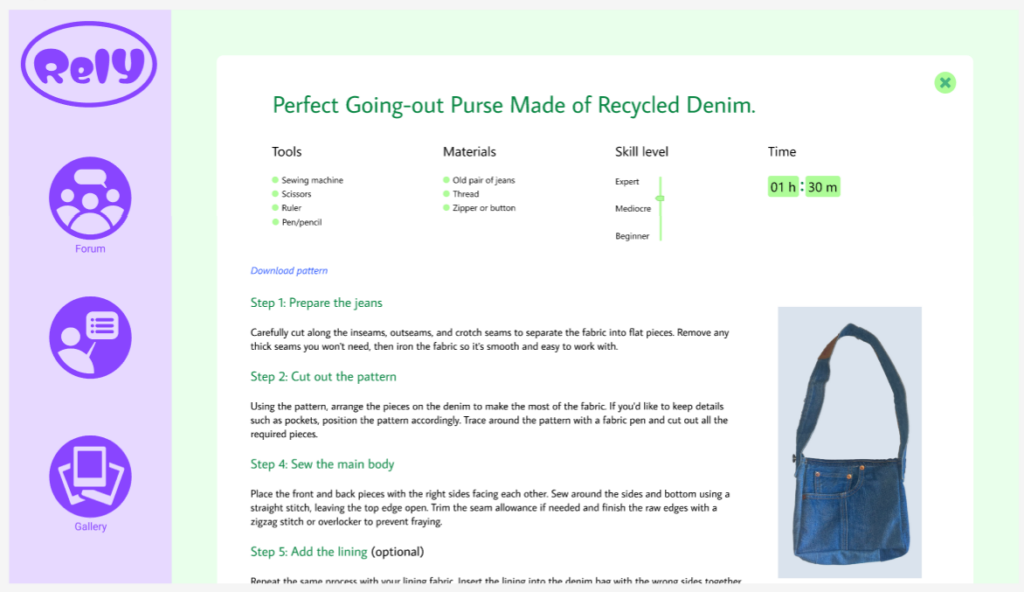
Before I started experimenting in Figma, I sketched a few ideas on paper to find a basic layout for my website. At first, I came up with a layout that closely resembled a typical AI interface.
First Figma wireframes:
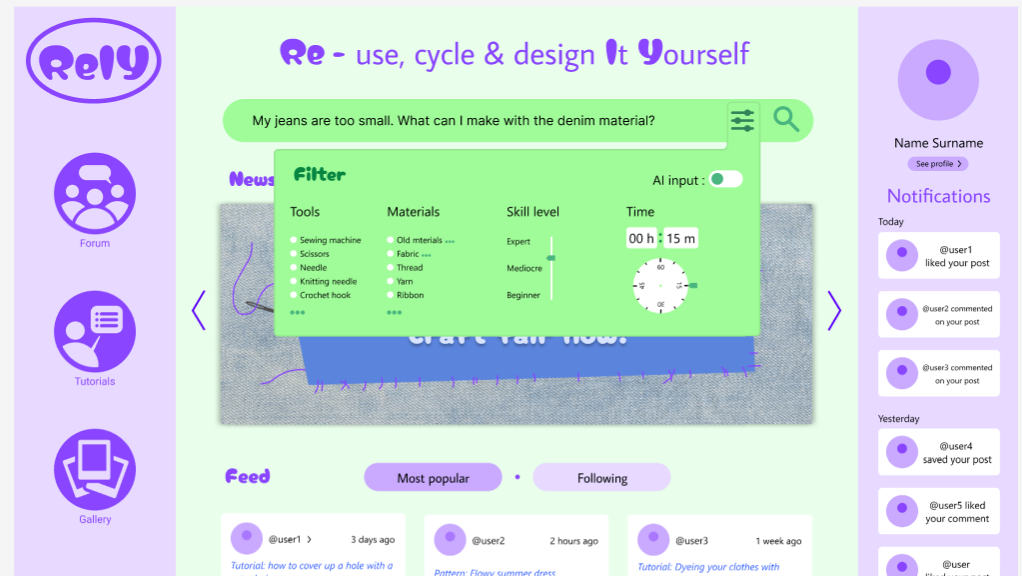
I tried to translate my sketches into a digital design while exploring which colors to use. I wanted the website to feel vibrant and playful because it’s meant to support a hobby that people enjoy for fun. I wanted to avoid giving it a serious or overly formal look. I really wanted to incorporate green because I feel like it symbolizes sustainability and a focus on the environment. I also really like how purple and green look together, so those are the two main colors I decided to go with.
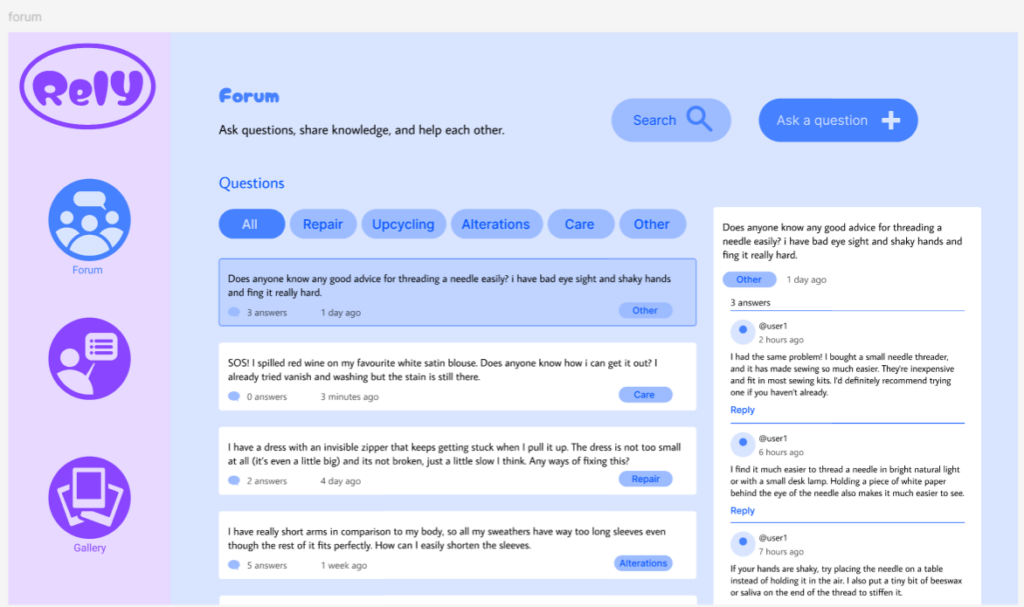
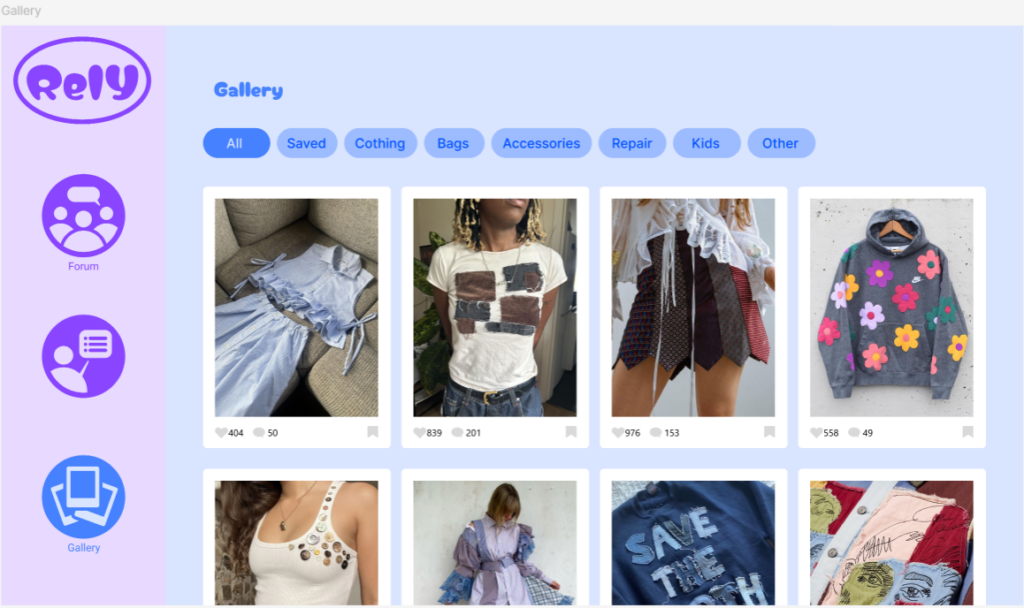
Final Figma Wireframes:
I decided to place less emphasis on AI on the website and instead focus more on the community, so I wanted the design to reflect that. I decided to go for an almost social media style layout, where you can access your profile on the right. I also placed the notifications on the right to emphasize the focus on community and helping each other. The search function is placed at the top center of the website to highlight its importance. I also added a news widget where updates about events and other community activities can be displayed to strengthen the community both online and in real life. Below that, as you scroll down, you’ll find a feed of posts from users you follow as well as popular posts. On the right, you can access the forum, tutorials, and gallery.
The filter function is designed to help users find more relevant results. I wanted to make it as easy as possible for people to describe their situation and find exactly what they’re looking for.
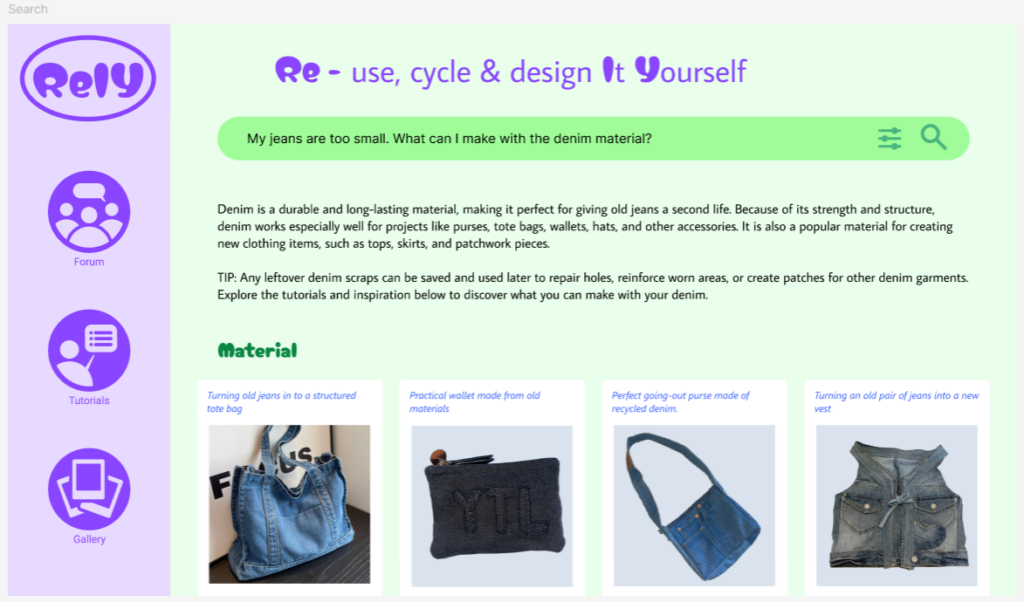
I used a blue color palette for the Forum, Tutorials, and Gallery pages to introduce more color and clearly distinguish them from the search function. While the search feature is designed for finding answers quickly, these pages serve as resources that users can browse and explore at their own pace.
I designed the forum to be simple and intuitive to use. Users can filter posts by category, easily read and comment on other users’ posts, and create their own questions when they need help.
How do people actually look at a poster? This question became the starting point for a workshop hosted by Jana Klammer and myself, where eight participants explored two different forms of analog printmaking: LEGO pixel printing and linocut printing. While both techniques share the same principle of transferring ink onto paper, they differ significantly in their visual language, material qualities, and level of detail. We had this idea after a course held by Jelena Donko, where the briefing was supposed to be to design something without any digital interference, so our goal was to research different approaches of analog techniques.
Rather than ending the workshop once the prints were finished, i wanted to understand how viewers interact with the resulting works. Which elements attract attention first? Which areas are explored for longer periods of time? And how does the printing technique itself influence visual perception? To investigate these questions, the finished prints were analyzed using eye tracking methods after the drying process and exhibition setup.
WORKSHOP STRUCTURE
The workshop was divided into four phases.
1. Introduction to Analog Printing
The session began with a short introduction to relief printing techniques. Participants were introduced to the historical background of printmaking and the role of reproduction, texture, and repetition in graphic design.
Particular attention was given to the differences between highly structured pixel based imagery and handcrafted carved forms.
2. LEGO Pixel Printing
The first exercise focused on pixel printing using LEGO bricks.
Participants used LEGO plates and bricks as modular printing matrices. Similar to digital pixel art, images were constructed through a grid system where every element occupied a defined position. Ink was applied directly onto the assembled surface before transferring the image onto paper.
This technique encouraged participants to think about reduction, abstraction, and visual communication through limited resolution.
3. Linocut Printing
The second exercise introduced linocut printing.
Participants transferred sketches onto linoleum plates before carving away negative space using gouges and cutting tools. Ink was rolled onto the remaining raised surfaces and transferred by hand onto fluorescent paper stocks.
Unlike LEGO printing, linocut allows for more organic shapes, irregular textures, and expressive mark making. The resulting prints displayed visible traces of the production process, including carving marks, pressure variations, and ink inconsistencies.
4. Exhibition and Eye Tracking
After printing, the works were left to dry and were installed as a temporary exhibition. The posters were then photographed and presented to viewers for eye tracking analysis.
Eye Tracking Setup
To keep the experiment accessible within a design education context, a Tobii Eye Tracker 5 was chosen as the reference system. Video based corneal reflection eye trackers are among the most widely used and accessible eye tracking technologies in research and education (Duchowski, 2017).
Eight participants viewed the posters individually while gaze data were recorded.
The analysis focused on:
First fixation
Fixation duration
Areas of interest
Heatmap distribution
Scan path behaviour
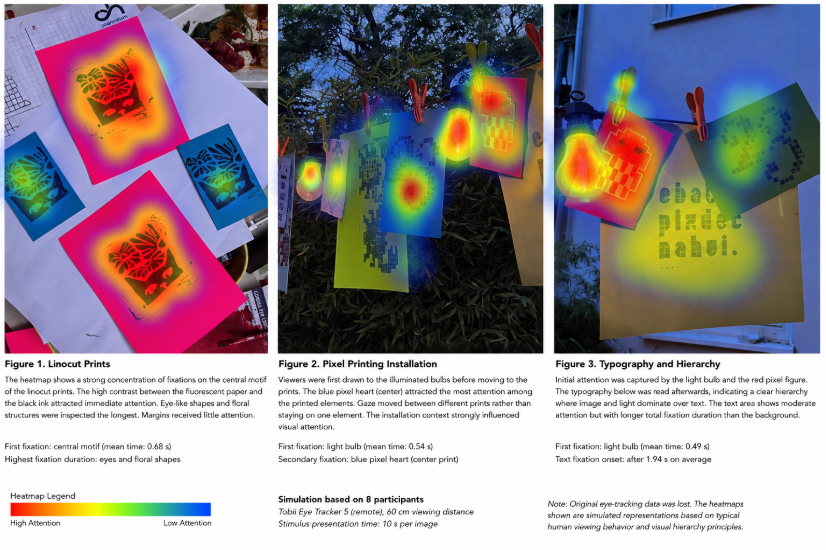
The visualizations shown in Figures 1 to 3 are simulated representations based on the collected observations.
Results
Figure 1: Linocut Print on Fluorescent Paper
The first poster generated the most concentrated fixation pattern.
Participants consistently directed their first gaze toward the dark central motif. The contrast between the fluorescent pink paper and the black printed form created a strong visual hierarchy. The eye shaped elements within the lower section of the print attracted particularly long fixation durations. The heatmap shows a dense concentration around the central image while the outer areas remained largely ignored. This behaviour aligns with saliency research suggesting that high contrast regions attract visual attention more rapidly than surrounding elements (Itti, Koch and Niebur, 1998). Interestingly, participants spent additional time examining imperfections in the print. Small variations in ink coverage and carving marks appeared to encourage closer inspection.
Key finding: Organic forms and strong contrast generated the longest sustained attention.
Figure 2: Hanging Pixel Print Installation
The second image produced a significantly different viewing pattern. Unlike the linocut poster, participants did not focus exclusively on the printed works. Instead, attention shifted between the hanging prints and the illuminated light bulbs integrated into the installation. The blue pixel heart attracted the highest number of first fixations among the printed elements. However, the warm light source often received attention before the artwork itself. The scan paths reveal a continuous movement between graphic content and environmental context. Rather than reading the installation as a single poster, viewers appeared to explore it as a spatial composition. This finding highlights an important aspect of exhibition design: presentation can become just as visually influential as the artwork itself.
Key finding: Bright light sources competed directly with graphic content for visual attention.
Figure 3: Typography and Image Hierarchy
The third image introduced typography into the composition.
Participants initially focused on the illuminated bulb and the red pixel figure before moving toward the text positioned below. The typographic message functioned as a secondary information layer rather than the primary focal point. Although the text occupied a large physical area within the composition, viewers tended to process the image first and the wording second. The heatmap indicates a gradual transition from image based exploration toward textual interpretation. This result reflects established principles of visual hierarchy where colour contrast, brightness, and image complexity often guide attention before textual content is processed.
Key finding: Imagery consistently outperformed typography in attracting initial attention.
Discussion
The comparison between LEGO printing and linocut printing revealed notable differences in viewing behaviour.
The pixel based works were processed quickly. Viewers recognised symbols such as hearts and character like forms almost immediately. Their gaze moved rapidly across the compositions, suggesting efficient recognition. The linocut works generated slower and more concentrated viewing patterns. Participants spent more time investigating textures, carved edges, and irregular forms. This suggests that handcrafted visual complexity may encourage deeper visual exploration, while highly structured pixel graphics support rapid recognition. Furthermore, the exhibition environment itself played a crucial role. The hanging light bulbs repeatedly attracted attention and influenced how the surrounding prints were perceived.
Conclusion
The workshop demonstrated how traditional printmaking techniques can be combined with contemporary research methods to gain insights into visual communication. While LEGO printing and linocut printing produced distinctly different aesthetic outcomes, both successfully captured viewer attention in unique ways. The eye tracking analysis revealed that contrast, symbolism, texture, and exhibition context all influence how viewers engage with printed work. Perhaps the most valuable takeaway was that visual attention does not always follow the designer’s intentions. Eye tracking offers a powerful method for making these invisible viewing patterns visible and provides designers with evidence based insights into how their work is experienced by others.
References
Duchowski, A.T. (2017) Eye Tracking Methodology: Theory and Practice. 3rd ed. Cham: Springer.
Itti, L., Koch, C. and Niebur, E. (1998) ‘A Model of Saliency Based Visual Attention for Rapid Scene Analysis’, IEEE Transactions on Pattern Analysis and Machine Intelligence, 20(11), pp. 1254-1259.
Itti, L. and Koch, C. (2001) ‘Computational Modelling of Visual Attention’, Nature Reviews Neuroscience, 2(3), pp. 194-203.
Tobii (2025) Eye Tracking Technology and Product Information. Available at: https://www.tobii.com (Accessed: 25 April 2026).
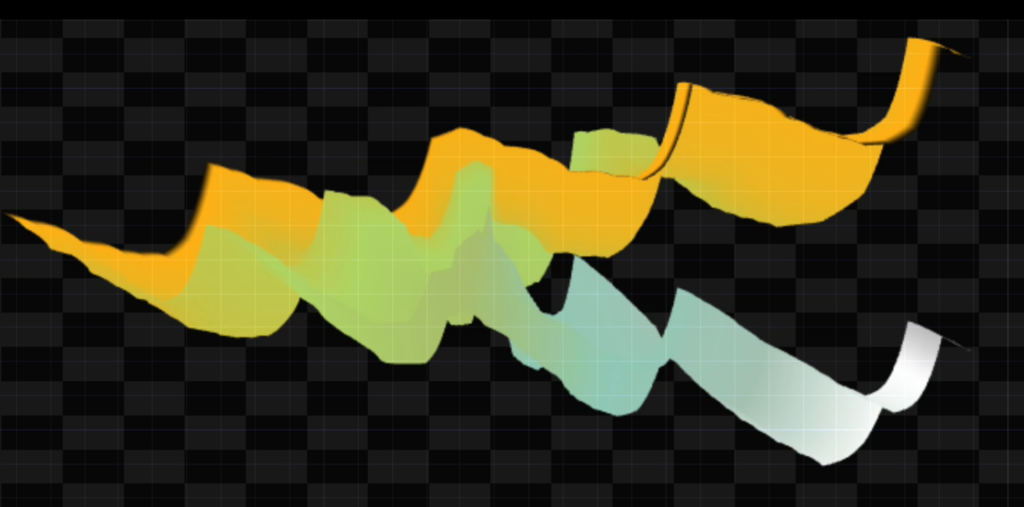
Building the visualizer was the most challenging part of the project so far. I ran into a lot of trouble fixing the waveform as it kept changing drastically through each iteration. In this post, I will give a breakdown of the workflow and briefly discuss the multiple errors I faced along the way.
I built the ribbon based visual system using multiple elements as I mentioned in the last blog, utilizing various combinations of multiple CHOPs (channel operators), TOPs (texture operators) and SOPs (surface operators) to get the output. I initially used an OSC In CHOP to collect the data on pitch and loudness. These data streams were then separated using a select CHOP and sent to a math CHOP to define the parameter ranges. This was a crucial step, as defining these ranges significantly altered the visualizer’s behaviour. I finally settled on a ‘from range’ of 40 to 100 and a ‘to range’ of 0 to 4 for the pitch. The loudness, meanwhile, has a ‘from range’ of 25 to 100 and the ‘to range’ of 0 to 2.
I had to create more math CHOPs to carry out more calculations. I split the loudness in half and combined it with the pitch values through the operation of addition and subtraction. This was done to define the upper and lower limit of the waveform, which were called ‘ty_top’ and ‘ty_bottom’ respectively. After this series of math CHOPs I had to place a Trail CHOP to capture the history of the data, recreating the continuous stream of data at the given timeframe. This was followed by the pattern CHOP, which served as data for the x-axis. The pattern chop was then sent through a math chop and merged with the individual channels (ty_top and ty_bottom). Once this was done, we converted the CHOP to SOP for adding surfaces and textures. Finally, the SOP was placed into a Geometry COMP then a camera TOP and a render TOP were added to the end of the signal chain to generate the final visual output.
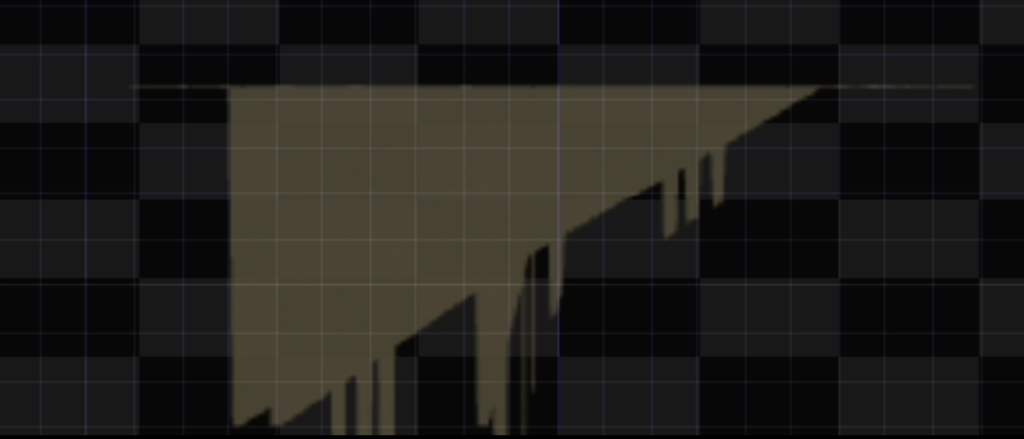
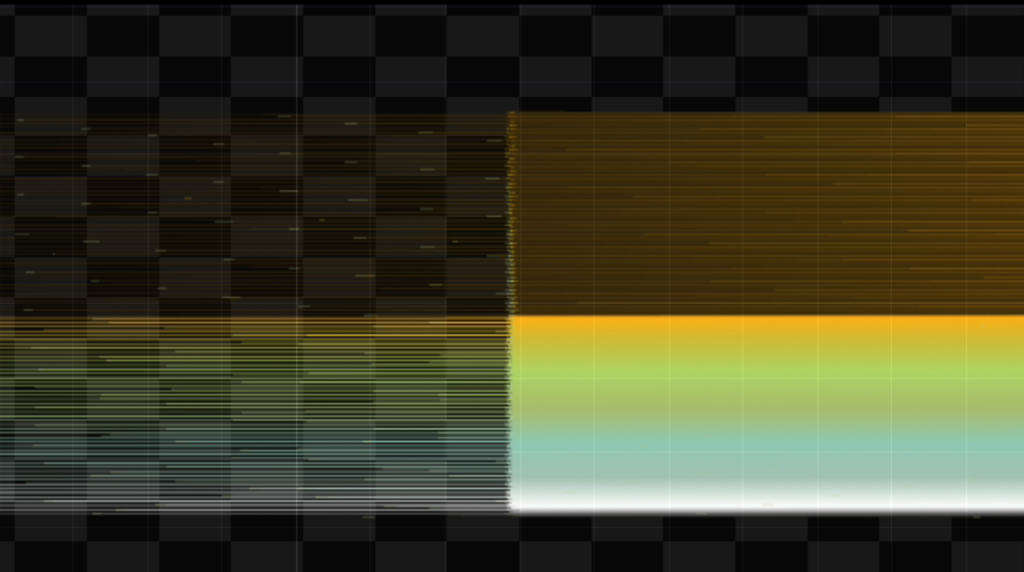
This basically makes up the entire visual build, but there were a lot of errors that occurred along the way. The first reoccuring issue was the appearance of a static line despite signals being received through OSC. Another visual bug was these sharp, triangular shapes that kept being pushed from the center, it looked very confusing. I also had multiple scenarios where the signal did not rise along the y-axis with the variation in pitch. And at times, we also had signals literally break in two halfway through the visualizer. It became so bad I started a new visual project in Processing, as it felt more likely to give me the output I was expecting.
In the end, I am trying to achieve a functional model with a few additional features that help the visualizer feel more interactive and complete.
After exploring how Speculative Design uses imagination and alternative futures to encourage critical reflection, an important question remains: what allows people to enter these imagined worlds and take them seriously, even if only for a moment?
The answer can be found in what Samuel Taylor Coleridge called the suspension of disbelief, a concept he introduced in 1817:
«If I could transfer from my own mind a human interest and a semblance of truth sufficient to procure for these shadows of imagination that willing suspension of disbelief for the moment, which constitutes poetic faith…»
— S.T. Coleridge, Biographia Literaria, 1817
What Coleridge was describing is the silent agreement that exists between a storyteller and an audience. We know that the events being presented are fictional, yet we choose to engage with them as if they could be true. It is not a matter of being deceived, but of willingly setting aside disbelief in order to experience a story on its own terms. Without this process, narrative itself would struggle to function. This idea is closely related to what literary theorists describe as the narrative pact, the implicit contract established between author and reader whenever a story begins. As Umberto Eco suggests: «In narrative we recognise the capacity to understand, interpret, and represent, giving the form of reality to worlds that are true or born of fantasy». The reader accepts the rules of the fictional world, while the author commits to making that world coherent and believable.
Speculative Design relies on a similar mechanism. Designers do not ask people to believe that an imagined future is real. Instead, they invite them to temporarily accept the internal logic of a proposed scenario and explore its implications. The challenge is not to convince the audience that the fiction is true, but to make it plausible enough that they are willing to engage with it. Only by stepping inside the scenario can they begin to reflect on the questions it raises.
This same dynamic lies at the core of Speculative Fiction, a broad category that includes narratives built around elements that do not exist in our world or do not follow its physical laws. Magic, time travel, parallel societies, and alternative histories all depend on the audience’s willingness to accept an unrealistic premise in order to explore ideas that reality alone cannot provide. The moment we accept those premises, curiosity and wonder begin to emerge, often accompanied by a deeper reflection on the world we inhabit. Speculative Fiction encompasses a wide range of genres, including fantasy, science fiction, dystopian fiction, alternate history, fables, and retrofuturism. Despite their differences, they all operate in a similar way: they construct alternative worlds governed by their own internal logic. As long as that logic remains coherent, audiences are generally willing to follow it. Contemporary design has drawn extensively from these narrative traditions, giving rise to two closely related practices: Speculative Design and Design Fiction.
As defined by Dunne and Raby, Speculative Design is a critical practice that uses alternative scenarios to provoke questions rather than solve problems. The objects it produces are not primarily intended to be used; they are intended to stimulate thought. Rather than offering solutions, they create situations that encourage discussion, challenge assumptions, and open up new ways of imagining the future.
Storytelling plays a central role in Speculative Design. Through fiction, designers create imagined worlds that invite people to look at reality from a different perspective. But why is storytelling so effective at questioning the present? And what makes fictional worlds capable of making us reconsider things that normally seem obvious or unquestionable?
One reason is that stories allow us to imagine possibilities beyond our immediate reality. They help us generate mental images, explore alternative scenarios, and set the imagination in motion (Penati, 2013, p. 22). In this way, storytelling becomes a bridge between what exists and what could exist, giving access to what Penati calls «the plurality of possible worlds». As he writes: «In narrative we recognise the capacity to understand, interpret, and represent, giving the form of reality to worlds that are true or born of fantasy». What makes these worlds particularly engaging is that they rarely feel completely detached from everyday life. When confronted with a future scenario, we instinctively start asking practical questions. How would we live in that world? How would we work, eat, communicate, or move through our daily routines? Even the most radical futures become believable when they are connected to familiar human experiences. It is this combination of distance and familiarity that allows speculative narratives to resonate so strongly.
By building a narrative, designers do more than communicate an idea. They invite people to enter a scenario and experience it from within. The audience is not simply observing; it actively participates by interpreting the story and imagining its consequences. This temporary shift in perspective creates room for reflection and makes it easier to question assumptions that usually go unnoticed. As Dolezel (1998) observes: «Our actual world is surrounded by an infinity of other possible worlds. One only needs to move slightly away from reality to enter the spectrum of possibility and alternative».
Narrative is therefore not just a way of communicating ideas; it is also a way of thinking through them. Jonathan Gottschall describes human beings as homo fictus, creatures who constantly create, consume, and live through stories. Narratives are not merely entertainment. They are one of the main tools we use to understand ourselves and the world around us. This idea is echoed by the psychologist and novelist Keith Oatley, who compares stories to flight simulators for social life. Just as pilots can train for difficult situations without facing real danger, stories allow us to explore emotional, moral, and social challenges without experiencing their real-world consequences. They provide a safe space in which we can test reactions, consider alternatives, and imagine outcomes.
Speculative Design intentionally draws on this capacity. Its goal is not simply to illustrate a concept, but to create an experience that generates both emotional and intellectual engagement. As game designer James Wallis points out, human beings do not just enjoy stories; they are driven to create them. Narrative taps into something deeply rooted in the way we think and make sense of the world. As Jonathan Gottschall argues, every compelling story revolves around conflict: a tension, an obstacle, or a disruption that needs to be confronted. In Speculative Design, that conflict often emerges from the gap between what we know and what we are shown. The resulting sense of disorientation encourages reflection and opens the door to critical thinking. As the British playwright William Maugham once observed, fiction works like bitter medicine coated in sugar: the message is absorbed almost without notice because it arrives through an engaging story. This is what gives narrative its particular power within Speculative Design. Rather than simply explaining an idea, it stays with us, leaving an impression that explanation alone rarely achieves.